 书单
理查德·法里尼亚
- 生卒
- 1937 – 1966
- 国籍
- 美国
- 外文名
- Richard Fariña
生平与创作
这个词条暂时没有中文维基百科条目,下面是英文维基百科的内容(英文原文):
Richard George Fariña (Spanish: [faˈɾiɲa]; March 8, 1937 – April 30, 1966) was an American folksinger, songwriter, poet and novelist.
Early years and education
Fariña was born in Brooklyn, New York, United States, the son of an Irish mother, Theresa Crozier, and a Cuban father of Galician origin, also named Richard Fariña. He grew up in the Flatbush neighborhood of Brooklyn and attended Brooklyn Technical High School. He earned an academic scholarship to Cornell University, starting out as an engineering major, but later switching to English. While at Cornell he published short stories for local literary magazines and for national periodicals, including Transatlantic Review and Mademoiselle. Fariña became good friends with Thomas Pynchon, David Shetzline, and Peter Yarrow while at Cornell. He was suspended for alleged participation in a student demonstration against campus regulations, and although he later resumed his status as a student, he dropped out in 1959, just before graduation.
Ascent on Greenwich Village folk scene
On returning to Manhattan, Fariña became a regular patron of the White Horse Tavern, the well-known Greenwich Village tavern frequented by poets, artists, and folksingers, where he befriended Tommy Makem. It was there that he met Carolyn Hester, a successful folk singer. They married 18 days later. Fariña appointed himself Hester's agent; they toured worldwide while Fariña worked on his novel and Carolyn performed gigs. Fariña was present when Hester recorded her third album at Columbia studios during September 1961, where a then-little-known Bob Dylan played the harmonica on several tracks. Fariña became a good friend of Dylan; their friendship is a major topic of David Hajdu's book, Positively 4th Street: The Lives and Times of Joan Baez, Bob Dylan, Mimi Baez Fariña, and Richard Fariña. Fariña and Hester recorded an EP with Rory and Alex McEwen, (later Fariña and Eric Von Schmidt recorded a 1963 album as a duo, with Dylan as a guest).
Fariña then travelled to Europe, where he met Mimi Baez, the teenage sister of Joan Baez, in the spring of 1962. Hester divorced Fariña soon thereafter, and Fariña married 17-year-old Mimi in April 1963. Thomas Pynchon was the best man. They moved to a small cabin in Carmel, California, where they composed songs with a guitar and Appalachian dulcimer. They debuted their act as "Richard & Mimi Fariña" at the Big Sur Folk Festival in 1964 and signed a contract with Vanguard Records. They recorded their first album, Celebrations for a Grey Day (released under the name Mimi & Richard Fariña), in 1965, with the help of Bruce Langhorne, who had previously played for Dylan. During Richard's life, the couple released only one other album, Reflections in a Crystal Wind, also in 1965. A third album, Memories, was issued in 1968, after his death. In early 1966, Richard and Mimi Fariña appeared as the sole guests on Episode 16 of Pete Seeger's short-lived UHF television program Rainbow Quest.
Fariña, like Dylan and others of this time, was considered a protest singer, and several of his songs are overtly political. Several critics have considered Fariña to be a major folk music talent of the 1960s. ("If Richard had survived that motorcycle accident, he would have easily given Dylan a run for his money," according to Ed Ward.)
His best-known songs are "Pack Up Your Sorrows" and "Birmingham Sunday", the latter of which was recorded by Joan Baez and became better known after it became the theme song for Spike Lee's film 4 Little Girls, a documentary about the 16th Street Baptist Church bombing in Birmingham, Alabama in 1963. "Birmingham Sunday" was also recorded by Rhiannon Giddens in 2017, on her album Freedom Highway. He also wrote "The Quiet Joys of Brotherhood", which was recorded by Sandy Denny.
At the time of his death, Fariña was producing an album for his sister-in-law Joan Baez. She ultimately decided not to release the album. Two of the songs were included on Fariña's posthumous album, and another, a cover version of Fariña's "Pack Up Your Sorrows", co-written by Fariña with the third Baez sister, Pauline Marden, was released as a single in 1966; it has been included in a number of Baez's compilation albums.
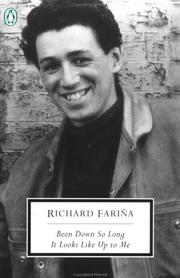
Been Down So Long It Looks Like Up to Me
Fariña is known for his novel Been Down So Long It Looks Like Up to Me, originally published by Random House in 1966. The title comes from the Furry Lewis song "I Will Turn Your Money Green" ("I been down so long/It seem like up to me"). The novel, based largely on his college experiences and travels, is a picaresque novel, set in 1958 in the American West, in Cuba during the Cuban Revolution, and mostly at Cornell University (called Mentor University in the novel). The protagonist is Gnossos Pappadopoulis, who enjoys dope, paregoric, feta cheese, Red Cap ale and retsina; attacks authority figures with anarchic glee; and lusts after the girl in the green knee-socks while searching for the right karma. The book became a cult classic among fans of the 1960s and counterculture literature. Thomas Pynchon, who later dedicated his book Gravity's Rainbow (1973) to Fariña, described Fariña's novel as "coming on like the Hallelujah Chorus done by 200 kazoo players with perfect pitch... hilarious, chilling, sexy, profound, maniacal, beautiful, and outrageous all at the same time."
Death
On April 30, 1966, two days after the publication of his novel, Fariña attended a book-signing ceremony at a Carmel Valley Village bookstore, the Thunderbird. Later that day, while at a party to celebrate his wife Mimi's twenty-first birthday, Fariña saw a guest with a motorcycle, who later gave Fariña a ride up Carmel Valley Road, heading east toward the rural Cachagua area of Carmel Valley.
以上文字摘自英文维基百科「Richard Fariña」(有删节,去掉了参考文献等尾部小节),按 CC BY-SA 4.0 使用,作者为维基百科的各位编者。
资料卡
- 出生
- 1937 年 3 月 8 日
- 出生地
- 布鲁克林区
- 逝世
- 1966 年 4 月 30 日
- 逝世地
- 滨海卡梅尔
- 职业
- 歌手、小说家、创作歌手、作家、作曲家
- 使用语言
- 英语
- 就读学校
- 康奈尔大学、布鲁克林技术高中
- 配偶
- Carolyn Hester、Mimi Fariña(1963)
- 代表作
- Been Down So Long It Looks Like Up to Me
资料卡来自 Wikidata Q1931654(CC0),众包数据,个别字段可能不全。
本站收录的作品(1)
作品年表(1 本)
本站书库里署名理查德·法里尼亚的书(Open Library 上至少 10 人加过书架的才收),按首版年份排(有本站书页的用 Wikidata 记的首版年,其余用 Open Library 的);年份偶尔记成后来的版本或译本,以原书为准。全部作品见 Open Library。