 书单
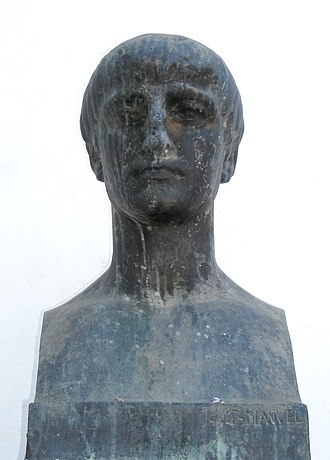
卢坎
- 生卒
- 39 – 65
- 国籍
- 古罗马
- 外文名
- Lucan
照片:Cruccone,CC BY 3.0,来自维基共享资源「Busto de Lucano, Cordoba.JPG」(经缩小)。
生平与创作
卢坎(Marcus Annaeus Lucanus,英文称Lucan,39年—65年)是罗马诗人。
生平
他最著名的著作是史诗《法沙利亚》(Pharsalia),描述凯撒与庞培之间的内战。这部史诗虽是未完成作品,却被誉为是维吉尔《埃涅阿斯》之外最伟大的拉丁文史诗。第七章完全在描述前48年发生于希腊北部法沙利亚的战事,全书也以此地为名。
作品
据斯塔提乌斯及6世纪语法学家瓦卡的作品《卢坎生平》(Vita Lucani),卢坎的著作有:
流传至今的作品:
《内战记》(Pharsalia),内容为凯撒及庞培之间的内战,书名取自法萨卢斯战役。
署名为卢坎的作品(也有抄本署名为其他作者):
《毕索赞》(Laus Pisonis),赞颂毕索家族之成员
已佚作品:
Catachthonion
Iliacon,有关特洛伊传说的作品
Epigrammata
Adlocutio ad Pollam
Silvae
Saturnalia
Medea
Salticae Fabulae
《尼禄赞》(Laudes Neronis)
Orpheus
Prosa oratio in Octavium Sagittam
Epistulae ex Campania
《焚城记》(De Incendio Urbis),内容和公元64年罗马大火有关,有可能是谴责尼禄的作品
以上文字摘自维基百科「盧坎」(去掉了参考文献等尾部小节),按 CC BY-SA 4.0 使用,作者为维基百科的各位编者。
中文维基百科的条目比较短,下面附上英文维基百科的内容(英文原文):
Marcus Annaeus Lucanus (3 November AD 39 – 30 April AD 65), better known in English as Lucan, was a Roman poet, born in Corduba, Hispania Baetica (present-day Córdoba, Spain). He is regarded as one of the outstanding figures of the Imperial Latin period, known in particular for his epic Pharsalia. His youth and speed of composition set him apart from other poets.
Life
Three brief ancient accounts allow for the reconstruction of a modest biography – the earliest attributed to Suetonius, another to an otherwise unknown Vacca, and the third anonymous and undated – along with references in Martial, Cassius Dio, Tacitus's Annals, and one of Statius's Silvae. Lucan was born in the Roman colony of Corduba into a wealthy family of central Italic origins; he was the son of Marcus Annaeus Mela and grandson of Seneca the Elder. He grew up under the tutelage of his uncle Seneca the Younger. He studied rhetoric at Athens and was probably provided with a philosophical and Stoic education by his uncle.
The 5th-century author Sidonius Apollinaris implies that Polla Argentaria—Lucan's wife—may have assisted him in the creation of the Pharsalia, though the philologist Peter White suggests that this story could easily be a later invention and denigrates the account as "sentimental fancy".
He found success under Nero, became one of the emperor's close friends and was rewarded with a quaestorship in advance of the legal age. In AD 60, he won a prize for extemporizing Orpheus and Laudes Neronis at the quinquennial Neronia, and was again rewarded when the emperor appointed him to the augurate. During this time he circulated the first three books of his epic poem Pharsalia (labelled De Bello civili in the manuscripts), which told the story of the civil war between Julius Caesar and Pompey.
At some point, a feud began between Nero and Lucan. Two very different accounts of the events have survived that both trivialize the feud. According to Tacitus, Nero became jealous of Lucan and forbade him to publish his poems. According to Suetonius, Nero disrupted a public reading by Lucan, by leaving and calling a meeting of the senate, and Lucan responded by writing insulting poems about Nero.
Other works, though, point to a more serious basis to the feud. Works by the grammarian Vacca and the poet Statius may support the claim that Lucan wrote insulting poems about Nero. Vacca mentions that one of Lucan's works was entitled De Incendio Urbis (On the Burning of the City). Statius's ode to Lucan mentions that Lucan described how the "unspeakable flames of the criminal tyrant roamed the heights of Remus." Additionally, the later books of Pharsalia are anti-Imperial and pro-Republic. This criticism of Nero and the office of the Emperor may have been the true cause of the ban.
Lucan later joined the conspiracy of Gaius Calpurnius Piso against Nero. The conspiracy was discovered and he was obliged, at the age of 25, to commit suicide by opening a vein, but not before incriminating his mother, Acilia, among others, in the hopes of a pardon. According to Tacitus, as Lucan bled to death, "(he) recalled some poetry he had composed in which he had told the story of a wounded soldier dying a similar kind of death and he recited the very lines. These were his last words." An alternative interpretation of events is that his death was not by suicide, but was an execution carried out at Nero's command.
His father was involved in the proscription, but his mother escaped. Statius's poem about Lucan was addressed to his widow, Polla Argentaria, upon the occasion of his birthday during the reign of Domitian (Silvae, ii.7, the Genethliacon Lucani).
Works
According to Vacca and Statius, Lucan's works included:
Surviving work:
Pharsalia or De Bello Civili (On the Civil War), on the wars between Julius Caesar and Pompey
Often attributed to him (but to others as well):
Laus Pisonis (Praise of Piso), a panegyric of a member of the Piso family
Lost works:
Catachthonion
Iliacon from the Trojan cycle
Epigrammata
以上文字摘自英文维基百科「Lucan」(有删节,去掉了参考文献等尾部小节),按 CC BY-SA 4.0 使用,作者为维基百科的各位编者。
资料卡
- 母语名
- Marcus Annaeus Lucanus
- 出生
- 39 年 11 月 3 日
- 出生地
- Corduba
- 逝世
- 65 年 4 月 30 日
- 逝世地
- 罗马
- 职业
- 诗人、历史学家、作家、朝臣
- 使用语言
- 拉丁语
- 写作语言
- 拉丁语
- 领域
- 诗歌、史诗
- 配偶
- Argentaria Polla
- 代表作
- 法萨里亚
资料卡来自 Wikidata Q188646(CC0),众包数据,个别字段可能不全。
本站收录的作品(1)
作品年表(1 本)
本站书库里署名卢坎的书(Open Library 上至少 10 人加过书架的才收),其中 1 本记的年份比作者去世晚 50 年以上或者早于他出生(多半是后世的版本、译本或占位年份),不列年份,按首版年份排(有本站书页的用 Wikidata 记的首版年,其余用 Open Library 的);年份偶尔记成后来的版本或译本,以原书为准。全部作品见 Open Library。
- 年份不详法萨里亚Pharsalia书架 14