 书单
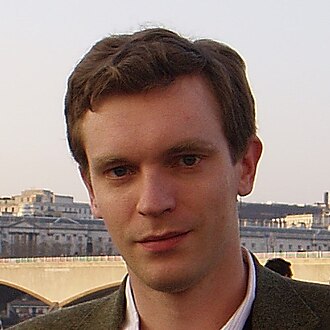
Mark Forsyth
- 生卒
- 1977 –
- 国籍
- 英国
照片:Mark Forsyth,CC0,来自维基共享资源「Mark Forsyth portrait.jpg」(经缩小)。
生平与创作
这个词条暂时没有中文维基百科条目,下面是英文维基百科的内容(英文原文):
Mark Forsyth (born 2 April 1977) is a British writer of non-fiction who came to prominence with a series of books concerning the meaning and etymology of English words.
He is the author of best-selling books The Etymologicon, The Horologicon, and The Elements of Eloquence, as well as being known for his blog The Inky Fool. Forsyth's earlier work was based around the meaning of words and more specifically, obscure and out-of-use words. His first two books were featured on BBC Radio 4's series Book of the Week.
In June 2012, Forsyth gave a TEDx talk entitled "What’s a snollygoster? A short lesson in political speak".
Education
Forsyth attended Winchester College in Winchester, Hampshire, England from 1990 to 1995. He also studied English Language & Literature at Lincoln College, Oxford University, from 1996 to 1999.
Career
The Inky Fool
As a self-described journalist, proofreader, ghostwriter and pedant, Forsyth started a blog called Inky Fool in 2009 as a forum to share his love of words. His posts often involve an exploration of words; where they come from and how they relate to each other. "Etymology is fun," Forsyth said in a Skepticality interview. "Some people talk about the true meaning. I just find it interesting and delightful and often just very, very funny. That's the main thing I love about etymology."
The Etymologicon
The popularity of Inky Fool led to Forsyth's first book publishing deal in 2011 with Icon Books. In The Etymologicon: A Circular Stroll Through the Hidden Connection of The English Language, Forsyth explains the meanings and derivations of well-known words and phrases, and explores the strange connections between words in a stream-of-consciousness fashion. The book's title, originally called Point Blank Check Mate: The Inky Fool's Book of Word Association, references the poet John Milton who purportedly invented the word "etymologicon" to describe a book containing etymologies. The book's structure leads the reader to "unexpected coinages and devious linkages, sexy, learned and satisfyingly obscure." It is, according to reviewer Karin Schimke, "a cursory run through history presented with a wry eye and a peculiar sense of humor." Reviewer Robert McCrum wrote: "Not since Eats, Shoots & Leaves has a book about language...attracted so much attention in bookshops, running through successive reprints." The Etymologicon was a Sunday Times No. 1 Bestseller in January 2012.
While The Etymologicon falls into the category of edutainment, the examples Forsyth includes in the book are well researched and supported by evidence. His goal was to include as much scholarly information as "lightly" as possible. Forsyth researches words and phrases as far back to their original sources as he can find. "Often, the joy of the research," he said in a Chicago Tribune interview, "is finding examples of the original usages that have been lost for centuries. For example, humble pie used to be umble pie because the umbles were the innards of a deer (so it was the poor man's equivalent of venison pie). I actually found a recipe book from 1727 deep in the bowels of the British Library that gave instructions on how to make it. So I did. And it was delicious."
In The Etymologicon, Forsyth cautions against what he calls "the danger of inductive reasoning" when determining the commonality among diverse languages. Some patterns in language, he asserts, are mere coincidence and linguists meticulously document specific examples of word and sound changes to determine whether or not disparate languages are, indeed, connected.
The Illustrated Etymologicon (Icon Books) won the Trade Illustrated award at The 2022 British Book Design and Production Awards (BBDPA) on 18 January 2023.
The Horologicon
The Horologicon: A Day's Jaunt Through the Lost Words of the English Language is Forsyth's second book and contains "weird words for familiar situations." Many of these words are no longer in use, such as snollygoster, durgeon and frumples. To avoid having his list of words "form what is technically known as a dictionary," Forsyth arranges The Horologicon or Book of Hours according to the hours in a day: from dawn, through breakfast, commuting, office life, shopping, going out drinking and stumbling home. Forsyth believes some of these words should be revived: "Never mind the puzzled looks," he says, "just use them. Throw them into conversation as often as possible."
A reviewer in The Daily Telegraph wrote: "From ante-jentacular to snudge by way of quafftide and wamblecropt, at last you can say, with utter accuracy, exactly what you mean."
The Wall Street Journal said the book “confirmed his aptitude for making a journey in the linguistic backwoods seem both leisurely and instructive.”
The Elements of Eloquence
The Elements of Eloquence: Secrets of the Perfect Turn of Phrase is Forsyth's third book. Described as a writer's tool-kit or recipe book, The Elements of Eloquence outlines 38 rhetorical figures (e.g., hyperbole, epizeuxis, catachresis) that, according to Forsyth, can be learned by almost anybody. Forsyth uses examples from William Shakespeare, Lord Byron, Winston Churchill, Lord Tennyson, Lewis Carroll, Quentin Tarantino, John Lennon and Katy Perry to reveal "the secrets" behind memorable lines and phrases. One reviewer wrote: "It's doubtful that if more people knew Forsyth's The Elements of Eloquence, the world would be a better place, but it would certainly sound a great deal better."
A reviewer on The Wall Street Journal said that Forsyth "is adept at adding spice to received wisdom and popularizing the findings of academic linguists."
"The Unknown Unknown"
Forsyth's essay "Unknown Unknown: Bookshops and the Delight of Not Getting What You Wanted" was a special commission for Independent Booksellers Week. and celebrates the discoveries one can make at independent bookshops. In his essay, Forsyth makes the case for the lost pleasures of undirected browsing that cannot be achieved with an internet search. Reviewer Matthew Parris wrote:
以上文字摘自英文维基百科「Mark Forsyth」(有删节,去掉了参考文献等尾部小节),按 CC BY-SA 4.0 使用,作者为维基百科的各位编者。
资料卡
- 出生
- 1977 年 4 月 2 日
- 出生地
- 英格兰
- 职业
- 博主、作家、新闻工作者
- 使用语言
- 英语
- 就读学校
- 牛津大学林肯学院
- 领域
- 词源学、英语
- 代表作
- The Etymologicon
资料卡来自 Wikidata Q16216552(CC0),众包数据,个别字段可能不全。
本站收录的作品(1)
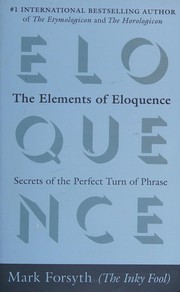
作品年表(1 本)
本站书库里署名Mark Forsyth的书(Open Library 上至少 10 人加过书架的才收),按首版年份排(有本站书页的用 Wikidata 记的首版年,其余用 Open Library 的);年份偶尔记成后来的版本或译本,以原书为准。全部作品见 Open Library。
- 2013The elements of eloquence书架 66