 书单
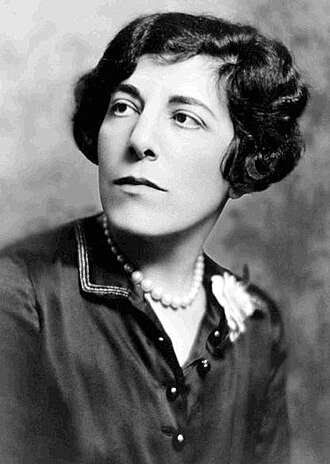
埃德纳·菲伯
- 生卒
- 1885 – 1968
- 国籍
- 美国
- 外文名
- Edna Ferber
照片:Theatre Magazine Company; Nickolas Muray, photographer,公有领域,来自维基共享资源「Edna-Ferber-1928.jpg」(经缩小)。
生平与创作
埃德娜·费伯(英语:Edna Ferber,1885年8月15日—1968年4月16日),美国作家,曾获1925年的普利策小说奖。
作品
由菲伯的小说《演艺船》改编的同名音乐剧被称为是第一部真正意义上的美国音乐剧。剧中的歌曲《老人河》也广为传唱。
长篇小说
Dawn O'Hara, The Girl Who Laughed (1911) ISBN 9781406864816
Fanny Herself (1917) ISBN 9780809594221
The Girls (1921) ISBN 9781297417634
Gigolo (1922) ISBN 9781421841434
So Big (1924) ISBN 9780061859984
Show Boat (1926) ISBN 9780899682815
Cimarron (1929) ISBN 9780345805751
American Beauty (1931) ISBN 9780451006509
Come and Get It (1935) ISBN 9781879483057
Saratoga Trunk (1941) ISBN Saratoga Trunk
Great Son (1945) ISBN 9780449241158
Giant (1952) ISBN 9780449241233
Ice Palace (1958) ISBN 9780385047999
以上文字摘自维基百科「埃德娜·费伯」(去掉了参考文献等尾部小节),按 CC BY-SA 4.0 使用,作者为维基百科的各位编者。
中文维基百科的条目比较短,下面附上英文维基百科的内容(英文原文):
Edna Ferber (August 15, 1885 – April 16, 1968) was an American novelist, short story writer and playwright. Her novels include the Pulitzer Prize-winning So Big (1924), Show Boat (1926; made into the celebrated 1927 musical), Cimarron (1930; adapted into the 1931 film which won the Academy Award for Best Picture), Giant (1952; made into the 1956 film of the same name) and Ice Palace (1958), which also received a film adaptation in 1960. She helped adapt her short story "Old Man Minick", published in 1922, into a play (Minick) and it was thrice adapted to film, in 1925 as the silent film Welcome Home, in 1932 as The Expert, and in 1939 as No Place to Go.
Life and career
Early years
Ferber was born August 15, 1885, in Kalamazoo, Michigan, to a Hungarian-born Jewish storekeeper, Jacob Charles Ferber, and his Milwaukee, Wisconsin–born wife, Julia (Neumann) Ferber, who was of German Jewish descent. The Ferbers had moved to Kalamazoo from Chicago, Illinois, in order to open a dry goods store, and her older sister Fannie had been born there three years earlier.
Ferber's father was not adept at business, and the family moved often during Ferber's childhood.
From Kalamazoo, they returned to Chicago for a year, and then moved to Ottumwa, Iowa, where they resided from 1890 to 1897 (ages 5 to 12 for Ferber).
In Ottumwa, Ferber and her family faced brutal anti-Semitism, including adult males verbally abusing, mocking and spitting on her on days when she brought lunch to her father, often mocking her in a Yiddish accent.
According to Ferber, her years in Ottumwa "must be held accountable for anything in me that is hostile toward the world".
During this time, Ferber's father began to lose his eyesight, necessitating costly and ultimately unsuccessful treatments. At the age of 12, Ferber and her family moved to Appleton, Wisconsin, where she graduated from high school and later briefly attended Lawrence University.
Career
After graduation, Ferber planned to study elocution, with vague thoughts of someday becoming an actress, but her family could not afford to send her to college.
On the spur of the moment, she took a job as a cub reporter at the Appleton Daily Crescent and subsequently moved to the Milwaukee Journal. In early 1909, Ferber suffered a bout of anemia and returned to Appleton to recuperate. She never resumed her career as a reporter, although she subsequently covered the 1920 Republican National Convention and 1920 Democratic National Convention for the United Press Association, and newspaper work was a theme in her first novel, Dawn O'Hara, The Girl Who Laughed, and the later Cimarron.
While Ferber was recovering, she began writing and selling short stories to various magazines, and in 1911 she published her first novel, Dawn O'Hara, The Girl Who Laughed. In 1912, a collection of her short stories was published in a volume titled Buttered Side Down. In her autobiography, Ferber wrote:
In that day, and for a girl in her early twenties, they were rather hard tough stories... The book got good reviews. I was startled and grimly pleased when some of the reviewers said that obviously these stories had been written by a man who had taken a feminine nom de plume as a hoax. I have always thought that a writing style should be impossible of sex determination; I don't think the reader should be able to say whether a book has been written by a man or a woman.
以上文字摘自英文维基百科「Edna Ferber」(有删节,去掉了参考文献等尾部小节),按 CC BY-SA 4.0 使用,作者为维基百科的各位编者。
资料卡
- 出生
- 1885 年 8 月 15 日
- 出生地
- 卡拉马祖
- 逝世
- 1968 年 4 月 16 日
- 逝世地
- 纽约
- 职业
- 剧作家、小说家、作家、编剧、新闻工作者、诗人、短篇故事作家
- 使用语言
- 英语
- 写作语言
- 英语
- 就读学校
- 劳伦斯大学
- 创作体裁
- 诗歌
- 所属团体
- 阿尔冈金圆桌、美国艺术暨文学学会
- 代表作
- Personality Plus、Our Mrs. McChesney、So Big、Show Boat、小说、American Beauty、Saratoga Trunk、Come and Get It、Giant
- 获奖
- 密歇根妇女名人堂(2009);另有 2 项只有外文名
资料卡来自 Wikidata Q283496(CC0),众包数据,个别字段可能不全。
本站收录的作品(1)

作品年表(2 本)
本站书库里署名埃德纳·菲伯的书(Open Library 上至少 10 人加过书架的才收),按首版年份排(有本站书页的用 Wikidata 记的首版年,其余用 Open Library 的);年份偶尔记成后来的版本或译本,以原书为准。全部作品见 Open Library。