 书单

乔治·威廉·多姆霍夫
- 生卒
- 1936 –
- 国籍
- 美国
- 外文名
- G. William Domhoff
照片:Tidak diketahui,CC BY-SA 4.0,来自维基共享资源「G. William Domhoff.jpg」(经缩小)。
生平与创作
这个词条暂时没有中文维基百科条目,下面是英文维基百科的内容(英文原文):
George William "Bill" Domhoff (born August 6, 1936) is an American psychologist and sociologist who is Distinguished Professor Emeritus and research professor of psychology and sociology at the University of California, Santa Cruz, and a founding faculty member of UCSC's Cowell College.
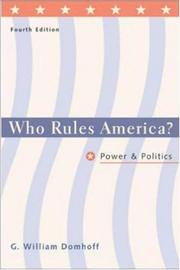
Domhoff is the author of Who Rules America? (1967), a widely cited analysis of political and economic power in the United States that has appeared in eight editions and has been used extensively in sociology courses.
Early life and education
Domhoff was born in Youngstown, Ohio, and raised in Rocky River, a suburb of Cleveland. In high school, Domhoff was a three-sport athlete (in baseball, basketball, and football), wrote for his school newspaper's sports section, served on student council, and won a contest to be the batboy for the Cleveland Indians. He graduated as co-valedictorian.
Domhoff received a Bachelor of Arts degree in psychology at Duke University (1958), where he finished freshman year tenth in his class, wrote for the Duke Chronicle, played baseball as an outfielder, and tutored the student athletes. As an undergraduate, he also wrote for The Durham Sun and received his Phi Beta Kappa key. He later earned a Master of Arts degree in psychology at Kent State University (1959), and a Doctor of Philosophy degree in psychology at the University of Miami (1962).
Career
Domhoff was an assistant professor of psychology at California State University, Los Angeles, from 1962 to 1965. In 1965, he joined the founding faculty of the University of California, Santa Cruz (UCSC), as an assistant professor at Cowell College, where he was affiliated with both the Department of Psychology and the Department of Sociology . He became an associate professor in 1969, a professor in 1976, and a Distinguished Professor in 1993. After his retirement in 1994, he continued to publish and teach classes as a research professor until 2019. Since 2020 he has focused on research and writing, along with invited lectures.
During his tenure at UCSC, he served in a number of leadership roles, including chair of the Sociology Department, chair of the Academic Senate, acting dean of the Division of Social Sciences, and chair of several university and statewide committees. In 2007, he received the Constantine Panunzio Distinguished Emeriti Award from the University of California, recognizing sustained post‑retirement scholarly contributions. In 2024, he was awarded a Edward A. Dickson Emeritus Professorship, which provided financial support for his research in the 2024-2025 academic year.
Research and scholarship
Power structure research
Domhoff's early work focused on the study of elite networks, corporate power, and governance in the United States. His first book, Who Rules America?, argued that a relatively cohesive corporate‑based power elite plays a central role in shaping policy through control of major corporations, policy‑planning organizations, foundations, and think tanks.
The book built on earlier elite theorists such as C. Wright Mills, E. Digby Baltzell, and Floyd Hunter, and contributed to ongoing debates between elite theory and pluralist theory in political sociology. Subsequent editions updated the analysis to reflect changes in party politics, corporate organization, and policy‑planning networks. Domhoff later extended this line of research through archival and network‑based studies of corporations, foundations, and policy‑planning groups, as well as collaborative work on class, race, gender, and elite recruitment. His work has been discussed in sociology reference works, peer‑reviewed journals, and teaching literature. Four of his books were on the list of the top 50 "best sellers" in sociology for the years 1950-1995: Who Rules America? (1967, #12); The Higher Circles (1970, #39); The Powers That Be (1979, #47); and Who Rules America Now? (1983, #43).
Who Rules was followed by a series of sociology and power structure books including C. Wright Mills and the Power Elite (1968), Bohemian Grove and Other Retreats (1974), The Higher Circles (1970), The Powers That Be (1979), and Who Rules America Now? (1983). Domhoff and his research assistant, Adam Schneider, maintain a website dedicated to power structure research, WhoRulesAmerica.net.
Dream research and psychology
Beginning in the 1960s, Domhoff collaborated with psychologist Calvin S. Hall on the quantitative analysis of dream content. He later became a leading proponent of treating dreams as a form of imaginative cognitive activity that is continuous with waking thought rather than as symbolic expressions requiring clinical interpretation.
Domhoff's later work developed the neurocognitive theory of dreaming, which integrates dream content analysis with findings from developmental psychology, lesion studies, and functional neuroimaging. According to this theory, dreaming depends on the activation of portions of the brain's default network and related systems, while higher‑order executive networks are relatively deactivated. Dreaming is said to be an intensified form of mind-wandering and daydreaming, which by now have been shown to be very similar in many ways to dreaming.
Most recently, he published Dreams, Sleep, and Consciousness in April, 2026, which interweaves his neurocognitive theory of dreaming with a new theory of sleep, developed by a sleep researcher, and a new theory of consciousness, developed by a psychologist who studied emotions for several decades before turning to the issue of consciousness. The new theory of sleep, the adaptive inactivity theory of sleep, explains why all mammals sleep in varying amounts, and best explains why dreaming occurs during the sleep-onset process, in the several REM periods during the night, and in the NREM 2 (N2) sleep that occurs in the 1-1.5 hours before the spontaneous morning awakening. The new theory of consciousness, the multistate hierarchical model of consciousness, makes it possible to explain how and why fact-knowing ("noetic") dreaming consciousness differs from self-knowing ("autonoetic") waking consciousness.
以上文字摘自英文维基百科「G. William Domhoff」(有删节,去掉了参考文献等尾部小节),按 CC BY-SA 4.0 使用,作者为维基百科的各位编者。
资料卡
- 出生
- 1936 年 8 月 6 日
- 出生地
- 扬斯敦
- 职业
- 社会学家、心理学家、大学教师
- 使用语言
- 英语
- 写作语言
- 英语
- 就读学校
- 杜克大学、肯特州立大学、迈阿密大学
- 领域
- 心理学、梦、权力结构、社会阶层
- 受谁影响
- 赖特·米尔斯
- 代表作
- Who Rules America?
资料卡来自 Wikidata Q326996(CC0),众包数据,个别字段可能不全。
本站收录的作品(1)
作品年表(1 本)
本站书库里署名乔治·威廉·多姆霍夫的书(Open Library 上至少 10 人加过书架的才收),按首版年份排(有本站书页的用 Wikidata 记的首版年,其余用 Open Library 的);年份偶尔记成后来的版本或译本,以原书为准。全部作品见 Open Library。