 书单
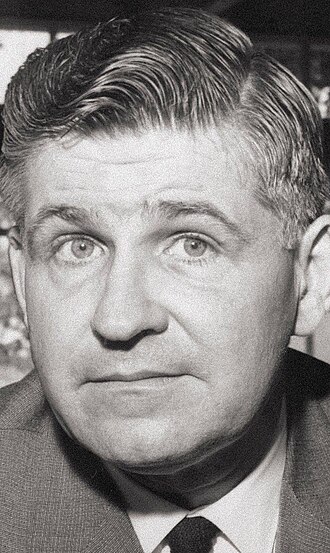
John Howard Griffin
- 生卒
- 1920 – 1980
- 国籍
- 美国
照片:United Press International,公有领域,来自维基共享资源「John Howard Griffin UPI Press Photo.jpg」(经缩小)。
生平与创作
这个词条暂时没有中文维基百科条目,下面是英文维基百科的内容(英文原文):
John Howard Griffin (June 16, 1920 – September 9, 1980) was an American journalist and author from Texas who wrote about and championed racial equality. He is best known for his 1959 project to temporarily pass as a black man and journey through the Deep South in order to see life and segregation from the other side of the color line first-hand. He first published a series of articles on his experience in Sepia magazine, which had underwritten the project, then later published an expanded account in book form, under the title Black Like Me (1961). This was later adapted into a 1964 film of the same name. A 50th anniversary edition of the book was published in 2011 by Wings Press.
Early life
Griffin was born in 1920 in Dallas, Texas, to John Walter Griffin and Lena May Young. His mother was a classical pianist, and Griffin acquired his love of music from her. Awarded a musical scholarship, he went to France to study French language and literature at the University of Poitiers and medicine at the École de Médecine. At 19, he joined the French Resistance as a medic, working at the Atlantic seaport of Saint-Nazaire, where he helped smuggle Austrian Jews to safety and freedom in England.
Griffin returned to the United States and enlisted, serving 39 months in the United States Army Air Forces stationed in the South Pacific, during which he was decorated for bravery. He spent 1943–44 as the only European-American on Nuni, one of the Solomon Islands, where he was assigned to study the local culture. He had a bout with spinal malaria that left him temporarily paraplegic.
Personal life
Griffin's first marriage was to a Solomon Islands woman. In 1946, he went slowly blind, the after effect of a severe concussion that he had received from a Japanese bomb. He would remain blind until inexplicably regaining his sight in 1957. A recent study of Griffin's loss of sight, based on a review of published and unpublished sources, presents evidence that Griffin may have feigned blindness.
Griffin returned home to Texas without his wife and converted to Catholicism in 1952, becoming a lay Carmelite. He also taught piano. Griffin gained dispensation from the Vatican for a second marriage. He married one of his students, Elizabeth Ann Holland, and they had four children.
Early career
In 1952, he published his first novel, The Devil Rides Outside, which tells the story of a young American composer who goes to study Gregorian chant in a French monastery.
During the 1940s and 1950s, Griffin wrote a number of essays about his loss of sight and his life, followed by his spontaneous return of sight in 1957. At that point he began to develop as a photographer.
He published Nuni (1956), a semi-autobiographical novel drawing from his year "marooned" in the Solomon Islands. It shows his developing interest in ethnography. He conducted a kind of social study in his 1959 project, resulting in his book Black Like Me (1961).
Black Like Me
In the fall of 1959, Griffin decided to investigate firsthand the plight of African Americans in the South, where racial segregation was legal; blacks had been disenfranchised since the turn of the century and closed out of the political system, and whites were struggling to maintain dominance against an increasing civil rights movement.
Griffin consulted a New Orleans dermatologist for aid in darkening his skin, being treated with a course of drugs, sunlamp treatments, and skin creams. Griffin shaved his head in order to hide his straight hair. He spent six weeks travelling as a black man in New Orleans and parts of Mississippi (with side trips to South Carolina and Georgia), getting around mainly by bus and by hitchhiking. He was later accompanied by a photographer who documented the trip, and the project was underwritten by Sepia magazine, in exchange for first publication rights for the articles he planned to write. These were published under the title Journey into Shame. When he decided to end his journey, in Montgomery, Alabama, he spent three days secluded in a hotel room to avoid the sunlight and stopped taking his skin-darkening medication.
Griffin published an expanded version of his project as Black Like Me (1961), which became a best seller in 1961. He described in detail the problems an African American encountered in the segregated Deep South meeting the needs for food, shelter, and toilet and other sanitary facilities. Griffin also described the hatred he often felt from white Southerners he encountered in his daily life—shop clerks, ticket sellers, bus drivers, and others. He was particularly shocked by the curiosity white men displayed about his sexual life. He also included anecdotes about white Southerners who were friendly and helpful.
The wide publicity about the book made Griffin a national celebrity for a time. The book had several editions. In a 1975 essay included in later editions of the book, Griffin recalled encountering hostility and threats to him and his family in his hometown of Mansfield, Texas. Someone hanged his figure in effigy. He eventually moved his family to Mexico for about nine months before they returned to Fort Worth.
The book was adapted as a 1964 film of the same name, starring James Whitmore as Griffin, and featuring Roscoe Lee Browne, Clifton James and Will Geer. A 50th anniversary edition of the book was published in 2011 by Wings Press.
Later life
Griffin continued to lecture and write on race relations and social justice during the early years of the Civil Rights Movement. In 1964, he received the Pacem in Terris Award from the Davenport (Iowa) Catholic Interracial Council for his contributions to racial understanding. In 1964, Griffin was beaten by the Ku Klux Klan. In 1975, Griffin was severely beaten by the Ku Klux Klan, but survived.
以上文字摘自英文维基百科「John Howard Griffin」(有删节,去掉了参考文献等尾部小节),按 CC BY-SA 4.0 使用,作者为维基百科的各位编者。
资料卡
- 出生
- 1920 年 6 月 16 日
- 出生地
- 达拉斯
- 逝世
- 1980 年 9 月 9 日
- 逝世地
- 沃思堡
- 职业
- 新闻工作者、小说家、自传作者、作家、人权活动家
- 使用语言
- 英语
- 就读学校
- 普瓦捷大学、R. L. Paschal High School、Lycée Descartes
- 代表作
- 像我一样黑
- 获奖
- 和平于世奖(1964)、安斯非德-禾夫图书奖(1962)
资料卡来自 Wikidata Q260879(CC0),众包数据,个别字段可能不全。
本站收录的作品(1)
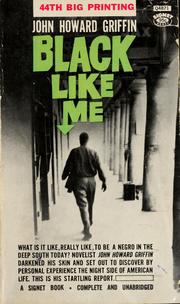
作品年表(1 本)
本站书库里署名John Howard Griffin的书(Open Library 上至少 10 人加过书架的才收),按首版年份排(有本站书页的用 Wikidata 记的首版年,其余用 Open Library 的);年份偶尔记成后来的版本或译本,以原书为准。全部作品见 Open Library。
- 1961像我一样黑Black like me书架 328