 书单
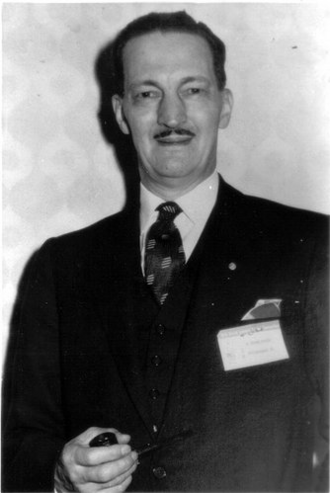
亨利·毕姆·派珀
- 生卒
- 1904 – 1964
- 国籍
- 美国
- 外文名
- H. Beam Piper
照片:作者不详,公有领域,来自维基共享资源「H. Beam Piper, 1952.png」(经缩小)。
生平与创作
这个词条暂时没有中文维基百科条目,下面是英文维基百科的内容(英文原文):
Henry Beam Piper (March 23, 1904 – c. November 6, 1964) was an American science fiction writer. He wrote many short stories and several novels. He is best known for his extensive Terro-Human Future History series of stories and a shorter series of "Paratime" alternate history tales.
He wrote under the name H. Beam Piper. Another source gives his name as "Horace Beam Piper" and a different date of death. His gravestone says "Henry Beam Piper". Piper himself may have been the source of part of the confusion; he told people the H stood for Horace, encouraging the assumption that he used the initial because he disliked his name. On a copy of Little Fuzzy given to Charles O. Piper, Beam's cousin and executor, he wrote "To Charles from Henry."
Biography
Piper was largely self-educated; he obtained his knowledge of science and history "without subjecting myself to the ridiculous misery of four years in the uncomfortable confines of a raccoon coat." He went to work at age 18 as a laborer at the Pennsylvania Railroad's Altoona yards in Altoona, Pennsylvania. He also worked as a night watchman for the railroad.
Piper published his first short story, "Time and Time Again", in 1947 in Astounding Science Fiction; it was adapted for the radio program Dimension X and first broadcast in 1951, and was re-produced for X Minus One in 1956. He was primarily a short story author until 1961, when he made a productive, if short-lived, foray into novels. He collected guns and wrote one mystery, Murder in the Gunroom.
In 1964, his career apparently on the skids, and prevented by reticence and his libertarian principles from asking anyone to assist him with his financial difficulties, Piper committed suicide. The exact date of his death is unknown; the last entry in his diary was dated November 5 ("Rain 0930"), and according to his Pennsylvania death certificate, his body was found on November 8. According to Jerry Pournelle's introduction to Little Fuzzy, Piper shut off all the utilities to his apartment, put painter's drop-cloths over the walls and floor, and took his own life with a handgun from his collection. In his suicide note, he gave an explanation that "I don't like to leave messes when I go away, but if I could have cleaned up any of this mess, I wouldn't be going away. H. Beam Piper."
Some biographers attribute his act to financial problems, others to family problems; Pournelle wrote that Piper felt burdened by financial hardships in the wake of a divorce, and the mistaken perception that his career was foundering (his agent had died without notifying him of multiple sales). Editor George H. Scithers, who knew Piper socially, has stated that Piper wanted to spite the ex-wife he despised: by killing himself, Piper voided his life insurance policy, and prevented her from collecting.
An unpublished story, "Only the Arquebus", was missing after his suicide; it is probable that he destroyed it along with many of his personal papers.
His output was eventually purchased by Ace Science Fiction and reprinted in a set of paperbacks in the early 1980s. Many of these have since gone out of print, though his two best-known arcs were again reprinted by Ace in 1998 and 2001. Late in his career, Piper corresponded with Pournelle, who was the Ace editor who helped reprint some of his novels.
Many of his earlier copyrights have been allowed to lapse, permitting Project Gutenberg to distribute his work online.
Themes and hallmarks
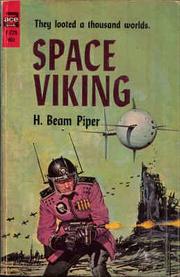
Piper's stories fall into two groups: stark space opera, such as Space Viking, or stories of cultural conflict or misunderstanding, such as Little Fuzzy or the Paratime stories.
A running theme in his work is that history repeats itself; past events will have direct and clear analogues in the future. The novel Uller Uprising is the clearest example of this, being based on the Sepoy Mutiny. A similar example is the very title of Space Viking, although the novel is not a direct reinterpretation of a specific historical precedent. A later theme in the book involves the takeover of a planet in a manner reminiscent of the rise of Adolf Hitler.
Piper's characterization was rooted in the notion of the self-reliant man, able to take care of himself and both willing and able to tackle any situation that might arise. This is exemplified in a bit of dialogue in his short story "Oomphel in the Sky" (1960):
He actually knows what has to be done and how to do it, and he's going right ahead and doing it, without holding a dozen conferences and round-table discussions and giving everybody a fair and equal chance to foul things up for him.
As a result, his stories tend towards the heroic, and the conflict is usually driven externally.
Piper was interested in general semantics. It is explicitly mentioned in Murder in the Gunroom, and its principles, such as awareness of the limitations of knowledge, are apparent in his later work.
Major storylines
Terro-Human Future History
The Terro-Human Future History is Piper's detailed account of the next 6,000 years of human history. 1942, the year the first fission reactor was constructed, is defined as the year 1 A.E. (Atomic Era). In 1973, a nuclear war devastates the planet, eventually laying the groundwork for the emergence of a Terran Federation, once humanity goes into space and develops antigravity technology.
The story "The Edge of the Knife" (collected in Empire) occurs slightly before the war, and involves a man who sees flashes of the future. It links many key elements of Piper's series.
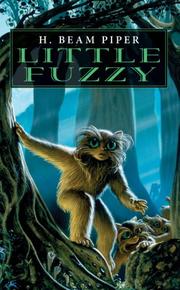
Most of the stories take place during the next millennium, during the age of the two Federations. Most notable among these novels are the three Fuzzy novels (starting with Little Fuzzy), which concern the recognition of a peculiar alien species as sapient, and the efforts of the two species to learn to live together on the Fuzzies' home world of Zarathustra.
以上文字摘自英文维基百科「H. Beam Piper」(有删节,去掉了参考文献等尾部小节),按 CC BY-SA 4.0 使用,作者为维基百科的各位编者。
资料卡
- 母语名
- Henry Beam Piper
- 本名
- Henry Beam Piper
- 笔名
- Horace Beam Piper
- 出生
- 1904 年 3 月 23 日
- 出生地
- 阿尔图纳
- 逝世
- 1964 年 11 月 6 日
- 逝世地
- 威廉斯波特
- 职业
- 作家、小说家、科幻作家
- 使用语言
- 美国英语
- 创作体裁
- 推想虚构作品、科学幻想
资料卡来自 Wikidata Q1364100(CC0),众包数据,个别字段可能不全。
本站收录的作品(2)
作品年表(6 本)
本站书库里署名亨利·毕姆·派珀的书(Open Library 上至少 10 人加过书架的才收),其中 1 本记的年份比作者去世晚 50 年以上或者早于他出生(多半是后世的版本、译本或占位年份),不列年份,按首版年份排(有本站书页的用 Wikidata 记的首版年,其余用 Open Library 的);年份偶尔记成后来的版本或译本,以原书为准。全部作品见 Open Library。
- 1962Little Fuzzy书架 48
- 1962The Fuzzy Papers书架 12
- 1963Space Viking书架 22
- 1964Fuzzy sapiens书架 12
- 1984Fuzzies and Other People书架 10
- 年份不详Short Fiction书架 10