 书单
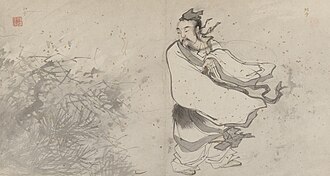
列御寇
- 生卒
- 公元前 450 – 公元前 375
- 国籍
- 中国
- 外文名
- Lie Yukou
照片:Zhang Lu,公有领域,来自维基共享资源「Album of 18 Daoist Paintings - 7.jpg」(经缩小)。
生平与创作
列御寇(约前450年—前375年),或称列圄寇,战国时期郑国人,道家学派的先驱者,人称列子,主张“贵虚”。
生平
列子于《史记》无传,其名散见于《庄子》、《管子》、《晏子》、《墨子》、《韩非子》、《尸子》、《吕氏春秋》等书。列御寇成名于《列子》一书,有章以其名为章名,主旨在于宣扬不可炫智于外而应养神于心,达到“天而不人”顺从自然,达到无用之用的境界。
列子是郑国人,大致早于庄子,与郑𦈡公同时。其学本于黄帝老子,主张清静无为。相传他曾向关尹喜问道,拜壶丘子为师,壶子对列子说:“乡吾示之以未始出吾宗。吾与之虚而委蛇,不知其谁何,因以为弟靡,因以为波流,故逃也。”后来又先后师事老商氏和支伯高子,修道九年之后,他就能御风而行。唐玄宗天宝年间诏封为“冲虚真人”,宋徽宗宣和年间封为“冲虚观妙真君”。
列子故里
列子故里位于河南郑州市郑东新区的圃田一带。2009年6月,位于郑州市管城区圃田乡的列子祠成为市级文保单位。
以上文字摘自维基百科「列子」(去掉了参考文献等尾部小节),按 CC BY-SA 4.0 使用,作者为维基百科的各位编者。
中文维基百科的条目比较短,下面附上英文维基百科的内容(英文原文):
Lie Yukou (Chinese: 列禦寇/列圄寇; pinyin: Liè Yùkòu/Liè Yǔkòu; Wade–Giles: Lieh4 Yü4-k‘ou4/Lieh4 Yü3-k‘ou4; Jyutping: Lit6 Jyu6kau3/Lit6 Jyu5kau3; fl. c. 400 BCE) was a Chinese philosopher who is considered the author of the Daoist book Liezi, which uses his honorific name Liezi (Chinese: 列子; pinyin: Lièzǐ; Wade–Giles: Lieh4 Tzŭ3; lit. 'Master Lie').
Early life
Lie Yukou was born in the State of Zheng, near today's Zhengzhou, Henan Province.
History
There is little historical evidence of Lie Yukou as a Hundred Schools of Thought philosopher during the Warring States period. This could be due to the burning of books and burying of scholars which occurred during the reign of Qin Shi Huang. However, some scholars believe that the Zhuangzi invented him as a Daoist exemplar. Frederic H. Balfour, who translated several Taoist texts, called Liezi "a philosopher who never lived" (1887:?) Lionel Giles expresses doubt in his Introduction: Very little is known of our author beyond what he tells us himself. His full name was Lieh Yü-k'ou, and it appears that he was living in the Chêng State not long before the year 398 BC, when the Prime Minister Tzu Yang was killed in a revolution. He figures prominently in the pages of Chuang Tzu, from whom we learn that he could 'ride upon the wind'. On the insufficient ground that he is not mentioned by the historian Ssu-ma Ch'ien, a certain critic of the Sung dynasty was led to declare that Lieh Tzu was only a fictitious personage invented by Chuang Tzu, and that the treatise which passes under his name was a forgery of later times. This theory is rejected by the compilers of the great Catalogue of Ch‘ien Lung's Library, who represent the cream of Chinese scholarship in the eighteenth century.
In the above quote Mr. Lionel Giles may have been refuting his father Herbert Allen Giles, who wrote of Lie Yukou or Lieh-Tzu in his translation of Chuang Tzu. Here is his quote which runs as follows:
The extent of the actual mischief done by this " Burning of the Books " has been greatly exaggerated. Still, the mere attempt at such a holocaust gave a fine chance to the scholars of the later Han dynasty (A.D. 25-221), who seem to have enjoyed nothing so much as forging, if not the whole, at any rate portions, of the works of ancient authors. Some one even produced a treatise under the name of Lieh Tzu, a philosopher mentioned by Chuang Tzu, not seeing that the individual in question was a creation of Chuang Tzu's brain!
以上文字摘自英文维基百科「Lie Yukou」(去掉了参考文献等尾部小节),按 CC BY-SA 4.0 使用,作者为维基百科的各位编者。
资料卡
- 母语名
- 列圄寇 等 2 项
- 出生
- 公元前 450 年
- 出生地
- 郑州市
- 逝世
- 公元前 375 年
- 职业
- 作家、哲学家、诗人
- 使用语言
- 中文
- 领域
- 哲学、道教
资料卡来自 Wikidata Q2984064(CC0),众包数据,个别字段可能不全。
本站收录的作品(1)
作品改编
Open Library 上的全部作品
正在读取…