 书单
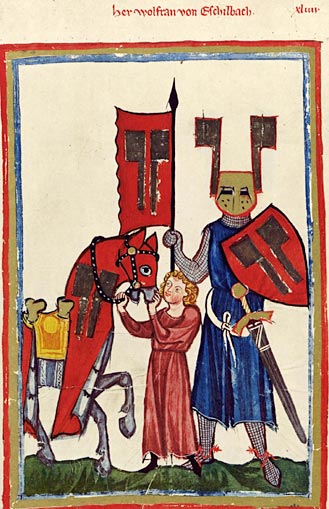
沃尔夫拉姆·封·埃申巴赫
- 生卒
- 1170 – 1220
- 国籍
- 神圣罗马帝国
- 外文名
- Wolfram von Eschenbach
照片:Meister des Codex Manesse,公有领域,来自维基共享资源「Wolfram47.jpg」(经缩小)。
生平与创作
沃尔夫拉姆·冯·埃申巴赫(德语:Wolfram von Eschenbach,1170年—1220年),是一位德国骑士,同时也是诗人。
他被视为是中世纪最杰出的史诗作家之一。
生平
沃尔夫拉姆·冯·埃申巴赫的生平鲜为人知,甚至在任何历史资料及文献中,都没有提及他的存在。
唯一的证明,就是他的作品。
作品
他最有名的著作是Parzival,被认为是德国中世纪最伟大的著作。
以上文字摘自维基百科「沃尔夫拉姆·冯·埃申巴赫」(去掉了参考文献等尾部小节),按 CC BY-SA 4.0 使用,作者为维基百科的各位编者。
中文维基百科的条目比较短,下面附上英文维基百科的内容(英文原文):
Wolfram von Eschenbach (German: [ˈvɔlfʁam fɔn ˈɛʃn̩bax]; c. 1160/80 – c. 1220) was a German knight, poet and composer, regarded as one of the greatest epic poets of medieval German literature. As a Minnesinger, he also wrote lyric poetry.
Life
Little is known of Wolfram's life. There are no historical documents which mention him, and his works are the sole source of evidence. In Parzival, he talks of wir Beier ("we Bavarians"); the dialect of his works is East Franconian. On the basis of this and a number of geographical references, the present-day Wolframs-Eschenbach, until 1917 Obereschenbach, near Ansbach in present-day Bavaria, has been officially designated as his birthplace. However, the evidence is circumstantial and not without problems – there are at least four other places named Eschenbach in Bavaria, and Wolframs-Eschenbach was not part of the Duchy of Bavaria (Altbayern, 'Old Bavaria') in Wolfram's time.
The arms shown in the Manesse manuscript come from the imagination of a 14th-century artist, drawing on the figure of the Red Knight in Parzival, and have no heraldic connection with Wolfram. Wolfram's work indicates a number of possible patrons (most reliably Hermann I of Thuringia), which suggests that he served at a number of courts during his life. He was presumably not a wealthy man, as he made frequent allusions to his own poverty.
In his Parzival, Wolfram states that he is illiterate; while the claim is treated with scepticism by some scholars, the truth of the assertion, difficult for some moderns to believe, is impossible to ascertain. But it has been credited by many commentators.
Works
Parzival
Wolfram is best known today for his Parzival, sometimes regarded as the greatest of all German Arthurian romances. Based on Chrétien de Troyes' unfinished Perceval, le Conte du Graal, it is the first extant work in German to have as its subject the Holy Grail (in Wolfram's interpretation a gemstone). In the poem, Wolfram's narrator expresses disdain for Chrétien's (unfinished) version of the tale, and states that his source was a poet from Provence called Kyot.
Titurel and Willehalm
Wolfram is the author of two other narrative works: the fragmentary Titurel and the unfinished Willehalm. These were both composed after Parzival, and Titurel mentions the death of Hermann I, which dates it firmly after 1217. Titurel consists of two fragments, which tell the story of Schionatulander and Sigune (lovers that were already depicted in Parzival). The first fragment deals with the birth of love between the main characters. The second fragment is quite different. Schionatulander and Sigune are alone in a forest, when their peace is suddenly disturbed by a mysterious dog, whose leash contains a story written in rubies. Sigune is eager to read the story, but the dog runs off. Schionatulander sets off to find him, but, as we already know from Parzival, he dies in the attempt.
Willehalm, an unfinished poem based on the Old French chanson de geste, Aliscans, was a significant work, and has been preserved in 78 manuscripts. It is set against the backdrop of the religious wars between the Christians and the Saracens. The eponymous hero Willehalm kidnaps a Saracen princess, converts her to Christianity and marries her. The Saracen king raises an army to rescue his daughter. The poem has many of the distinguishing features of medieval literature: the victory of the Christians over a much larger Saracen army, the touching death of the young knight Vivian, Willehalm's nephew and the works mirror of chivalric courage and spiritual purity.
以上文字摘自英文维基百科「Wolfram von Eschenbach」(有删节,去掉了参考文献等尾部小节),按 CC BY-SA 4.0 使用,作者为维基百科的各位编者。
资料卡
- 母语名
- Wolfram von Eschenbach
- 出生
- 1170 年
- 出生地
- 沃尔夫拉姆斯-埃申巴赫
- 逝世
- 1220 年
- 职业
- 诗人、作曲家、恋诗歌手、骑士、歌手、作家
- 使用语言
- 中古高地德语
- 创作体裁
- 骑士文学
- 代表作
- 帕西瓦尔、Willehalm、Titurel、Lieder
资料卡来自 Wikidata Q18821(CC0),众包数据,个别字段可能不全。
本站收录的作品(1)
作品年表(1 本)
本站书库里署名沃尔夫拉姆·封·埃申巴赫的书(Open Library 上至少 10 人加过书架的才收),其中 1 本记的年份比作者去世晚 50 年以上或者早于他出生(多半是后世的版本、译本或占位年份),不列年份,按首版年份排(有本站书页的用 Wikidata 记的首版年,其余用 Open Library 的);年份偶尔记成后来的版本或译本,以原书为准。全部作品见 Open Library。
- 年份不详帕西瓦尔Parzival书架 64