 书单
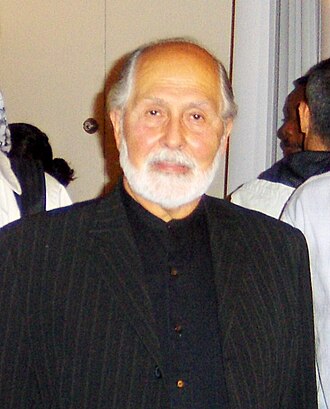
赛义德·纳斯尔
- 生卒
- 1933 –
- 国籍
- 伊朗
- 外文名
- Hossein Nasr
照片:Tariqabjotu at English Wikipedia,CC BY 3.0,来自维基共享资源「Hossein nasr.jpg」(经缩小)。
生平与创作
这个词条暂时没有中文维基百科条目,下面是英文维基百科的内容(英文原文):
Seyyed Hossein Nasr (Persian pronunciation: [sejjed̪̥ hoséjn næsɹ]; born April 7, 1933) is an Iranian-American philosopher, theologian, and Islamic scholar. He is a University Professor of Islamic studies at George Washington University.
Born in Tehran, Nasr completed his education in the Imperial State of Iran and the United States, earning a B.A. in physics from Massachusetts Institute of Technology, a M.A. in geology and geophysics, and a doctorate in the history of science from Harvard University. He returned to his homeland in 1958, turning down teaching positions at MIT and Harvard, and was appointed a professor of philosophy and Islamic sciences at Tehran University. He held various academic positions in Iran, including vice-chancellor at Tehran University and president of Aryamehr University, and established the Imperial Iranian Academy of Philosophy at the request of Empress Farah Pahlavi, which soon became one of the most prominent centers of philosophical activity in the Islamic world. During his time in Iran, he studied with several traditional masters of Islamic philosophy and sciences.
In 1979, the Islamic Revolution in Iran forced him to exile with his family to the United States, where he has lived and taught Islamic sciences and philosophy ever since. He has been an active representative of the Islamic philosophical tradition and the perennialist school of thought, especially its Traditionalist stream.
Nasr's works offer a critique of modern worldviews as well as a defense of Islamic and perennialist doctrines and principles. Central to his argument is the claim that knowledge has become desacralized in the modern period, meaning that it has become severed from its divine source – God or the Ultimate Reality – which calls for its resacralization through the utilization of sacred traditions and sacred science. Although Islam and Sufism are major influences on his writings, his perennialist approach inquires into the essence of all orthodox religions, regardless of their formal particularities. His environmental philosophy is expressed in terms of Islamic environmentalism and resacralization of nature. He is the author of over fifty books and more than five hundred articles.
Biography
Early life
Seyyed Hossein Nasr was born on April 7, 1933 in Tehran, Imperial State of Iran, to Seyyed Valiollah Nasr, who was a physician to the Iranian royal family, philosopher, and homme de lettres, and one of the founders of modern education in Iran. He is a descendant of Sheikh Fazlollah Nouri from his mother's side, is the cousin of Iranian philosopher Ramin Jahanbegloo, as well as the father of American academic Vali Nasr. The surname "Nasr", which means "victory", was given to his grandfather by Reza Shah. The honorific title "Seyyed" indicates a descendant of the Islamic prophet Muhammad.
Education
Nasr completed his primary education in Tehran. His education was supplemented by religious and philosophical discussions with his father and an entourage of theologians, ministers, scholars, and mystics. He immersed himself in Quranic studies, Persian literature, Arabic and French languages at an early age. While he was completing his first year of secondary school at Firooz Bahram High School, his father was hurt in a serious accident, so his mother sent him to continue his education in the United States so that he would not be present at the time of his father's imminent death. He would later say that there are three things that his father left him: "first of all, love of knowledge for our own Persian culture, our religious, literary, philosophical tradition; secondly, an avid interest in what was going on in the West in the realm of science and philosophy, literature and everything else; thirdly, a sense of serenity that he had within himself."
In the United States, Nasr first attended Peddie School in Hightstown, New Jersey, graduating in 1950 as the valedictorian of his class. He then applied to the Massachusetts Institute of Technology in Boston to study physics and was accepted with a scholarship. When he realized, after an encounter with the philosopher Bertrand Russell, that the study of physics would not bring answers to his questions, he enrolled in additional courses on metaphysics and philosophy with Giorgio de Santillana who introduced him to the works of René Guénon. From there, Nasr discovered the works of other Perennialist metaphysicians, notably Frithjof Schuon, Ananda Coomaraswamy, Titus Burckhardt, Martin Lings, and Marco Pallis. This school of thought has shaped Nasr's life and thinking ever since. The widow of Commaraswamy gave him access to the library of her late husband, and Nasr spent much of his time there and worked to catalogue the library. He visited Schuon and Burckhardt in Switzerland while still a student, and was initiated into the Alawite branch of the Shadhili Sufi order. He considered the works of Schuon, with central importance given to the practice of a spiritual discipline in addition to doctrinal knowledge, especially instrumental in determining his intellectual and spiritual life.
After receiving a Bachelor of Science degree in physics at the Massachusetts Institute of Technology in 1954, Nasr enrolled in the graduate program in geology and geophysics at Harvard University, where he received a Master of Science degree in both fields in 1956, and went on to pursue his doctorate in the history of science and learning at the same university. He planned to write his dissertation under the supervision of George Sarton, but Sarton died before he could begin his dissertation work and so he wrote it under the direction of I. Bernard Cohen, Hamilton Gibb, and Harry Wolfson.
以上文字摘自英文维基百科「Seyyed Hossein Nasr」(有删节,去掉了参考文献等尾部小节),按 CC BY-SA 4.0 使用,作者为维基百科的各位编者。
资料卡
- 出生
- 1933 年 4 月 7 日
- 出生地
- 德黑兰
- 职业
- 哲学家、大学教师、作家
- 使用语言
- 波斯语、阿拉伯语、英语、法语
- 就读学校
- 麻省理工学院、Peddie School、哈佛大学
- 受谁影响
- Ahmad al-Alawi、Frithjof Schuon、Shihab al-Din Suhrawardi、雷内·格农、伊本·西那、阿南达·库马拉斯瓦米、伊本·阿拉比、Titus Burckhardt、穆拉 沙扎、鲁米
资料卡来自 Wikidata Q471041(CC0),众包数据,个别字段可能不全。
作品年表(3 本)
本站书库里署名赛义德·纳斯尔的书(Open Library 上至少 10 人加过书架的才收),按首版年份排(有本站书页的用 Wikidata 记的首版年,其余用 Open Library 的);年份偶尔记成后来的版本或译本,以原书为准。全部作品见 Open Library。
- 1966Ideals and Realities of Islam书架 10
- 1987Islamic art and spirituality书架 22
- 2002Islam书架 21