 书单
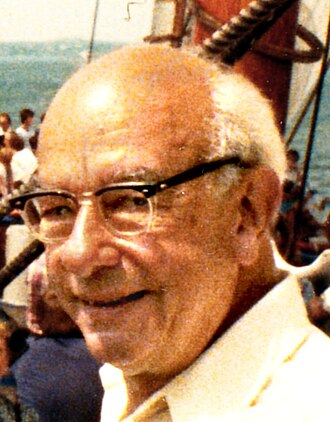
威拉德·范奥曼·蒯因
- 生卒
- 1908 – 2000
- 国籍
- 美国
- 外文名
- Willard Van Orman Quine
照片:Maryclaire Quine,CC BY 4.0,来自维基共享资源「Willard Van Orman Quine on Bluenose II in Halifax NS harbor 1980.jpg」(经缩小)。
生平与创作
威拉德·范奥曼·蒯因(英语:Willard Van Orman Quine,/kwaɪn/;1908年6月25日—2000年12月25日;又译奎因),20世纪最有影响的美国哲学家、逻辑学家之一。出生于俄亥俄州阿克伦的富裕家庭,其父为一成功的实业家,其母则任职教师。1926年入欧柏林学院,1930年得数学与哲学学士,1932即于哈佛大学取得哲学博士学位。蒯因在哈佛大学任教时为全校薪金最高的教职员。
概述
蒯因忠实地归属于分析哲学传统,尽管他是“哲学不是概念分析”的观点的主要支持者。蒯因用一生时间在他的母校哈佛大学教授哲学和数学,在那里他从1956年到1978年把持 Edgar Pierce 哲学讲座。他的主要著作包括《经验论的两个教条》,攻击了在分析命题和综合命题之间的差别,并提倡了一种形式的语义整体论;和《语词和对象》,进一步的发展了这种立场并介入了著名的翻译的不明确性论题。
以上文字摘自维基百科「威拉德·范奥曼·蒯因」(去掉了参考文献等尾部小节),按 CC BY-SA 4.0 使用,作者为维基百科的各位编者。
中文维基百科的条目比较短,下面附上英文维基百科的内容(英文原文):
Willard Van Orman Quine ( KWYNE; June 25, 1908 – December 25, 2000) was an American logician and philosopher in the analytic tradition, recognized as "one of the most influential philosophers of the twentieth century". He held the Edgar Pierce Chair of Philosophy at Harvard University from 1956 to 1978.
Quine was a teacher of logic and set theory. He was famous for his position that first-order logic is the only kind worthy of the name, and developed his own system of mathematics and set theory, known as New Foundations. In the philosophy of mathematics, he and his Harvard colleague Hilary Putnam developed the Quine–Putnam indispensability argument, an argument for the reality of mathematical entities. He was the main proponent of the view that philosophy is not conceptual analysis, but continuous with science; it is the abstract branch of the empirical sciences. This led to his famous quip that "philosophy of science is philosophy enough". He led a "systematic attempt to understand science from within the resources of science itself" and developed an influential naturalized epistemology that tried to provide "an improved scientific explanation of how we have developed elaborate scientific theories on the basis of meager sensory input". He also advocated holism in science, known as the Duhem–Quine thesis.
His major writings include the papers "On What There Is" (1948), which elucidated Bertrand Russell's theory of descriptions and contains Quine's famous dictum of ontological commitment, "To be is to be the value of a variable", and "Two Dogmas of Empiricism" (1951), which attacked the traditional analytic-synthetic distinction and reductionism, undermining the then-popular logical positivism, advocating instead a form of semantic holism and ontological relativity. They also include the books The Web of Belief (1970), which advocates a kind of coherentism, and Word and Object (1960), which further developed these positions and introduced Quine's famous indeterminacy of translation thesis, advocating a behaviorist theory of meaning.
Biography
Quine's parents were Cloyd Robert Quine and Harriet Ellis Van Orman. Quine grew up in Akron, Ohio, where he lived with his parents and older brother Robert Cloyd. His father was a manufacturing entrepreneur (founder of the Akron Equipment Company, which produced tire molds) and his mother was a schoolteacher and housewife. Quine became an atheist around the age of nine and remained one for the rest of his life.
Education
Quine received his B.A., summa cum laude, in mathematics from Oberlin College in 1930, and his Ph.D. in philosophy from Harvard University in 1932. His thesis supervisor was Alfred North Whitehead. He was then appointed a Harvard Junior Fellow, which excused him from having to teach for four years. During the academic year 1932–33, he travelled in Europe thanks to a Sheldon Fellowship, meeting Polish logicians (including Jan Łukasiewicz, Stanislaw Lesniewski and Alfred Tarski) and members of the Vienna Circle (including Rudolf Carnap), as well as the logical positivist A. J. Ayer. It was in Prague that Quine developed a passion for philosophy, thanks to Carnap, whom he called his "true and only maître à penser".
World War II
Quine arranged for Tarski to be invited to the September 1939 Unity of Science Congress in Cambridge, for which the Jewish Tarski sailed on the last ship to leave Danzig before Nazi Germany invaded Poland and triggered World War II. Tarski survived the war and worked another 44 years in the US. During the war, Quine lectured on logic in Brazil, in Portuguese, and served in the United States Navy in a military intelligence role, deciphering messages from German submarines, and reaching the rank of lieutenant commander. Quine could lecture in French, German, Italian, Portuguese, and Spanish as well as his native English.
Personal
He had four children by two marriages. Guitarist Robert Quine was his nephew.
以上文字摘自英文维基百科「Willard Van Orman Quine」(有删节,去掉了参考文献等尾部小节),按 CC BY-SA 4.0 使用,作者为维基百科的各位编者。
资料卡
- 母语名
- Willard Van Orman Quine
- 出生
- 1908 年 6 月 25 日
- 出生地
- 阿克伦
- 逝世
- 2000 年 12 月 25 日
- 逝世地
- 波士顿
- 职业
- 数学家、分析哲学家、语言哲学家、知识论者、科学哲学家、大学教师、哲学家、逻辑学家 等 9 项
- 使用语言
- 英语
- 写作语言
- 英语
- 就读学校
- 哈佛大学(1930)、奥伯林学院(1926)
- 领域
- 模型论、集合论、本体论
- 所属团体
- 美国文理科学院、美国国家科学院、美国哲学会(1957)
- 代表作
- Word and Object、The Roots of Reference、经验主义的两个教条、奎因-麦克拉斯基算法、杜恒-纽拉特-蒯因、Quine's paradox、Quine–Putnam indispensability argument
- 获奖
- 肖克奖(1993)、京都艺术与哲学奖(1996)、怀疑调查委员会会员、哈佛大学名誉博士(1979);另有 1 项只有外文名
资料卡来自 Wikidata Q214969(CC0),众包数据,个别字段可能不全。
本站收录的作品(1)
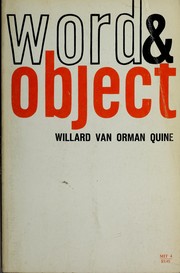
作品年表(3 本)
本站书库里署名威拉德·范奥曼·蒯因的书(Open Library 上至少 10 人加过书架的才收),按首版年份排(有本站书页的用 Wikidata 记的首版年,其余用 Open Library 的);年份偶尔记成后来的版本或译本,以原书为准。全部作品见 Open Library。
- 1940Mathematical logic书架 12
- 1950Methods of logic书架 11
- 1960Word and object书架 15