 书单
John Holt
- 生卒
- 1923 – 1985
- 国籍
- 美国
生平与创作
这个词条暂时没有中文维基百科条目,下面是英文维基百科的内容(英文原文):
John Caldwell Holt (April 14, 1923 – September 14, 1985) was an American author and educator, a proponent of homeschooling (specifically the unschooling approach), and a pioneer in youth rights theory.
After a six-year stint teaching elementary school in the 1950s, Holt wrote the book How Children Fail (1964), which cataloged the problems he saw with the American school system. He followed it up with How Children Learn (1967). Both books were popular, and they started Holt's career as a consultant to American schools. By the 1970s he decided he would try reforming the school system and began to advocate homeschooling and, later, the form of homeschooling known as unschooling. He wrote a total of 11 books on the subject of schooling as well as starting the newsletter Growing Without Schooling (GWS).
Early life
Holt was born on April 14, 1923, in New York City; he had two younger sisters. He attended Phillips Exeter Academy, then attended Yale University, graduating in 1943 with a degree in Industrial Engineering. Directly after graduating he enlisted with the United States Navy, and served in World War II on the submarine USS Barbero. He was discharged in 1946, then joined the United World Federalists, an organization that promoted world peace through the formation of a single world government. He rose up the ranks of the organization, and served as the executive director of the group's New York State chapter when he left in 1952 due to frustration with the organization's lack of progress.
Teaching career
Holt's sister encouraged him to become an elementary school teacher, and in 1953 he began teaching at the newly-formed Colorado Rocky Mountain School, a private school in Carbondale, Colorado. In 1957 and 1958 he taught at the Shady Hill School, a private elementary and middle school in Cambridge, Massachusetts. In 1959 he taught fifth grade at the Lesley Ellis School, also in Cambridge.
While teaching, Holt came to the belief that the students in his classroom, despite often being intelligent and from wealthy backgrounds, were more timid and unsure than the infant and toddler children of his sisters and friends.
Holt became disillusioned with the school system after several years of working within it; he became convinced that reform of the school system was not possible and began to advocate homeschooling. He believed that "children who were provided with a rich and stimulating learning environment would learn what they are ready to learn, when they are ready to learn it".
Holt believed that children did not need to be coerced into learning; they would do so naturally if given the freedom to follow their own interests and a rich assortment of resources. This line of thought came to be called unschooling.
Holt's Growing Without Schooling newsletter, founded in 1977, was America's first home education newsletter. He also set up John Holt's Bookstore, which made selected books available by mail order. This brought in additional revenue that helped sustain the newsletter, which carried very little advertising.
Holt wrote several books that have greatly influenced the unschooling movement. His writings have influenced many individuals and organizations, including the Evergreen State College, Caleb Gattegno, Americans for a Society Free from Age Restrictions, the National Youth Rights Association, and the Freechild Project.
Holt did not have a teaching degree, which many believe allowed for his work in the private school sector to make way for him to have a more objective opinion on the American school system. Being new to the environment, it is thought that he was able to make more objective distinctions than other educators as to what the schools said they were doing and what they were actually doing. For the first many years of his teaching career, he maintained the belief that schools overall were not meeting their missions due to using the wrong methods and pedagogical approaches, and that these failures were the cause for rendering young scholars as children who were less willing to learn and more focused on avoiding the embarrassment and ridicule of not learning.
Writing career
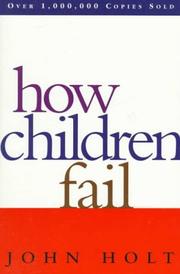
How Children Fail (1964)
As Holt wrote in his first book, How Children Fail (1964) "...after all, if they (meaning us) know that you can't do anything, then they won't blame you or punish you for not being able to do what you have been told to do." This notion led him to make changes within his own classroom to provide an environment in which his students would feel more comfortable and confident. With the support of his colleague Bill Hull, Holt began putting less emphasis on grades and tests, and began taking steps to decrease the notion of ranking the children. He focused on his students being able to grasp concepts, rather than having them work for the correct answer. Instead of using the typical methods to determine students' progress, he adopted a more student-centered approach. Patrick Farenga paraphrased Holt's distinction between good and bad students: "a good student is careful not to forget what he studied until after the test is taken." Eventually, his new methods for teaching caused him to be terminated from his position, which he claimed was due to the school wanting to maintain "old 'new' ideas not new 'new' ideas."
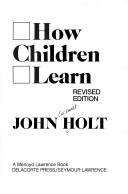
How Children Learn (1967)
After leaving Colorado, Holt sought other opportunities in education. Although it took him some time to come to a conclusion about his own thoughts on education as well as make sense of his observations, studies, and data, ultimately he felt that schools were "a place where children learn to be stupid." Once he developed this conclusion, his focus shifted to making suggestions to help teachers and parents capable of teaching their children how to learn, thus prompting his second book, How Children Learn, in 1967. Despite his successful career, he still met rejections, resentment, and false hopes from colleagues and school systems surrounding his ideas and methods. This reality pushed him further and further into the idea of deschooling.
以上文字摘自英文维基百科「John Holt (American educator)」(有删节,去掉了参考文献等尾部小节),按 CC BY-SA 4.0 使用,作者为维基百科的各位编者。
资料卡
- 母语名
- John Caldwell Holt
- 出生
- 1923 年 4 月 14 日
- 出生地
- 纽约
- 逝世
- 1985 年 9 月 14 日
- 逝世地
- 波士顿
- 职业
- 教育学家、作家、教师、教育家
- 使用语言
- 英语
- 就读学校
- 菲利普斯埃克塞特学院
资料卡来自 Wikidata Q964117(CC0),众包数据,个别字段可能不全。
本站收录的作品(2)
作品年表(2 本)
本站书库里署名John Holt的书(Open Library 上至少 10 人加过书架的才收),按首版年份排(有本站书页的用 Wikidata 记的首版年,其余用 Open Library 的);年份偶尔记成后来的版本或译本,以原书为准。全部作品见 Open Library。
- 1964How children fail书架 29
- 1967How children learn书架 39