 书单
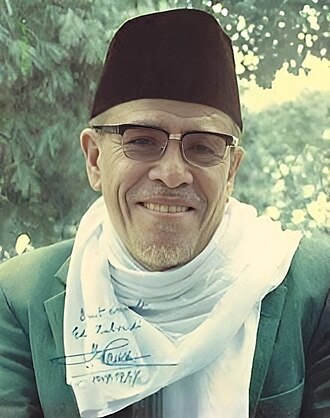
哈姆卡
- 生卒
- 1908 – 1981
- 国籍
- 印度尼西亚
- 外文名
- Abdul Malik Karim Amrullah
照片:Vedolique,CC BY-SA 4.0,来自维基共享资源「Buya hamka.jpg」(经缩小)。
生平与创作
这个词条暂时没有中文维基百科条目,下面是英文维基百科的内容(英文原文):
Abdul Malik Karim Amrullah, better known by his pen name Hamka (17 February 1908 – 24 July 1981), was an Indonesian ʿālim, philosopher, writer, novelist, lecturer, politician and journalist.
First affiliated with the Masyumi Party, until it was disbanded due to connection to the PRRI rebellion, Hamka was jailed because he was close to other PRRI members. He also served as the inaugural chief cleric of the Indonesian Ulema Council, and was active in Muhammadiyah until he died. Al-Azhar University and Malaysian National University both granted him honorary doctorates, while Moestopo University of Jakarta appointed him a Distinguished Professor.
Hamka is further honoured by being the namesake of Hamka Muhammadiyah University in Jakarta, and is named an Indonesian National Hero.
Early life
Hamka was born on 17 February 1908 in Agam, West Sumatra, the eldest of four siblings. Raised in a family of devout Muslims, his father was Abdul Karim Amrullah, a clerical reformer of Islam in Minangkabau, also known as "Haji Rasul". His mother, Sitti Shafiyah, came from a lineage of Minangkabau artists. His paternal grandfather, Muhammad Amrullah, was a member of the Naqshbandiyah. Hamka had a younger brother, Abdul Wadud Karim Amrullah, whose child is the American drag performer and winner of the third season of RuPaul's Drag Race, Raja Gemini.
Prior to his formal education, Hamka lived with his grandmother in a house south of Maninjau. When he was four years old, Hamka and his family moved to Padang Panjang, where he learned to read the Qur'an and recite prayers under the guidance of his half-sister Fatimah. At the age of seven, Malik entered the Village School. In 1916, Zainuddin Labay El Yunusy opened a religious school, Diniyah School, replacing the traditional surau-based education system. While attending lessons every morning at the Village School, Malik took afternoon classes at Diniyah School where he quickly learned Arabic.
Education
In 1918, Hamka left the Village School after three years, because he wanted to emphasize religious education, and his father registered him in a Thawalib. The school required its students to memorize classical books, rules regarding nahwu, and neuroscience. After studying at Diniyah School every morning, Malik attended Thawalib classes in the afternoon and returned to the surau in the evening. Most of the Thawalib's students were teenagers who were older than Hamka because of the heavy material that was needed to be memorized. From the lessons he attended, he was only interested in the arudh lessons which discussed poetry in Arabic. Although his activities from morning to evening were filled with learning, he was known to be a troublemaker, annoying his friends and cutting class to watch movies at a theater.
When he was 12 years old, Hamka's parents divorced, because although his father was a devout religious Muslim, his mother's relatives still practiced traditional practices that did not comply with Islamic teachings. The first few days after his parents divorced, Hamka did not go to school. He instead spent time traveling around Padang Panjang. Hamka had been absent for fifteen days in a row until a teacher at the Thawalib came to the house to check up on him. Finding out Hamka was absent, his father got angry and hit him.
Because of fear of his father, Hamka returned to the class as usual. After he discovered that his teacher, Zainuddin Labay El Yunusy, had opened a book rental library, Hamka spent most of his time reading through borrowed books. He read literary works published by Balai Pustaka, Chinese stories, and Arabic translations. After reading, Malik copied his own version. Running out of money to rent the books, Hamka offered to work for a printing house owned by Bagindo Sinaro, where the book collection were covered with protective cardboard. He helped cut cardboard, make glue dough as a glue for books, and make coffee, but as a reward, he asks to be allowed to read the collection of books that were to be rented out. Within three hours of returning from Diniyah before leaving for Thawalib, Hamka arranged his time to have time to read. Because of his neat work, he was allowed to bring a new book that had not been cardboard to work on at home. However, since Malik was often caught reading story books, his father reprimanded him, so every time he noticed his father was watching, Hamka would put down the story book he was reading, took a religious book while pretending to read it. Family problems caused Hamka to often travel long distances alone. He would leave his classes at Diniyah and Thawalib, and travels to Maninjau to visit his mother. Hamka was conflicted about choosing to live with his mother or father. Hamka sought association with the young people of Maninjau. He studied silat and randai, as well as listening to kaba, stories sung with traditional Minangkabau musical instruments. He walked further to Bukittinggi and Payakumbuh, briefly hanging out at cockfights and horse racing jockeys. He was neglected for almost a year until when he was 14 years old, his father felt restless and took him to go recite the Koran to the cleric Sheikh Ibrahim Musa in Parabek, about five kilometers from Bukittinggi. In Parabek, for the first time Hamka lived independently.
In Parabek, young Hamka learnt to fulfill his daily needs as a santri. During his stay at the pesantren, Hamka took advantage of the freed Saturday to go out to the surrounding the villages near Parabek. Interested in hearing traditional speeches, Hamka often attended the inauguration of the penghulu, when the traditional elders gathered. He noted down while memorizing rhymes and dictated passages in the traditional speeches he heard.
Moving to Java
Hamka travelled all over Minangkabau as a teenager, gaining the nickname Si Bujang Jauh, (the Boy from Afar) from his father.
以上文字摘自英文维基百科「Hamka」(有删节,去掉了参考文献等尾部小节),按 CC BY-SA 4.0 使用,作者为维基百科的各位编者。
资料卡
- 出生
- 1908 年 2 月 17 日
- 出生地
- 阿甘县
- 逝世
- 1981 年 7 月 24 日
- 逝世地
- 雅加达
- 职业
- 新闻工作者、哲学家、作家、乌理玛、政治人物
- 使用语言
- 印尼语
- 配偶
- Sitti Raham
- 获奖
- 印度尼西亚民族英雄
资料卡来自 Wikidata Q5645435(CC0),众包数据,个别字段可能不全。
本站收录的作品(2)

作品年表(10 本)
本站书库里署名哈姆卡的书(Open Library 上至少 10 人加过书架的才收),按首版年份排(有本站书页的用 Wikidata 记的首版年,其余用 Open Library 的);年份偶尔记成后来的版本或译本,以原书为准。全部作品见 Open Library。
- 1938Tenggelamnya kapal Van der Wijck书架 116
- 1941Merantau ke-Deli书架 20
- 1961Sejarah umat Islam书架 37
- 1963Terusir书架 12
- 1965Tafsir al-Azhar书架 26
- 1981Perjalanan terakhir Buya Hamka书架 43
- 1982Falsafah Hidup书架 62
- 1983Filsafat ketuhanan书架 38
- 2014Buya Hamka Berbicara tentang Perempuan书架 43
- 2016Tasawuf Moden书架 38