 书单
Vaikom Muhammad Basheer
- 生卒
- 1908 – 1994
- 国籍
- 印度、英属印度
生平与创作
这个词条暂时没有中文维基百科条目,下面是英文维基百科的内容(英文原文):
Vaikom Muhammad Basheer (21 January 1908 – 5 July 1994), popularly referred to as the Beypore Sultan, was an Indian writer of Malayalam literature, a humanist and a freedom fighter in the Indian national movement. He was a novelist and a short story writer known for his path-breaking, down-to-earth style of writing that made him equally popular among the literary critics as well as the public.
In 1982, the Government of India awarded him the Padma Shri, the country's fourth highest civilian honour. He was also a recipient of the Sahitya Akademi Fellowship, Kerala Sahitya Akademi Fellowship, and the Kerala State Film Award for Best Story. He was a recipient of the Vallathol Award in 1993.
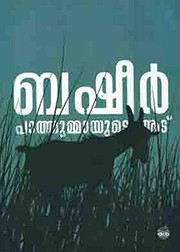
His notable works include Balyakalasakhi, Shabdangal, Pathummayude Aadu, Ntuppuppakkoranendarnnu, Mathilukal, Janmadinam and Anargha Nimisham. Several of his works have been translated into other languages.
Biography
Basheer was born on 21 January 1908 in Thalayolaparambu (near Vaikom) Kottayam District, to Kayi Abdurahman, a timber merchant, and his wife, Kunjathumma, as their eldest child. His siblings were Abdulkhader, Pathumma, Haneefa, Anumma and Aboobakker, in order from eldest and youngest. After completing his primary education at a local Malayalam medium school, he joined an English medium school in Vaikom, 5 miles (8.0 km) away, for higher education. It was during this time, he met Mahatma Gandhi, when the Indian independence movement leader came to Vaikom for the satyagraha, which later came to be known as Vaikom Satyagraham, and became his follower. He started wearing Khādī, inspired by the swadeshi ideals of Gandhi. Basheer would later write about his experiences on how he managed to climb on to the car in which Gandhi was travelling and touched his hand.
Involvement in the freedom struggle
He resolved to join the fight for an Indian Independence, leaving school to do so while he was in the fifth form. Basheer was known for his secular attitude, and he treated all religions with respect. Since there was no active independence movement in Travancore – being a princely state – he went to Malabar district to take part in the Salt Satyagraha in 1930. His group was arrested before they could participate in the satyagraha. Basheer was sentenced to three months imprisonment and sent to Kannur Prison. He became inspired by stories of heroism by revolutionaries like Bhagat Singh, Sukhdev Thapar and Shivaram Rajguru, who were executed while he was in the jail. His release, along with 600 of his fellow prisoners, came in March 1931 following the Gandhi-Irwin pact. Once free, he organized an anti-British movement and edited a revolutionary journal, Ujjivanam, because of which an arrest warrant was issued on him and he left Kerala.
Journey
Having left Kerala, he embarked upon a long journey that took him across the length and breadth of India and to many places in Asia and Africa for seven years, doing whatever work that seemed likely to keep him from starvation. His occupations ranged from that of a loom fitter, fortune teller, cook, newspaper seller, fruit seller, sports goods agent, accountant, watchman, shepherd, hotel manager to living as an ascetic with Hindu saints and Sufi mystics in their hermitages in Himalayas and in the Ganges basin, following their customs and practices, for more than five years. There were times when, with no water to drink, without any food to eat, he came face to face with death.
After doing menial jobs in cities such as Ajmer, Peshawar, Kashmir and Calcutta, Basheer returned to Ernakulam in the mid-1930s. While trying his hands at various jobs, like washing vessels in hotels, he met a manufacturer of sports goods from Sialkot who offered him an agency in Kerala. And Basheer returned home to find his father's business bankrupt and the family impoverished. He started working as an agent for the Sialkot sports company at Ernakulam, but lost the agency when a bicycle accident incapacitated him temporarily. On recovering, he resumed his endless hunt for jobs. He walked into the office of a newspaper Jayakesari whose editor was also its sole employee. He did not have a position to offer, but offered to pay money if Basheer wrote a story for the paper. Thus Basheer found himself writing stories for Jayakesari and it was in this paper that his first story "Ente Thankam" (My Darling) was published in the year 1937. A path-breaker in Malayalam romantic fiction, it had its heroine a dark-complexioned hunchback. His early stories were published between 1937 and 1941 in Navajeevan, a weekly published in Trivandrum in those days.
Imprisonment and after
At Kottayam (1941–42), he was arrested and put in a police station lock-up, and later shifted to another lock up in Kollam Kasba police station. The stories he heard from policemen and prisoners there appeared in later works, and he wrote a few stories while at the lock-up itself. He spent a long time in lock-up awaiting trial, and after trial was sentenced to two years and six months imprisonment. He was sent to Thiruvananthapuram central jail. While at jail, he forbade M. P. Paul from publishing Balyakalasakhi. He wrote Premalekhanam (1943) while serving his term and published it on his release. Baalyakaalasakhi was published in 1944 after further revisions, with an introduction by Paul. M. K. Sanu, critic and a friend of Basheer, would later say that M. P. Paul's introduction contributed significantly in developing his writing career. He then made a career as a writer, initially publishing the works himself and carrying them to homes to sell them. He ran two bookstalls in Ernakulam; Circle Bookhouse and later, Basheer's Bookstall. After Indian independence, he showed no further interest in active politics, though concerns over morality and political integrity are present all over his works.
以上文字摘自英文维基百科「Vaikom Muhammad Basheer」(有删节,去掉了参考文献等尾部小节),按 CC BY-SA 4.0 使用,作者为维基百科的各位编者。
资料卡
- 出生
- 1908 年 1 月 21 日
- 出生地
- Thalayolaparambu
- 逝世
- 1994 年 7 月 4 日
- 逝世地
- 贝伊波雷
- 职业
- 小说家、编剧、散文家、作家、日记作者、词曲作家
- 使用语言
- 马拉雅拉姆语
- 写作语言
- 马拉雅拉姆语
- 代表作
- Balyakalasakhi、Ntuppuppakkoranendarnnu、Mathilukal
资料卡来自 Wikidata Q2737220(CC0),众包数据,个别字段可能不全。
本站收录的作品(1)
同时代的印度作家
Open Library 上的全部作品
正在读取…