 书单
查尔斯·凯·奥格登
- 生卒
- 1889 – 1957
- 国籍
- 英国
- 外文名
- Charles Kay Ogden
生平与创作
查尔斯·凯·奥格登(英语:Charles Kay Ogden)是英国的语言学家,哲学家和作家。他被形容为博学者,但又是个古怪和局外人,他参与了许多与文学,政治,艺术和哲学有关的事业,尤其是作为英语改革版的编辑,翻译和活动家,产生了广泛的影响。语言。他通常被定义为语言心理学家,现在人们大多将他视为基础英语的发明者和传播者
以上文字摘自维基百科「查尔斯·凯·奥格登」(去掉了参考文献等尾部小节),按 CC BY-SA 4.0 使用,作者为维基百科的各位编者。
中文维基百科的条目比较短,下面附上英文维基百科的内容(英文原文):
Charles Kay Ogden (1 June 1889 – 20 March 1957) was a British linguist, philosopher, and writer. Described as a polymath but also an eccentric and outsider, he took part in many ventures related to literature, politics, the arts, and philosophy, having a broad effect particularly as an editor, translator, and activist on behalf of a reformed version of the English language. He is typically defined as a linguistic psychologist, and is now mostly remembered as the inventor and propagator of Basic English.
Early life and education
Charles Kay Ogden was born at Rossall School in Fleetwood, Lancashire, on 1 June 1889 to Charles Burdett Ogden (13 July 1849 – 10 December 1923) and Fanny Hart (1850 – 21 December 1944), who were married in 1888 at Chorlton, Lancashire. His father was employed in various capacities at the Rossall School during the years 1873–1909.
Charles Kay Ogden was educated at Buxton and Rossall, won a scholarship to Magdalene College, Cambridge, and commenced his undergraduate study of Classics in 1908.
He visited continental Europe to investigate methods of language teaching in 1912 and 1913. Ogden obtained a MA in 1915.
Career
The Heretics Society
In 1909, while still an undergraduate, Ogden co-founded the Heretics Society in Cambridge which questioned traditional authorities in general and religious dogmas in particular, in the wake of the paper Prove All Things, read by William Chawner, Master of Emmanuel College, a past Vice-Chancellor. The Heretics began as a group of 12 undergraduates interested in Chawner's agnostic approach.
The Society was nonconformist and open to women, and Jane Harrison found an audience there, publishing her inaugural talk for the Society of 7 December 1909 as the essay Heresy and Humanity (1911), an argument that warned of the dangers of group-think and implored the audience to realize that we are constantly negotiating the line between egotism and herd instinct, but that how we navigate that line matters. Investigating the origins of the word 'heresy'; her lecture, later published in Alpha and Omega (1915), challenged many of the religious restrictions and rules of the Anglican Church and its connections with the university. The talk of the following day was from J. M. E. McTaggart, and was also published, as Dare to Be Wise (1910). Another early member with anthropological interests was John Layard; Herbert Felix Jolowicz, Frank Plumpton Ramsey and Philip Sargant Florence were among the members. Alix Sargant Florence, sister of Philip, was active both as a Heretic and on the editorial board of the Cambridge Magazine.
Ogden was President of the Heretics from 1911, for more than a decade; he invited a variety of prominent speakers and linked the Society to his role as editor. In November 1911 G. K. Chesterton used a well-publicised talk to the Heretics, titled The Future of Religion, to reply to George Bernard Shaw, who in May had talked on The Religion of the Future. On this occasion Chesterton produced one of his well known bons mots:
Questioner: ... I say it is perfectly true that I have an intuition that I exist.
Mr. Chesterton: Cherish it.
In 1912 T. E. Hulme and Bertrand Russell spoke. Hulme's talk on Anti-Romanticism and Original Sin was written up by Ogden for the Cambridge Magazine, where in 1916 both Hulme and Russell would write on the war, from their opposite points of view. Rupert Brooke addressed them on contemporary theatre, and an article based on his views of Strindberg appeared in the Cambridge Magazine in October 1913. Another talk from 1913 that was published was from Edward Clodd on Obscurantism in Modern Science. Ogden was very active at this period in seeing these works into print.
On 4 February 1923, the biologist J.B.S. Haldane lectured the Society on "Daedalus; or, Science and the Future", a speculative vision that enjoyed some success in print and spurred in 1924 a less optimistic response from Bertrand Russell entitled "Icarus or the Future of Science".
以上文字摘自英文维基百科「Charles Kay Ogden」(有删节,去掉了参考文献等尾部小节),按 CC BY-SA 4.0 使用,作者为维基百科的各位编者。
资料卡
- 母语名
- Charles Kay Ogden
- 笔名
- Adelyne More
- 出生
- 1889 年 6 月 1 日
- 出生地
- 费利伍德
- 逝世
- 1957 年 3 月 21 日
- 逝世地
- 伦敦
- 职业
- 语言学家、哲学家、作家、教育学家
- 使用语言
- 英语
- 写作语言
- 英语
- 就读学校
- 莫德林学院、罗塞尔学校
- 领域
- 语言学
资料卡来自 Wikidata Q503276(CC0),众包数据,个别字段可能不全。
本站收录的作品(1)
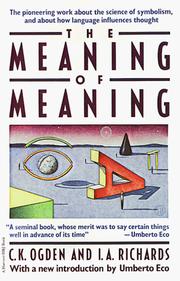
作品年表(2 本)
本站书库里署名查尔斯·凯·奥格登的书(Open Library 上至少 10 人加过书架的才收),按首版年份排(有本站书页的用 Wikidata 记的首版年,其余用 Open Library 的);年份偶尔记成后来的版本或译本,以原书为准。全部作品见 Open Library。
- 1923含义之含义The meaning of meaning书架 33
- 1930Basic English书架 17