 书单
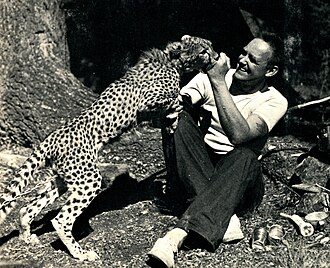
丹尼尔·P·曼尼克斯
- 生卒
- 1911 – 1997
- 国籍
- 美国
- 外文名
- Daniel P. Mannix
照片:Dustjacket designed by Adolph LeMoult. Published by E. P. Dutton & Company.,公有领域,来自维基共享资源「Daniel P. Mannix (A Sporting Chance dustjacket photograph).jpg」(经缩小)。
生平与创作
这个词条暂时没有中文维基百科条目,下面是英文维基百科的内容(英文原文):
Daniel Pratt Mannix IV (October 27, 1911 – January 29, 1997) was an American writer, journalist, photographer, sideshow performer, stage magician, animal trainer, and filmmaker. One of his two best-known works is the 1958 book Those About to Die (republished in 2001 as The Way of the Gladiator), which was inspiration for the Ridley Scott film Gladiator in 2000 and the TV drama Those About to Die on Peacock. The other is the 1967 novel The Fox and the Hound, which was loosely adapted into an animated feature film by Walt Disney Productions in 1981.
Early life
The Mannix family had a long history of service in the U.S. Navy, and Mannix' father, Daniel P. Mannix, III, was an American naval officer.
His mother would often join her husband on his postings, and the Mannix children would stay at their grandparents' farm outside Philadelphia. The young Mannix was an avid reader of books in his grandparents' library. He commented that "On rainy days, I sat in the library and read. During their 200-year residence in Pennsylvania, my family had built up a library containing at least one volume devoted to any conceivable subject". It was there that Mannix also began to keep and raise various wild animals. He wrote fictionalized stories about his animals (supposedly to cover the cost of feeding them) in his first two books, The Back-Yard Zoo, and More Back-Yard Zoo. The Back-Yard Zoo was published in 1934, while he was a senior in college.
Following family tradition, Mannix had enrolled in the U.S. Naval Academy in 1930, but he could not adjust to the rigorous training. Finally, the commandant wrote a letter to his father saying that "he is definitely not officer material" and he left the academy. In recounting this experience, Mannix wrote that after leaving, he was so worn down that spent the next two months in bed. However, the following year he was accepted by the University of Pennsylvania where he earned a degree in journalism which he took up after failing zoology.
Mannix married Jule Junker in 1939 and she became a partner in his adventures.
Their family was listed in the Philadelphia Social Register. A writer and friend of the family wrote: "Families like the Mannix family are also referred to as being from 'old money', although if economic circumstances changed, they might become known as 'fallen aristocracy'".
Career
Mannix served as a naval lieutenant with the Photo-Science Laboratory in Washington, D.C. during World War II, where he was tasked with creating training films. His civilian career could briefly be described as engaging in various adventurous activities which he filmed for lectures or wrote about in magazines and books. The latter were often enhanced with illustrations by accomplished artists or by his own photographs. He also kept a small menagerie of wild and domestic animals which allowed him to study their behavior and then feature them in print and film. His interest in unsavory, even horrifying, human behavior and attitudes was also featured in some of his books. However, he was also interested in gentler topics such as L. Frank Baum and his books about the land of Oz.
Carnival life
Mannix joined a traveling carnival after college where he learned to be a sword swallower, fire eater, stage magician, escape artist, mind reader, and lock picker, performing under the stage name The Great Zadma. His magazine articles about these experiences, with his wife Jule Junker Mannix, proved popular and were later expanded into book form in his 1951 account of carnival life, Step Right Up, which in turn was reprinted in 1964 as Memoirs of a Sword Swallower. He claimed that he held the record for many years for swallowing the longest sword (26 inches) although there is no documented proof of that.
At the conclusion of Step Right Up, Mannix stated that while still in the carnival (and still single) he borrowed a typewriter from the carnival manager and submitted the manuscript of his first article, How to Swallow a Sword to Colliers magazine and that shortly before he left the carnival, he received notice that it had been accepted. His dream of becoming a freelance writer seemed to be becoming a reality. In the final lines of the book, he wrote "I made up my mind. That night I packed my suitcase, left a note for the Impossible [stage name of his mentor at the Carnival] and started east in my car. In my inside pocket was the letter from Colliers asking for a series of articles based on carnival life. And on the seat beside me was a second-hand typewriter I'd purchased from the carnival manager."
The Colliers articles were published from 1944 to 1947. These dates appear inconsistent with the Step Right Up account (i.e.: artistic license was taken in the book), since they were years after his marriage to Jule Mannix in 1939. In any event, most of them were published under the by-line, The Great Zadma as told to Jule Junker Mannix. How to Swallow a Sword, 1944, the first in the series, was printed in condensed form in the Reader's Digest in 1945.
以上文字摘自英文维基百科「Daniel P. Mannix」(有删节,去掉了参考文献等尾部小节),按 CC BY-SA 4.0 使用,作者为维基百科的各位编者。
资料卡
- 出生
- 1911 年 10 月 27 日
- 出生地
- 宾夕法尼亚州
- 逝世
- 1997 年 1 月 29 日
- 逝世地
- 马尔文
- 职业
- 作家、儿童文学作家、新闻工作者、电影制片人、魔术师、摄影师
- 使用语言
- 英语
- 领域
- 文学、电影制作、新闻学
资料卡来自 Wikidata Q2368388(CC0),众包数据,个别字段可能不全。
本站收录的作品(1)

同时代的美国作家
Open Library 上的全部作品
正在读取…