 书单
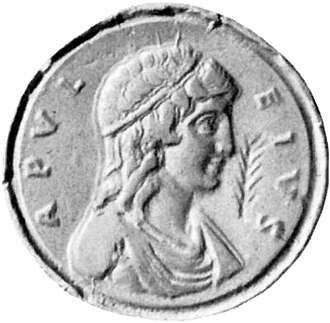
阿普列尤斯
- 生卒
- 125 –
- 国籍
- 古罗马
- 外文名
- Apuleius
照片:Johann Jacob Bernoulli,公有领域,来自维基共享资源「Apuleius-Kontorniat.jpg」(经缩小)。
生平与创作
鲁齐乌斯·阿普列尤斯(Lucius Apuleius,约124年-约189年)是古罗马作家、哲学家。柏柏尔人。出生于北非的古罗马殖民地努密底省马道拉地方(属今阿尔及利亚),为官吏家庭。曾在雅典学习柏拉图主义哲学,后广泛游历地中海地区。阿普列尤斯在返乡途中与黎波里富孀普登提拉结婚,却被其家人控告,罪名是“以魔法迷惑普登提拉”,阿普列由斯遂写了《辩护状》(Apologia)驳斥,这份文件后来成为了解阿普列尤斯的重要史料。著有小说《金驴记》(Metamorphoses,一译“变形记”),透过主角路鸠士化身为驴所看见的真实罗马,讽刺罗马帝国的社会生活。
以上文字摘自维基百科「阿普列尤斯」(去掉了参考文献等尾部小节),按 CC BY-SA 4.0 使用,作者为维基百科的各位编者。
中文维基百科的条目比较短,下面附上英文维基百科的内容(英文原文):
Apuleius ( APP-yuu-LEE-əs), also called Lucius Apuleius Madaurensis (c. 124 – after 170), was a Numidian Latin-language prose writer, Platonist philosopher and rhetorician. He was born in the Roman province of Numidia, in the Berber city of Madauros, modern-day M'Daourouch, Algeria. He studied Platonism in Athens, travelled to Italy, Asia Minor, and Egypt, and was an initiate in several cults or mysteries. The most famous incident in his life was when he was accused of using magic to gain the attentions (and fortune) of a wealthy widow. He declaimed his own defense before the proconsul and a court of magistrates convened in Sabratha, near Oea (modern Tripoli, Libya). This speech, which Apuleius subsequently published, is known as the Apologia.
His most famous work is his bawdy picaresque novel the Metamorphoses, otherwise known as The Golden Ass. It is the only ancient Latin novel that has survived in its entirety. It relates the adventures of its protagonist, Lucius, who experiments with magic and is accidentally turned into a donkey. Lucius goes through various adventures before he is turned back into a human being by the goddess Isis.
Life
Apuleius was born in Madauros, a colonia in Numidia on the North African coast bordering Gaetulia, and he described himself as "half-Numidian half-Gaetulian." Madauros, in whose university Augustine of Hippo later received his early education, was located well away from the Romanized coast, but nonetheless contains some pristine Roman ruins. Apuleius's praenomen is not given in any ancient source; late-medieval manuscripts began the tradition of calling him Lucius after the hero of his novel. Details regarding his life come mostly from his defense speech (Apology) and his work Florida, a collection of excerpts from some of his best speeches.
Upon the death of their father, a duumvir, or municipal magistrate, Apuleius and his brother inherited nearly two million sesterces. Apuleius studied with a master at Carthage, where he later settled. After his initial stay in Carthage he moved on to Athens, studying Platonist philosophy among other subjects, and then to Rome to study Latin rhetoric and, most likely, to speak in the law courts for a time before returning to his native North Africa. He also travelled extensively in Asia Minor and Egypt, furthering his knowledge of philosophy and religion but also depleting his inheritance.
Apuleius was an initiate in several Greco-Roman mysteries, including the Dionysian Mysteries. He was a priest of Asclepius and, according to Augustine, sacerdos provinciae Africae (i.e., priest of the province of Carthage).
Not long after his return home he set out upon a new journey to Alexandria. On his way there he was taken ill at the town of Oea (modern-day Tripoli) and was hospitably received into the house of Sicinius Pontianus, whom he had befriended in Athens. Pontianus's mother Pudentilla was a very rich widow. With her son's consent – indeed encouragement – Apuleius agreed to marry her. Pontianus's father-in-law, Herennius Rufinus, was indignant that Pudentilla's wealth should pass out of the family; he instigated Pontianus, Pontianus's younger brother Sicinius Pudens, a mere boy, and their paternal uncle, Sicinius Aemilianus, to join him in impeaching Apuleius upon the charge of gaining Pudentilla's affections by charms and magic spells. The case was heard at Sabratha, near Tripoli, c. 158 AD, before Claudius Maximus, proconsul of Africa. The accusation itself seems to have been ridiculous, and the spirited and triumphant defence spoken by Apuleius is still extant. This is known as the Apologia (A Discourse on Magic). Apuleius accuses an extravagant personal enemy of turning his house into a brothel and prostituting his wife.
以上文字摘自英文维基百科「Apuleius」(有删节,去掉了参考文献等尾部小节),按 CC BY-SA 4.0 使用,作者为维基百科的各位编者。
资料卡
- 出生
- 125 年
- 出生地
- 马达罗斯
- 逝世地
- Roman Carthage
- 职业
- 作家、哲学家、小说家、诗人、修辞学家、医生、散文家、律师 等 9 项
- 使用语言
- 拉丁语
- 写作语言
- 拉丁语
- 文学运动 / 流派
- 中柏拉图主义
- 领域
- 哲学、修辞学
- 代表作
- 金驴记、Apologia
资料卡来自 Wikidata Q170512(CC0),众包数据,个别字段可能不全。
本站收录的作品(1)
作品年表(2 本)
本站书库里署名阿普列尤斯的书(Open Library 上至少 10 人加过书架的才收),按首版年份排(有本站书页的用 Wikidata 记的首版年,其余用 Open Library 的);年份偶尔记成后来的版本或译本,以原书为准。全部作品见 Open Library。
- 1469The golden asse of Lucius Apuleius书架 40
- 1500金驴记Metamorphoses书架 93