 书单
生平与创作
这个词条暂时没有中文维基百科条目,下面是英文维基百科的内容(英文原文):
John Edward Mack (October 4, 1929 – September 27, 2004) was an American psychiatrist, writer, and professor of psychiatry. He served as the head of the department of psychiatry at Harvard Medical School from 1977 to 2004. In 1977, Mack won the Pulitzer Prize for his book A Prince of Our Disorder on T. E. Lawrence.
Mack's clinical expertise was in child psychology, adolescent psychology, and the psychology of religion. He was also known as a leading researcher on the psychology of teenage suicide and drug addiction, and he later became a researcher in the psychology of alien abduction experiences.
Early life, education and military service
Mack was born in New York City to an academic German Jewish family. His father, the historian Edward Clarence Mack (1904–1973), was a professor at CUNY, while his mother Eleanor Liebmann Mack (1905–1930) died while John was an infant. After his mother died, his father married the economist Ruth P. Mack, through which he had a half-sister, Mary Lee Ingbar, a pioneer of computer analysis who became a professor at Dartmouth College and University of Massachusetts Medical School. As John grew up, his father would read the Bible to him and his sister, but as a work of culture or literature. Mack graduated from the Horace Mann-Lincoln School in 1947 and Phi Beta Kappa from Oberlin in 1951 and received his medical doctorate degree cum laude from Harvard Medical School in 1955. Mack subsequently interned at the Massachusetts General Hospital and trained as a psychiatrist at the Massachusetts Mental Health Center.
In 1959, Mack joined the United States Air Force, serving as a medic in Japan, where he rose to the rank of captain. In 1961, he returned from military service in Japan, continuing at the Massachusetts Mental Health Center and Boston Psychoanalytic Society and Institute, receiving certification in child and adult psychoanalysis and psychotherapy. From 1964, Mack returned to Harvard Medical School, becoming a full professor at Harvard in 1972. In 1977, he became the chairman of the executive committee of Psychiatry at Harvard Medical School, which position he occupied until his death in 2004.
Mack published over 150 scientific articles and eleven books in his career. As department head at Harvard Medical School, he worked primarily in the field of child and adolescent psychology. He worked on treating suicidal patients and published research on heroin addiction. The dominant theme of his life's work at Harvard had been the exploration of how one's perceptions of the world affect one's relationships. He addressed this issue of "world view" on the individual level in his early clinical explorations of dreams, nightmares and teen suicide, and in A Prince of Our Disorder, his biographical study of the life of British officer T. E. Lawrence, for which he received the Pulitzer Prize for Biography in 1977.
Activism during the Cold War
In the 1980s, Mack interviewed many international political figures as part of his research into the root causes of the Cold War, including former United States President Jimmy Carter and the "father of the hydrogen bomb", Edward Teller.
Mack, together with astrophysicist Carl Sagan and other Physicians for Social Responsibility (the United States affiliate of International Physicians for the Prevention of Nuclear War), promoted the elimination of nuclear weapons and an end to the simmering conflict between the United States and the Soviet Union. Emboldened by the organization's receipt of the Nobel Peace Prize in 1985, Mack, Sagan, and 700 other academics walked upon the grounds of the Nevada Test Site in the summer of 1986, setting a civil disobedience record for that nuclear weapons testing facility.
Psychology of alien abduction phenomena
In the early 1990s, Mack commenced a decade-plus psychological study of 200 men and women who reported recurrent alien encounter experiences. Such encounters had seen some limited attention from academic figures, R. Leo Sprinkle perhaps being the earliest, in the 1960s. Mack, however, remains probably the most esteemed academic to have studied the subject.
He initially suspected that such persons were suffering from mental illness, but when no obvious pathologies were present in the persons he interviewed, his interest was piqued. Following encouragement from longtime friend Thomas Kuhn, who predicted that the subject might be controversial, but urged Mack to collect data and ignore prevailing materialist, dualist and "either/or" analysis, Mack began concerted study and interviews. Many of those he interviewed reported that their encounters had affected the way they regarded the world, including producing a heightened sense of spirituality and environmental concern.
Mack was somewhat more guarded in his investigations and interpretations of the abduction phenomenon than were earlier researchers. Literature professor Terry Matheson writes that "On balance, Mack does present as fair-minded an account as has been encountered to date, at least as these abduction narratives go." In a 1994 interview, Jeffrey Mishlove stated that Mack seemed "inclined to take these [abduction] reports at face value". Mack replied by saying "Face value I wouldn't say. I take them seriously. I don't have a way to account for them." In a 1996 interview with PBS, he stated '' There are aspects of this which I believe we are justified in taking quite literally. That is, UFOs are in fact observed, filmed on camera at the same time that people are having their abduction experiences....It's both literally, physically happening to a degree; and it's also some kind of psychological, spiritual experience occurring and originating perhaps in another dimension.'' The BBC quoted Mack as saying, "I would never say, yes, there are aliens taking people. [But] I would say there is a compelling powerful phenomenon here, that I can't account for in any other way, that's mysterious. Yet I can't know what it is, but it seems to me that it invites a deeper, further inquiry."
以上文字摘自英文维基百科「John E. Mack」(有删节,去掉了参考文献等尾部小节),按 CC BY-SA 4.0 使用,作者为维基百科的各位编者。
资料卡
- 母语名
- John Edward Mack
- 本名
- John Edward Mack
- 出生
- 1929 年 10 月 4 日
- 出生地
- 曼哈顿
- 逝世
- 2004 年 9 月 27 日
- 逝世地
- 伦敦
- 职业
- 精神科医师、散文家、幽浮学家、作家、心理学家、大学教师
- 使用语言
- 英语
- 就读学校
- 哈佛医学院、奥伯林学院
- 领域
- 儿童心理学、青少年、宗教心理学、外星人绑架
- 所属团体
- ΦΒΚ荣誉学会
- 代表作
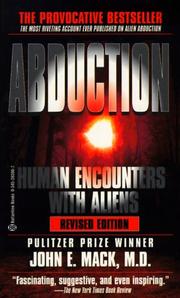
- Abduction: Human Encounters with Aliens
- 获奖
- 普利策传记奖(1977)、搞笑诺贝尔奖、普利策奖
资料卡来自 Wikidata Q1367806(CC0),众包数据,个别字段可能不全。
本站收录的作品(1)
同时代的美国作家
前后几届的普利策传记奖得主
全部得主 ›Open Library 上的全部作品
正在读取…