 书单
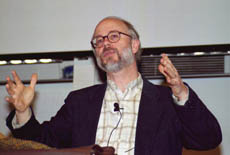
迈克尔·比希
- 生卒
- 1952 –
- 国籍
- 美国
- 外文名
- Michael Behe
照片:Campus Photo • Bryan Matluk,CC BY-SA 3.0,来自维基共享资源「MichaelBehe.jpg」(经缩小)。
生平与创作
这个词条暂时没有中文维基百科条目,下面是英文维基百科的内容(英文原文):
Michael Joseph Behe ( BEE-hee; born January 18, 1952) is an American biochemist and an advocate of the pseudoscientific principle of intelligent design (ID).
Behe serves as professor of biochemistry at Lehigh University in Bethlehem, Pennsylvania, and as a senior fellow of the Discovery Institute's Center for Science and Culture. He advocates for the validity of the argument for irreducible complexity (IC), which claims that some biochemical structures are too complex to be explained by known evolutionary mechanisms and are therefore probably the result of intelligent design. Behe has testified in several court cases related to intelligent design, including the court case Kitzmiller v. Dover Area School District, where his views were cited in the ruling that intelligent design is not science and is religious in nature.
As of 2014, Behe was unfavorably regarded by the scientific community; the scientific community had "thoroughly rejected" his work on intelligent design.
Early life and education
Behe was born in Altoona, Pennsylvania, and grew up in Harrisburg, Pennsylvania, where he graduated from Bishop McDevitt High School. He graduated from Drexel University with a Bachelor of Science in chemistry in 1974. He then earned his Ph.D. in biochemistry from the University of Pennsylvania in 1978. His doctoral dissertation was titled, "Investigation of some physical chemical factors affecting the gelation of sickle cell hemoglobin".
From 1978 to 1982, he did postdoctoral work on DNA structure at the National Institutes of Health. From 1982 to 1985, he was assistant professor of chemistry at Queens College in New York City, where he met his wife, Celeste. In 1985, he moved to Lehigh University in Bethlehem, Pennsylvania, where he is currently a professor of biochemistry. From 2005 to 2024, Lehigh University's department of biological sciences exhibited a position statement on its website stating that its faculty reject Behe's views on evolution:
The department faculty, then, are unequivocal in their support of evolutionary theory, which has its roots in the seminal work of Charles Darwin and has been supported by findings accumulated over 140 years. The sole dissenter from this position, Prof. Michael Behe, is a well-known proponent of "intelligent design." While we respect Prof. Behe's right to express his views, they are his alone and are in no way endorsed by the department. It is our collective position that intelligent design has no basis in science, has not been tested experimentally, and should not be regarded as scientific.
As of 2024, his faculty webpage states: "My arguments about irreducible complexity and intelligent design are my own, and are not endorsed either by Lehigh University in general or by the Department of Biological Sciences in particular." Behe said that the university' biology department gave no scientific evidence that intelligent design "has no basis in science".
Career
Behe says he once fully accepted the scientific theory of evolution, but that after reading Evolution: A Theory in Crisis (1985), by Michael Denton, he came to question evolution. Later, Behe came to believe that there was evidence, at a biochemical level, that some biological systems were "irreducibly complex". He thought that these systems could not, even in principle, have evolved by natural selection. He believed that the only possible alternative explanation for such complex structures was that they were created by an "intelligent designer". Irreducible complexity has been rejected by the scientific community.
The 1987 Edwards v. Aguillard U.S. Supreme Court decision barred the required teaching of creation science from public schools but allowed evolutionary theory on the grounds of scientific validity. After the decision, a later draft of the textbook Of Pandas and People (1989) systematically replaced each and every cognate of the word "creation" with the phrase "intelligent design" or similar ID terms. The books of lawyer Phillip E. Johnson on theistic realism dealt directly with criticism of evolutionary theory and its purported biased "materialist" science, and aimed to legitimize the teaching of creationism in schools. In March 1992, a conference at Southern Methodist University brought Behe together with other leading figures into what Johnson later called the "wedge strategy." In 1993, the "Johnson-Behe cadre of scholars" met at Pajaro Dunes, California, and Behe presented for the first time his idea of irreducibly complex molecular machinery. Following a summer 1995 conference, "The Death of Materialism and the Renewal of Culture," the group obtained funding through the Discovery Institute.
For the 1993 edition of Pandas, Behe wrote a chapter on blood clotting, presenting arguments which he later presented in very similar terms in a chapter in his 1996 book Darwin's Black Box. Behe later agreed that they were essentially the same when he defended intelligent design at the Dover trial.
In 1996, Behe became a senior fellow of the Discovery Institute's Center for the Renewal of Science and Culture, later renamed the Center for Science and Culture, an organization dedicated to promoting intelligent design.
Darwin's Black Box
In 1996, Behe published his ideas on irreducible complexity in his book Darwin's Black Box. Behe's refusal to identify the nature of any proposed intelligent designer frustrates scientists, who see it as a move to avoid any possibility of testing the positive claims of ID while allowing him and the intelligent design movement to distance themselves from some of the more overtly religiously motivated critics of evolution.
As to the identity of the intelligent designer, Behe responds that if, deep in the woods, one were to come across a group of flowers that clearly spelled out the name "LEHIGH", one would have no doubt that the pattern was the result of intelligent design. Determining who the designer was, however, would not be nearly as easy.
以上文字摘自英文维基百科「Michael Behe」(有删节,去掉了参考文献等尾部小节),按 CC BY-SA 4.0 使用,作者为维基百科的各位编者。
资料卡
- 出生
- 1952 年 1 月 18 日
- 出生地
- 阿尔图纳
- 职业
- 生物化学家、大学教师、作家、化学家
- 使用语言
- 英语
- 就读学校
- 宾夕法尼亚大学、德雷克塞尔大学、Bishop McDevitt High School
- 领域
- 生物化学、智能设计
资料卡来自 Wikidata Q368363(CC0),众包数据,个别字段可能不全。
本站收录的作品(1)

作品年表(1 本)
本站书库里署名迈克尔·比希的书(Open Library 上至少 10 人加过书架的才收),按首版年份排(有本站书页的用 Wikidata 记的首版年,其余用 Open Library 的);年份偶尔记成后来的版本或译本,以原书为准。全部作品见 Open Library。
- 1996Darwin's Black Box书架 20