 书单
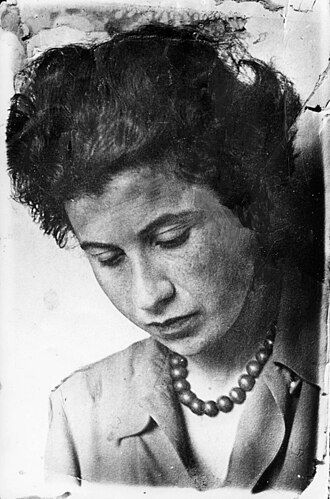
Etty Hillesum
- 生卒
- 1914 – 1943
- 国籍
- 荷兰王国
照片:作者不详,公有领域,来自维基共享资源「EttyHillesum.jpg」(经缩小)。
生平与创作
这个词条暂时没有中文维基百科条目,下面是英文维基百科的内容(英文原文):
Esther "Etty" Hillesum (15 January 1914 – 30 November 1943) was a Dutch Jewish author of confessional letters and diaries which describe both her religious awakening and the persecutions of Jewish people in Amsterdam during the German occupation. In 1943, she was deported and murdered in the Auschwitz concentration camp.
Life
Esther Hillesum was born on 15 January 1914 in her family home in the town of Middelburg, the oldest of the three children – she had two brothers: Jacob, or "Jaap" (1916–1945), and Michael, or "Mischa" (1920–1944) – of Levie Hillesum (1880–1943) and Riva Bernstein (1881–1943). After completing school in 1932, she moved to Amsterdam to study law and Slavic languages. There, she met Hendrik (Hans) J. Wegerif, with whom she had a relationship that she describes in her diaries.
Etty Hillesum began writing her diary in March 1941, possibly at the suggestion of her analyst Julius Spier, whom she had been consulting for a month. Although his patient, Etty also became his secretary, friend, and, eventually, his lover. His influence on her spiritual development is apparent in her diaries; as well as teaching her how to deal with her depressive and egocentric episodes, he introduced her to the Bible and St. Augustine, and helped her develop a deeper understanding of the work of Rilke and Dostoyevsky.
Her diaries record the increasing anti-Jewish measures imposed by the occupying German army, and the growing uncertainty about the fate of fellow Jews who had been deported by them. As well as forming a record of oppression, her diaries describe her spiritual development and deepening faith in God.
When round-ups of Jews intensified in July 1942, Etty took on administrative duties for the "Jewish Council", voluntarily transferring to a department of "Social Welfare for People in Transit" at Westerbork transit camp. She worked there for a month, but returned in June 1943, by which time she had refused offers to go into hiding, much to the consternation of her non-Jewish friends. This refusal was due to her belief that her duty was to support others scheduled to be transported from Westerbork to the concentration camps in German-occupied Poland and Germany. On 5 July 1943, her personnel status was suddenly revoked, and she became a camp internee, along with her father, mother, and brother Mischa.
On 7 September 1943, the family was deported from Westerbork to Auschwitz. Only Jaap Hillesum did not go with them; he arrived in Westerbork after their removal, and in February 1944, he was sent to Bergen-Belsen, dying shortly after its liberation in April 1945.
Etty Hillesum's parents are recorded as having died on 10 September 1943, suggesting they died in transit or were murdered immediately upon their arrival. Mischa Hillesum remained in Auschwitz until October 1943, when he was moved to the Warsaw Ghetto, where, according to the Red Cross, he died before 31 March 1944. Etty was murdered in Auschwitz on 30 November 1943.
Personal growth and philosophy
Etty Hillesum's youth was chaotic and turbulent, possibly resulting from her emotionally unstable family, to which she herself referred as a "madhouse". Her diaries reflect the inner turmoil that she experiences during her young adulthood, as well as the healing and growth during the years before her murder.
Russian authors and Christian mystics likely contributed to Hillesum's understanding of spirituality. She did not strive for ecstasy, but longed to meet the depth of her own interior and life itself. Her spirituality was not confined to her intellectual understanding of a greater power and is reflected in her diaries. In the concentration camp of Westerbork, she had unusual experiences of spiritual awakenings and insight: "Those two months behind barbed wire have been the two richest and most intense months of my life, in which my highest values were so deeply confirmed. I have learnt to love Westerbork". Hillesum addressed God repeatedly in her diaries, regarding him not as a saviour, but as a power one must nurture inside of oneself: "Alas, there doesn't seem to be much You Yourself can do about our circumstances, about our lives. Neither do I hold You responsible. You cannot help us, but we must help You and defend Your dwelling place inside us to the last."
Still in Amsterdam, Hillesum developed an ideology of showing others the way to their own interior in a time of great adversity – the Nazi terror. Her time at Westerbork – as reflected in her diaries – portrays the redemption of her spirit, while her body was captured and eventually murdered. She neither denies the horror of the Nazi terror, nor identifies with her victimhood. In the midst of extreme conditions, Hillesum develops an awareness of the indestructible beauty of this world. She writes during her time at Westerbork: "The sky is full of birds, the purple lupins stand up so regally and peacefully, two little old women have sat down for a chat, the sun is shining on my face – and right before our eyes, mass murder... The whole thing is simply beyond comprehension." Hillesum continuously writes from a place of great tenderness, empathy, and realisation.
Hillesum suffered great inner turmoil during her young adulthood, but increasingly transforms into a woman of maturity and wisdom. She wrote, "Everywhere things are both very good and very bad at the same time. The two are in balance, everywhere and always. I never have the feeling that I have got to make the best of things; everything is fine just as it is. Every situation, however miserable, is complete in itself and contains the good as well as the bad." In touch with the equilibrium of a bigger picture she is aware of, she continuously draws from this place to find meaning in her current reality. Hillesum saw it as her duty to assist her people in preserving their human dignity in the face of Nazi attempts to not only murder Jews but also take away their humanity.
以上文字摘自英文维基百科「Etty Hillesum」(有删节,去掉了参考文献等尾部小节),按 CC BY-SA 4.0 使用,作者为维基百科的各位编者。
资料卡
- 出生
- 1914 年 1 月 15 日
- 出生地
- 米德尔堡
- 逝世
- 1943 年 11 月 30 日
- 逝世地
- 比尔克瑙 等 3 项
- 职业
- 作家、日记作者、教师、传记作家
- 使用语言
- 荷兰语
- 代表作
- Het verstoorde leven
资料卡来自 Wikidata Q126400(CC0),众包数据,个别字段可能不全。
本站收录的作品(1)
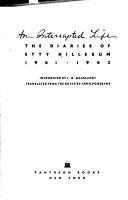
作品年表(2 本)
本站书库里署名Etty Hillesum的书(Open Library 上至少 10 人加过书架的才收),按首版年份排(有本站书页的用 Wikidata 记的首版年,其余用 Open Library 的);年份偶尔记成后来的版本或译本,以原书为准。全部作品见 Open Library。
- 1981Het verstoorde leven书架 30
- 1981Het verstoorde leven书架 10