 书单
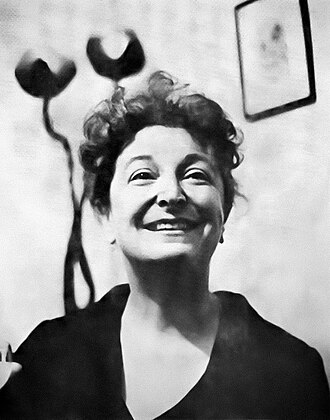
保利娜·基尔
- 生卒
- 1919 – 2001
- 国籍
- 美国
- 外文名
- Pauline Kael
照片:Rollins Maxwell,公有领域,来自维基共享资源「Pauline Kael (1968).jpg」(经缩小)。
生平与创作
这个词条暂时没有中文维基百科条目,下面是英文维基百科的内容(英文原文):
Pauline Kael ( KAYL; June 19, 1919 – September 3, 2001) was an American film critic who wrote for The New Yorker from 1968 to 1991. Known for her "witty, biting, highly opinionated and sharply focused" reviews, Kael often defied the consensus of her contemporaries.
One of the most influential American film critics of her era, she left a lasting impression on the art form. Roger Ebert wrote in an obituary that Kael "had a more positive influence on the climate for film in America than any other single person over the last three decades". Kael, he said, "had no theory, no rules, no guidelines, no objective standards. You couldn't apply her 'approach' to a film. With her it was all personal." In a blurb for The Age of Movies, a collection of Kael's writings for the Library of America, Ebert wrote, "Like George Bernard Shaw, she wrote reviews that will be read for their style, humor and energy long after some of their subjects have been forgotten."
For American readers, she brought attention to international cinema, and championed New Hollywood directors. Sanford Schwartz writes that, in the 1960s, she "gave a breathing, textured life to the aims and sensibilities of Ingmar Bergman, Jean-Luc Godard, Federico Fellini, Satyajit Ray, Akira Kurosawa, François Truffaut, and Michelangelo Antonioni, among other European and Asian directors; and she endowed Robert Altman, Martin Scorsese, Paul Mazursky, Brian De Palma, and Francis Ford Coppola, among American directors of the following decade, with the same full-bodied presence. [...] Her deepest subject, in the end, isn't movies at all—it's how to live more intensely."
Early life and education
Kael was the fifth and last child of Isaac Paul Kael and Judith Kael (née Friedman), Jewish immigrants from Poland, who moved from New York to run a chicken farm among other Jewish chicken farmers, in Petaluma, California. Her siblings were Louis (1906), Philip (1909), Annie (1912), and Rose (1913). Her parents lost their farm when Kael was eight, and the family moved to San Francisco, where Kael attended Girls High School.
Kael wrote of film critics of her generation: "We were in almost at the beginning, when something new was added to the human experience." Her parents took her to see silent films, which she later referred to, writing that D. W. Griffith's Intolerance (1916) was "the greatest movie ever made" and that Renée Falconetti's performance in Carl Theodor Dreyer's The Passion of Joan of Arc (1928) was "the finest ever recorded on film". In 1936, Kael matriculated at the University of California, Berkeley, where she studied philosophy, literature, and art. Her confidence in writing was evident from early on and can be seen in unpublished writings to her university friends, poet Robert Duncan and writer Violet Ginsberg. In college, as a teaching assistant, she graded papers for up to three professors, and met with students after hours offering frank advice. Kael dropped out in 1940. She had intended to go to law school, but fell in with a group of artists and moved to New York City with the poet Robert Horan.
Three years later, Kael returned to Berkeley and "led a bohemian life", writing plays and working in experimental film. In 1948, she and the filmmaker James Broughton had a daughter, Gina James, whom Kael raised alone. Gina had a congenital heart defect for much of her childhood that Kael could not afford the surgery to correct.
Early career
From age 17, when she started college, until 30 years later, when she was publishing work in national publications, Kael held a steady stream of odd jobs to support herself and later her daughter. She wrote advertising copy and edited manuscripts, preferring to take less time-intensive work so that it would not interfere with her own writing. She took jobs such as nanny, cook, seamstress, and violin teacher in addition to her copy writing and editing work.
In 1952, Peter D. Martin, the editor of City Lights, overheard Kael arguing about films in a coffee shop with a friend and asked her to review Charlie Chaplin's Limelight (1952). Kael dubbed the film "Slimelight" and began publishing film criticism regularly in magazines.
Kael later said of her writing: "I worked to loosen my style—to get away from the term-paper pomposity that we learn at college. I wanted the sentences to breathe, to have the sound of a human voice." She disparaged the supposed critic's ideal of objectivity, calling it "saphead objectivity", and incorporated aspects of autobiography into her criticism. In a review of Vittorio De Sica's Shoeshine (1946) that has been ranked among her most memorable, Kael described seeing the film after one of those terrible lovers' quarrels that leave one in a state of incomprehensible despair. I came out of the theater, tears streaming, and overheard the petulant voice of a college girl complaining to her boyfriend, "Well I don't see what was so special about that movie." I walked up the street, crying blindly, no longer certain whether my tears were for the tragedy on the screen, the hopelessness I felt for myself, or the alienation I felt from those who could not experience the radiance of Shoeshine. For if people cannot feel Shoeshine, what can they feel? ... Later I learned that the man with whom I had quarreled had gone the same night and had also emerged in tears. Yet our tears for each other, and for Shoeshine, did not bring us together. Life, as Shoeshine demonstrates, is too complex for facile endings.
以上文字摘自英文维基百科「Pauline Kael」(有删节,去掉了参考文献等尾部小节),按 CC BY-SA 4.0 使用,作者为维基百科的各位编者。
资料卡
- 出生
- 1919 年 6 月 19 日
- 出生地
- 佩塔卢马
- 逝世
- 2001 年 9 月 3 日
- 逝世地
- 大巴灵顿
- 职业
- 影评人、作家、新闻工作者
- 使用语言
- 英语
- 就读学校
- 加州大学伯克利分校
- 获奖
- 古根海姆学者奖(1964)、美国国家图书奖(1974)、乔治·波尔克奖(1970);另有 2 项只有外文名
资料卡来自 Wikidata Q436910(CC0),众包数据,个别字段可能不全。
本站收录的作品(1)
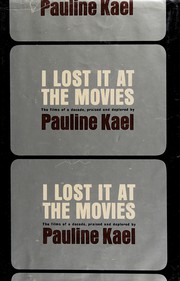
作品年表(4 本)
本站书库里署名保利娜·基尔的书(Open Library 上至少 10 人加过书架的才收),按首版年份排(有本站书页的用 Wikidata 记的首版年,其余用 Open Library 的);年份偶尔记成后来的版本或译本,以原书为准。全部作品见 Open Library。
- 1965I lost it at the movies书架 22
- 1965I lost it at the movies书架 10
- 1976Reeling书架 10
- 19825001 nights at the movies书架 14