 书单
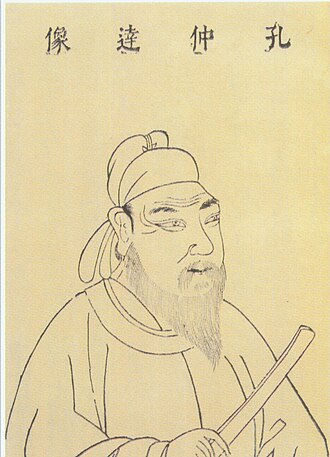
孔颖达
- 生卒
- 574 – 648
- 国籍
- 隋朝、唐朝
- 外文名
- Kong Yingda
照片:Wang Qi,公有领域,来自维基共享资源「Kong Yingda.jpg」(经缩小)。
生平与创作
孔颖达(574年—648年10月10日),字冲远(一作冲远、仲达、冲澹),冀州衡水(今河北衡水市)人。孔安之子,孔子三十二代孙。唐朝经学家。
生平
生于北齐后主武平五年(574年),八岁就学,曾从刘焯问学,日诵千言,熟读经传,善于词章,隋大业初,选为“明经”,授河内郡博士,补太学助教。隋末大乱,避地虎牢(今河南省荥阳汜水镇西北)。入唐,任国子监祭酒。曾奉唐太宗命编纂《五经正义》,融合南北经学家的见解,是集魏晋南北朝以来经学大成的著作。卒于贞观二十二年(648年),终年75岁。
孔颖达所疏或正义的经书包括《周易》、《尚书》、《诗经》、《礼记》和《左传》等。
孔颖达碑
现在陕西醴泉县昭陵博物馆,于志宁撰文,书者不详。螭首方趺,碑圭篆书阳文《大唐故国子祭酒曲阜宪公孔公之碑铭》,共4行,每行4字。前人称《孔祭酒碑》或《曲阜宪公碑》。
以上文字摘自维基百科「孔颖达」(去掉了参考文献等尾部小节),按 CC BY-SA 4.0 使用,作者为维基百科的各位编者。
中文维基百科的条目比较短,下面附上英文维基百科的内容(英文原文):
Kong Yingda (Chinese: 孔穎達; Wade–Giles: K'ung Ying-ta; 574 – 648), courtesy names Chongyuan (冲遠) and Zhongda (仲達), was a Chinese philosopher during the Sui and Tang dynasty. An ardent Confucianist, he is considered one of the most influential Confucian scholars in Chinese history. His most important work is the Wujing Zhengyi 五經正義 ("Correct Meaning of the Five Classics"), which became the standard curriculum for the imperial examinations, and the basis for all future official commentaries of the Five Classics. He was also "skilled at mathematics and the calendar."
Early life
Kong Yingda was born 574 in Hengshui, Jizhou (冀州), in the state of Northern Qi of the Northern dynasties. He was said to be a 32nd-generation descendant of Confucius, and his father Kong An (孔安), grandfather Kong Shuo (孔碩), and great-grandfather Kong Linggui (孔靈龜) all served as high-ranking government officials.
Kong began studying Confucian classics in childhood. He later became a pupil of Liu Zhuo (劉焯), a renowned scholar of the time, and studied the Shangshu and Du Yu's annotations of the Zuo Zhuan under his guidance.
Sui dynasty
After Emperor Yang ascended the throne of the Sui dynasty in 604, the emperor invited famous scholars and their students to his court, including Liu Zhuo and Kong Yingda. Kong excelled in scholarly debates, and was appointed to a high post at the age of only 30. His eminence caused envy in some established scholars, who were ashamed of being inferior to him and made an abortive attempt to have him assassinated.
Tang dynasty
After the Tang dynasty replaced the short-lived Sui, Kong Yingda became one of the "Eighteen Scholars" in the court of Emperor Taizong of Tang, along with the likes of Du Ruhui and Fang Xuanling. He served in several top positions of the Imperial Academy, and participated in the composition of the Book of Sui, the official history of the Sui dynasty. The emperor awarded him the nobility rank of viscount.
To reconcile the conflicting versions and traditions of the Confucian classics, in 637, Emperor Taizong sponsored a project to create a standardized compilation and interpretation of the texts. Kong Yingda was appointed the head of the project, and he gathered a team of experts including Yan Shigu, Sima Caizhang (司马才章), Wang Gong (王恭), and Wang Yan (王琰), who spent five years to finish the project, and Emperor Taizong personally named the work Wujing Zhengyi (五經正義, "Correct Meaning of the Five Classics"). However, their work was criticized for verbosity by other scholars including Ma Jiayun (馬嘉運), and the emperor ordered further revisions to be made. Kong Yingda died before the revision was completed, and Zhangsun Wuji was appointed to finish the work, which was finally approved in 653 by the next emperor, Gaozong.
Kong Yingda died in 648, at the age of 74. He was given the honour to be buried in the Zhao Mausoleum, accompanying Emperor Taizong in death.
Legacy
Kong Yingda's Wujing Zhengyi became the canonical interpretation of the Confucian classics, and the standard curriculum for the imperial examinations. He coined the Chinese word for curriculum, kecheng, in a commentary to the Classic of Poetry. Wujing Zhengyi was also the basis for all future official commentaries on the Five Classics. As such, Kong Yingda is recognized as one of the most influential Confucian scholars in history.
以上文字摘自英文维基百科「Kong Yingda」(去掉了参考文献等尾部小节),按 CC BY-SA 4.0 使用,作者为维基百科的各位编者。
资料卡
- 出生
- 574 年
- 出生地
- 衡水市
- 逝世
- 648 年 10 月 10 日
- 职业
- 哲学家、作家
- 使用语言
- 中文
资料卡来自 Wikidata Q5369940(CC0),众包数据,个别字段可能不全。
本站收录的作品(1)
同时代的隋朝作家
Open Library 上的全部作品
正在读取…