 书单
生平与创作
小威廉·汤玛斯·盖迪斯(英语:William Thomas Gaddis, Jr.,1922年12月29日—1998年12月16日),美国小说家。他的第一部,也是最长的小说《承认》(The Recognitions)被《时代杂志》评为时代杂志百大英文小说,另外两部小说则获得了年度美国国家图书奖。盖迪斯是美国最重要的后现代主义作家之一。由于其复杂性和创造力的结构和风格,他的小说往往具有挑战性。
作品
《承认》(The Recognitions), 1955. ISBN 9780140187083
《木匠的哥特式》(Carpenter's Gothic), 1985. ISBN 9780670697939
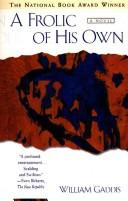
《他自己的嬉戏》(A Frolic of His Own), 1994. ISBN 9780670855537
《争取第二名》(The Rush for Second Place), 2002. ISBN 9780142002384
连结
The Gaddis Annotations, a comprehensive scholarly site
WorldCat 联合目录中威廉·盖迪斯的著作或与之相关的著作
The William Gaddis papers at Washington University in St. Louis
The William Gaddis pages at The Modern Word website
Zoltán Abádi-Nagy. William Gaddis, The Art of Fiction No. 101. Paris Review. Winter 1987.
以上文字摘自维基百科「威廉·蓋迪斯」(去掉了参考文献等尾部小节),按 CC BY-SA 4.0 使用,作者为维基百科的各位编者。
中文维基百科的条目比较短,下面附上英文维基百科的内容(英文原文):
William Thomas Gaddis Jr. (December 29, 1922 – December 16, 1998) was an American novelist.
The first and longest of his five novels, The Recognitions, was named one of TIME magazine's 100 best novels from 1923 to 2005
and two others, J R and A Frolic of His Own, won the annual U.S. National Book Award for Fiction.
A collection of his essays was published posthumously as The Rush for Second Place (2002). The Letters of William Gaddis was published by Dalkey Archive Press in February 2013.
A MacArthur Fellow, Gaddis is widely considered one of the first and most important American postmodern writers.
Life and career
Gaddis was born in New York City to William Thomas Gaddis, who worked "on Wall Street and in politics", and Edith (Charles) Gaddis, who worked her way up from being secretary to the president of the New York Steam Corporation to an executive position as its chief purchasing agent. When he was three, his parents separated and Gaddis was subsequently raised by his mother in Massapequa, Long Island. At age 5 he was sent to Merricourt Boarding School in Berlin, Connecticut. He continued in private school until the eighth grade, after which he returned to Long Island to receive his diploma at Farmingdale High School in 1941. He entered Harvard in 1941 where he was a member of The Harvard Lampoon (where he eventually served as president), but was asked to leave in 1944 due to an altercation with police. He worked as a fact checker for The New Yorker for little over a year (late February 1945 until late April 1946), then spent five years traveling in Mexico, Central America, Spain, France, England, and North Africa, returning to the United States in 1951.
His first novel, The Recognitions, appeared in 1955. A lengthy, complex, and allusive work, it had to wait to find its audience. Newspaper reviewers considered it overly intellectual, overwritten, and disgusting. Seven years later, the book was defended by Jack Green in a series of broadsheets blasting the critics; the series was collected later under the title Fire the Bastards!.
Gaddis then turned to public relations work and the making of documentary films to support himself and his family. In this role he worked for Pfizer, Eastman Kodak, IBM, and the United States Army, among others. He also received a National Institute of Arts and Letters grant, a Rockefeller grant, and two National Endowment for the Arts grants, all of which helped him write his second novel. In 1975 he published J R, told almost entirely in unattributed dialogue. Its eponymous protagonist, an 11-year-old, learns enough about the stock market from a class field trip to build a financial empire of his own. Critical opinion had caught up with him, and the book won the National Book Award for Fiction.
Carpenter's Gothic (1985) offered a shorter and more accessible picture of Gaddis's sardonic worldview, focusing on religious fundamentalism and apocalyptic thinking. Instead of struggling against misanthropy (as in The Recognitions) or reluctantly giving ground to it (as in J R), Carpenter's Gothic wallows in it. The continual litigation that was a theme in that book becomes the central theme and plot device in A Frolic of His Own (1994)—which earned him his second National Book Award and was a finalist for the National Book Critics Circle Award for Fiction.
Gaddis died at home in East Hampton, New York, of prostate cancer on December 16, 1998, but not before creating his final work, Agapē Agape (the first word of the title is the Greek agapē, meaning divine, unconditional love), which was published in 2002, a novella in the form of the last words of a character similar but not identical to his creator. The Rush for Second Place, published at the same time, collected most of Gaddis's previously published nonfiction.
以上文字摘自英文维基百科「William Gaddis」(有删节,去掉了参考文献等尾部小节),按 CC BY-SA 4.0 使用,作者为维基百科的各位编者。
资料卡
- 出生
- 1922 年 12 月 29 日
- 出生地
- 纽约
- 逝世
- 1998 年 12 月 16 日
- 逝世地
- 东汉普顿
- 职业
- 作家、小说家
- 使用语言
- 英语
- 写作语言
- 英语
- 就读学校
- 哈佛大学、Farmingdale High School
- 所属团体
- 美国文理科学院、美国艺术暨文学学会
- 代表作
- The Recognitions、小大亨、他自己的嬉戏
- 获奖
- 古根海姆学者奖、麦克阿瑟天才奖、美国国家图书奖·小说(1976)、美国国家图书奖·小说(1994)
资料卡来自 Wikidata Q456958(CC0),众包数据,个别字段可能不全。
本站收录的作品(3)


受 Ta 影响的作家
同时代的美国作家
前后几届的美国国家图书奖·小说得主
全部得主 ›前后几届的美国国家图书奖·小说得主
全部得主 ›Open Library 上的全部作品
正在读取…