 书单
奥利弗·拉法尔
- 生卒
- 1901 – 1963
- 国籍
- 美国
- 外文名
- Oliver La Farge
生平与创作
这个词条暂时没有中文维基百科条目,下面是英文维基百科的内容(英文原文):
Oliver Hazard Perry La Farge II (December 19, 1901 – August 2, 1963) was an American writer and anthropologist. In 1925, he surveyed many early Olmec sites in Mexico, and later studied additional sites in Central America and the American Southwest. He wrote more than 15 scholarly works on this topic, mostly about Native American cultures.
In addition, he wrote several novels, one of which, Laughing Boy (1929), won a Pulitzer Prize. La Farge also wrote short stories, published in such prominent magazines as The New Yorker and Esquire.
His more notable works, both fiction and non-fiction, emphasize Native American cultures. He was most familiar with the Navajo people and was fluent in their language. They gave him a Navajo name, 'Anast'harzi Nez', meaning "Tall Cliff-Dweller".
Early life and education
Oliver La Farge was born in New York City but grew up in Newport, Rhode Island. He was the son of Christopher Grant La Farge, a noted Beaux-Arts architect, and Florence Bayard Lockwood. His older brother Christopher La Farge became a writer and was a novelist. La Farge and his paternal uncle, architect Oliver H.P. La Farge, were both named for their great-great-grandfather Oliver Hazard Perry.
La Farge received both his Bachelor of Arts degree (1924) and his master's degree (1929) from Harvard University.
Career
La Farge worked as a writer and an anthropologist. In 1925, he traveled with the Danish archeologist Frans Blom, who taught at Tulane University, to what is now known as the Olmec heartland. He (re)discovered San Martin Pajapan Monument 1 and, more importantly, the ruins of La Venta, one of the major Olmec centers.
La Farge devoted considerable study to Native American peoples and issues, especially after moving to Santa Fe, New Mexico in 1933. He became a champion for American Indian rights and was president of the Association on American Indian Affairs for several years.
During World War II, La Farge served with the U.S. Air Transport Command, ending service with the rank of major. He participated in the Battle for Greenland, commanded by Colonel Bernt Balchen. Balchen, together with Corey Ford and La Farge, wrote War Below Zero: The Battle for Greenland (1944), about the actions to defend Greenland.
Marriage and family
La Farge married heiress Wanden Matthews and had two children with her: a son, Oliver Albee La Farge (b. 1931, later known as Peter La Farge) and a daughter, Povy. They moved to Santa Fe in 1933, but Wanden disliked the area. The couple divorced in 1937.
Their first son, Oliver Albee, became estranged from his father and changed his name to Peter La Farge. He moved to New York City, where he became a well-known folksinger and songwriter in Greenwich Village. He performed mostly during the 1950s and 1960s. Some of his more successful songs have Native American themes, including "As Long as the Grass Shall Grow", which takes its name from the title of one of his father's books. It was about the Seneca people.
La Farge married a second time to Consuelo Otile Baca, with whom he had a son, John Pendaries "Pen" La Farge. La Farge's non-fiction book Behind the Mountains (1956) is based on his memories of Consuelo's family, the Baca family of New Mexico, who were ranchers in northern New Mexico.
La Farge also wrote a regular column for The New Mexican, a Santa Fe newspaper. Some of his columns were collected and published posthumously as The Man with the Calabash Pipe (1966).
La Farge died of heart failure in Santa Fe in 1963 at age 61.
Legacy and honors
Pulitzer Prize (1930) for fiction for Laughing Boy
Building dedicated as the "Oliver La Farge" branch of the Santa Fe Public Library system
Works
Non-fiction
Tribes and Temples (with Frans Blom), 1926–1927
The Year Bearer's People (with Douglas Byers), 1931
Introduction to American Indian Art (with John Sloan), 1931
An Alphabet for Writing the Navajo Language, 1940
As Long As The Grass Can Grow – Indians Today, with photographs by Helen M. Post, 1940
The Changing Indian (editor), 1942
War Below Zero: The Battle for Greenland (Colonel Bernt Balchen, with Major Corey Ford), 1944
Santa Eulalia: The Religion of a Cuchumatan Indian Town, 1947
The Eagle in the Egg, 1949
Cochise of Arizona, 1953
The Mother Ditch, 1954
A Pictorial History of the American Indian, 1956
Behind the Mountains, 1956
Santa Fe: The Autobiography of a Southwestern Town (with Arthur N. Morgan), 1959
Fiction and personal
Laughing Boy (1929), novel, adapted for the 1934 motion picture of the same name
Sparks Fly Upward (1931), novel
Long Pennant (1933), novel
All the Young Men (1935), collection of short stories
The Enemy Gods (1937), novel
The Copper Pot (1942), novel
Raw Material (1945), a memoir
A Pause in the Desert (1957), collection of short stories
The Door in the Wall (1965), collection of short stories
The Man With the Calabash Pipe (1966), collected columns, edited by Winfield Townley Scott
Translation
A Man's Place (1940), translation of El lugar de un hombre, by Ramón J. Sender
以上文字摘自英文维基百科「Oliver La Farge」(去掉了参考文献等尾部小节),按 CC BY-SA 4.0 使用,作者为维基百科的各位编者。
资料卡
- 母语名
- Oliver Hazard Perry La Farge II
- 出生
- 1901 年 12 月 19 日
- 出生地
- 纽约
- 逝世
- 1963 年 8 月 2 日
- 逝世地
- 圣菲
- 职业
- 人类学家、小说家、作家、编剧、新闻工作者、考古学家
- 使用语言
- 英语
- 就读学校
- 哈佛大学
- 所属团体
- 美国文理科学院、美国艺术暨文学学会
- 代表作
- Santa Fe: the autobiography of a southwestern town、Laughing Boy、A Pictorial History of the American Indian
- 获奖
- 古根海姆学者奖(1941);另有 1 项只有外文名
资料卡来自 Wikidata Q761453(CC0),众包数据,个别字段可能不全。
本站收录的作品(1)
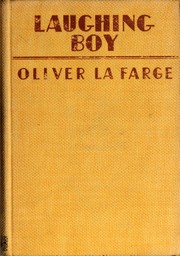
作品年表(1 本)
本站书库里署名奥利弗·拉法尔的书(Open Library 上至少 10 人加过书架的才收),按首版年份排(有本站书页的用 Wikidata 记的首版年,其余用 Open Library 的);年份偶尔记成后来的版本或译本,以原书为准。全部作品见 Open Library。
- 1929Laughing Boy书架 20