 书单
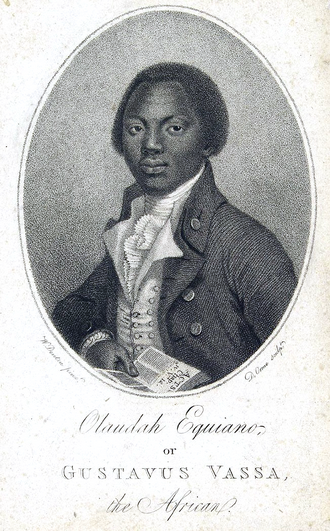
奥拉达·艾奎亚诺
- 生卒
- 1745 – 1797
- 外文名
- Olaudah Equiano
照片:作者不详,公有领域,来自维基共享资源「Olaudah Equiano - Project Gutenberg eText 15399.png」(经缩小)。
生平与创作
奥拉达·艾奎亚诺(英语:Olaudah Equiano 1745年—1797年3月31日)贝宁帝国伊博地区作家及废奴主义者,幼年时被掳为奴,后被英国皇家海军军官带到加勒比群岛卖为奴隶,后赎买自己获得自由。他在伦敦投入废奴主义运动,加入英国黑人组成的组织,撰写传记《生平奇事》描写了恐怖的奴隶生活,描述了宗号船大屠杀,该书多次重印促进了英国废奴法案的通过。艾奎亚诺后与一位英格兰妇女结婚,育有两位女儿。
以上文字摘自维基百科「奥拉达·艾奎亚诺」(去掉了参考文献等尾部小节),按 CC BY-SA 4.0 使用,作者为维基百科的各位编者。
中文维基百科的条目比较短,下面附上英文维基百科的内容(英文原文):
Olaudah Equiano (c. 1745 – 31 March 1797), known for most of his life as Gustavus Vassa, was a writer who, drawing on his experiences as an enslaved African in the Americas, became a celebrated figure within the abolitionist movement in Great Britain and Ireland. According to his memoir, he was kidnapped from his home in West Africa (a village in what is now southern Nigeria) and shipped first to Barbados and then to Virginia. There he was bought by a Royal Navy officer whom he accompanied, during the Seven Years' War, as a valet. He was sold twice more in the Caribbean before, having been permitted to trade on his own account, purchasing his freedom in 1766.
As a freedman in London, Equiano embraced the British abolitionist movement, in the 1780s becoming one of its Sons of Africa, Africans living in Britain active as speakers on the abolitionist circuit. His 1789 autobiography, The Interesting Narrative of the Life of Olaudah Equiano, went through nine editions in his lifetime, and is credited with helping shift opinion in favour of the British Slave Trade Act 1807, under which the Royal Navy was committed to the suppression of the Atlantic slave trade. As a member of the London Corresponding Society, he was also associated with the cause of democratic reform.
The Interesting Narrative was rediscovered by scholars in the late 20th century and remains a widely-cited primary source.
Early life and enslavement
According to his 1789 memoir, Equiano was born around 1745 in the village of Essaka (thought to be Isseke in today's Anambra State, Nigeria). Professor Paul Lovejoy, in his 2025 publication, argues that Equiano was from the village of Usaka (Essaka), present day Ikwuano (Equiano) in Abia State as Igbos at the time of Olaudah's youth didnt bare surnames. In the 4th, 1791, edition of his book, he is also described as a native of the Eboe (Igbo) province, and in addresses and correspondence variously described himself as an "African", an "Eboan African" and as an "oppressed Ethiopian".
He was the youngest of six surviving sons, and had a sister; their father owned many slaves. His older brothers had helped foil one attempt at kidnapping of children in his village, but at the age eleven, alone in the family compound, he and his sister were seized. Separated and sold to slave traders, he was trafficked a considerable distance, changing owners several times. Six months after he had been kidnapped, he arrived at the coast, where he was taken on board a European slave ship. With 244 other enslaved Africans, he was transported across the Atlantic Ocean to Barbados in the British West Indies. He and a few other slaves were then sent on for sale in the British colony of Virginia.
In Virginia, Equiano was bought by Michael Henry Pascal, a lieutenant in the Royal Navy. Pascal renamed the boy Gustavus Vassa after the 16th-century King of Sweden Gustav Vasa who led had Protestant forces in the Thirty Years' War. Equiano had already been renamed twice: he had been called Michael on board the slave ship that brought him to the Americas and Jacob by his first owner. This time Equiano protested, telling Pascal that he would prefer to be called Jacob. His resistance, he says, "gained me many a cuff" and eventually he submitted to the new name. He used this name for the rest of his life, including on all official records; he used Equiano only in his autobiography.
Pascal took Equiano with him when he returned to England and had him accompany him as a valet during the Seven Years' War. Equiano was present at the siege of Louisbourg in 1758, the Battle of Lagos in 1759 and the capture of Belle Île in 1761. Also trained in seamanship, Equiano assisted the crews of the ships he was on in times of battle as a powder monkey. Pascal favoured Equiano and sent him to his sister-in-law in Great Britain so that he could attend school and learn to read and write. Equiano converted to Christianity and was baptised at St Margaret's, Westminster on 9 February 1759.
以上文字摘自英文维基百科「Olaudah Equiano」(有删节,去掉了参考文献等尾部小节),按 CC BY-SA 4.0 使用,作者为维基百科的各位编者。
资料卡
- 出生
- 1745 年
- 出生地
- 贝宁
- 逝世
- 1797 年 3 月 31 日
- 逝世地
- 威斯敏斯特
- 职业
- 作家、自传作者、理发师、商人、演员
- 使用语言
- 法语、英语
- 创作体裁
- 自传、社会批判
- 代表作
- The Interesting Narrative of the Life of Olaudah Equiano
资料卡来自 Wikidata Q379887(CC0),众包数据,个别字段可能不全。
本站收录的作品(1)
作品年表(2 本)
本站书库里署名奥拉达·艾奎亚诺的书(Open Library 上至少 10 人加过书架的才收),其中 1 本记的年份比作者去世晚 50 年以上或者早于他出生(多半是后世的版本、译本或占位年份),不列年份,按首版年份排(有本站书页的用 Wikidata 记的首版年,其余用 Open Library 的);年份偶尔记成后来的版本或译本,以原书为准。全部作品见 Open Library。