 书单
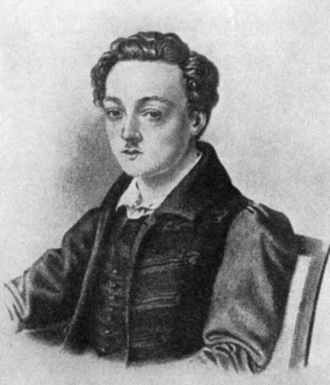
格奥尔格·毕希纳
- 生卒
- 1813 – 1837
- 国籍
- 黑森-达姆施塔特
- 外文名
- Georg Büchner
照片:Philipp August Joseph Hoffmann (1807 bis 1883),公有领域,来自维基共享资源「Georg Büchner.png」(经缩小)。
生平与创作
卡尔·格奥尔格·毕希纳(德语:Karl Georg Büchner,1813年10月17日—1837年2月19日),德国作家、革命家。他所撰写的悲剧《丹东之死》(Dantons Tod)是现代思想史上的一块路碑。其主要作品有政治宣传册《黑森信使》,小说《伦茨》,戏剧《雷昂采与雷娜》。
格奥尔格·毕希纳1813年生于达姆施塔特附近的黑森。19岁时开始学习医学。在学习自然科学之外,他也撰写了许多文学作品和政治宣传册。
21岁那年,毕希纳通过一篇名为《黑森信使》的政治小册子而出名,这份小册子被称作《共产党宣言》之前19世纪最革命的宣言。在这份传单中,他和其他的作者号召民众起来革命,反抗贵族的剥屑统治。在传单中可以找到许多从法国大革命传统中引用的词句,例如“给茅屋和平!对宫廷宣战!”(Friede den Hütten! Krieg den Palästen!)。他认为故乡的社会秩序是劳动者贫穷和苦难的根源。在传单散布之后,他和其他的作者也将遭到逮捕。
毕希纳逃到了法国的斯特拉斯堡,之后他完成了他的第一部著作:《丹东之死》(Dantons Tod)上演于法国大革命时期, 毕希纳也把自己的政治观点写进其中。在1836年完成讽刺喜剧《莱昂斯和莱娜》(Leonce und Lena)之后,他撰写了一部悲剧《沃伊采克》(Woyzek)。在这第三部也或许是最重要的著作中,他深入剖析了社会的苦难和不公平性。
格奥尔格·毕希纳生命的最后两年是在苏黎世度过的,期间他完成了关于鱼类神经网络的科学论文。不久之后,年仅23岁的毕希纳死于伤寒。他的剧本至今仍然活跃在舞台,也将继续在全世界上演。
德语文学的最重要文学奖格奥尔格·毕希纳奖以他为名。
以上文字摘自维基百科「格奥尔格·毕希纳」(去掉了参考文献等尾部小节),按 CC BY-SA 4.0 使用,作者为维基百科的各位编者。
中文维基百科的条目比较短,下面附上英文维基百科的内容(英文原文):
Karl Georg Büchner (17 October 1813 – 19 February 1837) was a German dramatist and writer of poetry and prose, considered part of the Young Germany movement. He was also a revolutionary and the brother of physician and philosopher Ludwig Büchner. His literary achievements, though limited by his death at age 23, are generally held in great esteem in Germany. Despite his brief career, his plays profoundly influenced naturalism, expressionism, and later developments in European theater.
At the age of 21, Büchner, with others, wrote a pamphlet entitled The Hessian Courier that has been called the most revolutionary manifesto of the nineteenth century before The Communist Manifesto.
Life and career
Born in Goddelau (now part of Riedstadt) in the Grand Duchy of Hesse as the son of a physician, Büchner attended the Darmstadt gymnasium, a humanistic secondary school.
In 1828, he became interested in politics and joined a circle of William Shakespeare aficionados, which later on probably became the Giessen and Darmstadt section of the Society for Human Rights (Gesellschaft für Menschenrechte).
In 1831, at age 18, he began to study medicine in Strasbourg. In Strasbourg, he immersed himself in French literature and political thought. He was influenced by the utopian communist theories of François-Noël Babeuf and Claude Henri de Saint-Simon. In 1833, he moved to Giessen and continued his studies at the local university.
While Büchner continued his studies in Giessen, he established a secret society dedicated to the revolutionary cause. In July 1834, with the help of evangelical theologian Friedrich Ludwig Weidig, he published the leaflet Der Hessische Landbote (The Hessian Courier), a revolutionary pamphlet critical of social injustice in the Grand Duchy of Hesse. The authorities charged them with treason and issued a warrant for their arrest. Weidig was arrested, tortured and later died in prison in Darmstadt; Büchner managed to flee across the border to Strasbourg, where he wrote most of his literary work and translated two French plays by Victor Hugo, Lucrèce Borgia and Marie Tudor. Two years later, his medical dissertation, "Mémoire sur le Système Nerveux du Barbeau (Cyprinus barbus L.)" was published in Paris and Strasbourg. In October 1836, after receiving his M.D. and being appointed by the University of Zürich as a lecturer in anatomy, Büchner relocated to Zürich, where he spent his final months writing and teaching until his death from typhus at the age of twenty-three.
His first play, Dantons Tod (Danton's Death), about the French Revolution, was published in 1835, followed by Lenz (first partly published in Karl Gutzkow's and Wienberg's Deutsche Revue, which was quickly banned). Lenz is a novella based on the life of the Sturm und Drang poet Jakob Michael Reinhold Lenz. In 1836, his second play, Leonce and Lena, satirized the nobility. His unfinished and most famous play, Woyzeck, exists only in fragments and was published posthumously.
Legacy
By the 1870s, Büchner was nearly forgotten in Germany when Karl Emil Franzos edited his works; these later became a major influence on the naturalist and expressionist movements. Arnold Zweig described Lenz, Büchner's only work of prose fiction, as "the beginning of modern European prose".
The play Woyzeck became the basis for many adaptations, including Alban Berg's landmark atonal opera Wozzeck, which premiered in 1925, and Werner Herzog's 1979 film Woyzeck (see main article, Woyzeck, for a full list). Woyzeck has been included in the curriculum for students in grade 12 in Germany.
A German literary Georg Büchner Prize is awarded annually. It was created in 1923.
Works
The Hessian Courier, 1834 – in cooperation with Friedrich Ludwig Weidig (Flugschrift)
Danton's Death, 1835 (Drama)
Lenz, 1835 (Novella, unfinished)
Leonce and Lena, 1836 (Comedy)
Woyzeck, 1837 (Drama – fragment)
Pietro Aretino, his drama about Pietro Aretino, has been lost.
Translations:
Lucrezia Borgia, 1835 (Of the play by Victor Hugo)
以上文字摘自英文维基百科「Georg Büchner」(有删节,去掉了参考文献等尾部小节),按 CC BY-SA 4.0 使用,作者为维基百科的各位编者。
资料卡
- 出生
- 1813 年 10 月 17 日
- 出生地
- 戈德劳
- 逝世
- 1837 年 2 月 19 日
- 逝世地
- 苏黎世
- 职业
- 剧作家、诗人、译者、医师作家、自然科学家、革命家、作家、哲学家 等 9 项
- 使用语言
- 德语
- 写作语言
- 德语
- 就读学校
- 斯特拉斯堡大学(1831)、吉森大学(1833)
- 代表作
- 黑森信使、沃伊采克、丹敦之死、Lenz、Leonce and Lena
资料卡来自 Wikidata Q154014(CC0),众包数据,个别字段可能不全。
本站收录的作品(1)
作品年表(2 本)
本站书库里署名格奥尔格·毕希纳的书(Open Library 上至少 10 人加过书架的才收),其中 2 本记的年份比作者去世晚 50 年以上或者早于他出生(多半是后世的版本、译本或占位年份),不列年份,按首版年份排(有本站书页的用 Wikidata 记的首版年,其余用 Open Library 的);年份偶尔记成后来的版本或译本,以原书为准。全部作品见 Open Library。
- 年份不详Woyzeck书架 60
- 年份不详Woyzeck and other writings书架 11