 书单
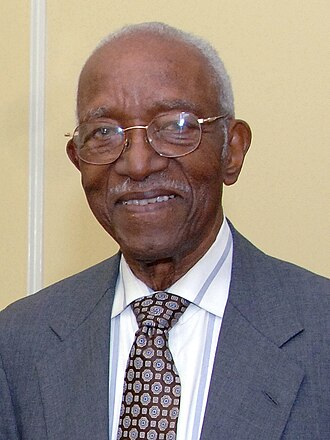
约翰·霍普·富兰克林
- 生卒
- 1915 – 2009
- 国籍
- 美国
- 外文名
- John Hope Franklin
照片:Darryl Herring--NARA Staff,公有领域,来自维基共享资源「John Hope Franklin 2006.jpg」(经缩小)。
生平与创作
这个词条暂时没有中文维基百科条目,下面是英文维基百科的内容(英文原文):
John Hope Franklin (January 2, 1915 – March 25, 2009) was an American historian who focused on the history of the United States. He is best known for his work From Slavery to Freedom, first published in 1947 and continually updated. More than three million copies have been sold.
Born in Oklahoma, Franklin attended Fisk University and then Harvard University, receiving his doctorate in 1941. He was a professor at Howard University, and in 1956 was named to head the history department at Brooklyn College, part of the City University of New York. Recruited to the University of Chicago in 1964, he eventually led the history department and was appointed to a named chair. He then moved to Duke University in 1983, as an appointee to a named chair in history.
He was a president of Phi Beta Kappa, the Organization of American Historians, the American Historical Association, the American Studies Association, and the Southern Historical Association. In 1995, he was awarded the Presidential Medal of Freedom, the nation's highest civilian honor.
Early life and education
Franklin was born in Rentiesville, Oklahoma, in 1915 to attorney Buck (Charles) Colbert Franklin and his wife Mollie (Parker) Franklin. He was named after John Hope, a prominent educator who was the first African-American president of Atlanta University.
Franklin graduated from Booker T. Washington High School (then segregated) in Tulsa, Oklahoma. He graduated in 1935 from Fisk University, a historically black university in Nashville, Tennessee, then earned a master's degree in 1936 and a doctorate in history in 1941 from Harvard University. Two fellowships (1937 and 1938) from the Rosenwald Fund enabled him to study for his PhD at Harvard.
Father
Buck Colbert Franklin was a civil rights lawyer, also known as "Amazing Buck Franklin," of African-American and Choctaw ancestry, born in the Chickasaw Nation in western Indian Territory (formerly Pickens County). He was the seventh of ten children born to David and Milley Franklin. David was a former slave, who became a Chickasaw Freedman when emancipated after the American Civil War. Milley was born free before the war and was of one-fourth Choctaw and three-fourths African-American ancestry.
Buck Franklin is best known for defending African-American survivors of the 1921 Tulsa race massacre, in which whites had attacked many blacks and buildings, and burned and destroyed the Greenwood District. This was known at the time as the "Black Wall Street," and was the wealthiest Black community in the United States, a center of black commerce and culture. In 2015, Buck Franklin's previously unknown written eyewitness account of the 1921 Greenwood attack, a 10-page typewritten manuscript, was discovered and subsequently obtained by the Smithsonian's National Museum of African American History and Culture. Franklin and his colleagues also became experts at oil law, representing "blacks and Native Americans in Oklahoma against white lawyers representing oil barons." His career demonstrated a strong professional black life in the West, at a time when such accomplishments would have been more difficult to achieve in the Deep South.
Career
"My challenge," Franklin said, "was to weave into the fabric of American history enough of the presence of blacks so that the story of the United States could be told adequately and fairly."
In his autobiography, Franklin has described a series of formative incidents in which he confronted racism while seeking to volunteer his services at the beginning of the Second World War. He responded to the navy's search for qualified clerical workers, but after he presented his extensive qualifications, the navy recruiter told him that he was the wrong color for the position. He was similarly unsuccessful in finding a position with a War Department historical project. When he went to have a blood test, as required for the draft, the doctor initially refused to allow him into his office. Afterward, Franklin took steps to avoid the draft, on the basis that the country did not respect him or have an interest in his well-being, because of his color.
According to his article, To and From Brown v. Board of Education, written upon the 50th anniversary of Brown and Bolling, Franklin says that Thurgood Marshall recruited him to help respond to the Supreme Court questions in response to the 5 cases brought. Specifically they wanted both sides to address the question of whether or not those who wrote and passed the Fourteenth Amendment also meant the elimination of segregation in the public schools.
Since Marshall and his colleagues were not that knowledgeable in the history of Reconstruction, he asked Franklin to work together with Woodward to develop the legal responses. Franklin continued to teach and then spent three days a week at the offices of the NAACP Legal Defense Fund to gather supporting evidence regarding Reconstruction and constitutional history on the topic. This included strategies and intentions of Southern leaders who perpetuated and enforced segregation. One of the papers he wrote was published as "Jim Crow Goes to School: The Genesis of Legal Segregation in Southern Schools". In a landmark ruling, it ruled in 1954 that the legal segregation of black and white children in public schools was unconstitutional, leading to integration of schools.
Professor and researcher
Franklin's teaching career began at Fisk University. During World War II, he taught at St. Augustine's College from 1939 to 1943 and the North Carolina College for Negroes, currently North Carolina Central University from 1943 to 1947.
From 1947 to 1956, he taught at Howard University. In 1956, Franklin was selected to chair the history department at Brooklyn College, the first person of color to head a major history department. Franklin served there until 1964, when he was recruited by the University of Chicago. He spent 1962 as a visiting professor at the University of Cambridge, holding the Professorship of American History and Institutions.
以上文字摘自英文维基百科「John Hope Franklin」(有删节,去掉了参考文献等尾部小节),按 CC BY-SA 4.0 使用,作者为维基百科的各位编者。
资料卡
- 母语名
- John Franklin
- 出生
- 1915 年 1 月 2 日
- 出生地
- 伦蒂斯维尔 (奥克拉荷马州)
- 逝世
- 2009 年 3 月 25 日
- 逝世地
- 达勒姆
- 职业
- 历史学家、大学教师、教授、作家
- 使用语言
- 英语
- 就读学校
- 杜克大学、迪拉德大学、Booker T. Washington High School、费斯克大学、哈佛大学
- 所属团体
- 美国文理科学院、阿尔法·菲·阿尔法、美国历史学会、美国笔会、美国全国有色人种协进会 等 6 项
- 代表作
- The Free Negro in North Carolina、From Slavery to Freedom
- 获奖
- 古根海姆学者奖(1950)、美国国家人文奖章、杰斐逊讲座(1976)、总统自由勋章(1995)、斯冰格奖章(1995)、赫尔默里奇奖(1997)、安斯非德-禾夫图书奖(1999)、克鲁格人文与社会科学终身成就奖(2006)、富布赖特项目;另有 7 项只有外文名
资料卡来自 Wikidata Q1367397(CC0),众包数据,个别字段可能不全。
同时代的美国作家
Open Library 上的全部作品
正在读取…