 书单
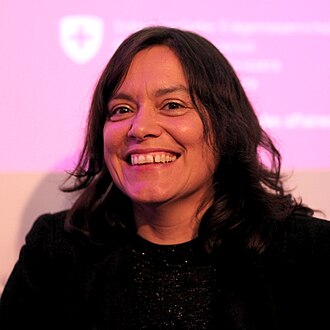
Sara Ahmed
- 生卒
- 1969 –
- 国籍
- 英国、澳大利亚
照片:Rama,CC BY-SA 3.0 fr,来自维基共享资源「Sara Ahmed-IMG 6457.jpg」(经缩小)。
生平与创作
这个词条暂时没有中文维基百科条目,下面是英文维基百科的内容(英文原文):
Sara Ahmed (born 30 August 1969) is a British-Australian writer and scholar whose area of study includes the intersection of feminist theory, queer theory, affect theory, critical race theory and postcolonialism. Her foundational work, The Cultural Politics of Emotion, in which she explores the social dimension and circulation of emotions, is recognized as a foundational text in the nascent field of affect theory.
Life
Ahmed was born in Salford, England on 30 August 1969. She is the daughter of a Pakistani father and an English mother, and she emigrated from England to Adelaide, Australia with her family in the early 1970s. Key themes in her work, such as migration, orientation, difference, strangeness, and mixed identities, relate directly to some of these early experiences. She completed her first degree at the University of Adelaide and doctoral research at the Centre for Critical and Cultural Theory, Cardiff University. She now lives on the outskirts of Cambridge with her partner, Sarah Franklin, who is an academic at the University of Cambridge.
Career
Ahmed was based at the Institute for Women's Studies at Lancaster University from 1994 to 2004, and is one of its former directors. She was appointed to the Department of Media and Communications at Goldsmiths, University of London in 2004, and was the inaugural director of its Centre for Feminist Research, which was set up 'to consolidate Goldsmiths' feminist histories and to help shape feminist futures at Goldsmiths.'
In spring 2009 Ahmed was the Laurie New Jersey Chair in Women's Studies at Rutgers University and in Lent 2013 she was the Diane Middlebrook and Carl Djerassi Professor in Gender Studies at Cambridge University, where she conducted research on "Willful Women: Feminism and a History of Will". In 2015 she was the keynote speaker at the National Women's Studies Association (NWSA) annual conference. In 2016 Ahmed resigned from her post at Goldsmiths in protest over the alleged sexual harassment of students by staff there. She indicated that she would continue her work as an independent scholar.
Ahmed blogs at feministkilljoys, a project she continues to update. The blog is a companion to her book Living a Feminist Life (2017) that enables her to reach people; posts become chapters and the book becomes blogging material. The term "feminist killjoy" "became a communication device, a way of reaching people who recognized in her something of their own experience."
Theories
Intersectionality
Intersectionality is essential to Ahmed's feminism. She states that "intersectionality is a starting point, the point from which we must proceed if we are to offer an account of how power works." She agrees with bell hooks, stating that if we aim to end sexism etc., we must also look at the other things attached, like racism and colonial power which molded our current society. To Ahmed, intersectionality is how we "make a point of how we come into existence." "How we can experience intersections," though, can be "frustrating, exhausting, painful."
Intersectionality is important to Ahmed, as it defines her own feminism and sense of self: “I am not a lesbian one moment and a person of color the next and a feminist at another. I am all of these at every moment. And lesbian feminism of color brings this all into existence, with insistence, with persistence.”
Diversity work
Diversity work is one of Ahmed's common topics. Included in many of her works, including Living a Feminist Life and On Being Included, it is a concept that makes tangible what it means to live a feminist life day to day in institutions. To Ahmed, diversity work is "[learning] about the techniques of power in the effort to transform institutional norms or in an effort to be in a world that does not accommodate our being." Diversity work is not any one thing. It is the act of trying to change an institution, and also simply the act of existing in one when it was not meant for you. She draws upon her experiences as a woman of color in academia and the works of others, including Chandra Talpade Mohanty, M. Jacqui Alexander, and Heidi Mirza.
Lesbian feminism of color
To Ahmed, lesbian feminism of color is "the struggle to put ourselves back together because within lesbian shelters too our being was not always accommodated." She draws upon the work of other lesbian feminists of color, like Cherie Moraga, Gloria Anzaldua, and Audre Lorde. These women have taken part in the effort to write "[themselves] into existence." Ahmed sees the texts of these women and many others like them to be a "lifeline".
Killjoy feminism
To Ahmed, practicing feminism is integral to the embodiment of living a feminist life. Ahmed's Killjoy Manifesto feministkilljoy blog elucidate the tenets of living and practicing life through a feminist philosophy, while also creating space for sharing how these embodiments create tension in life experiences under systems of patriarchy and oppression. She also addresses such tensions, and how institutions treat those who raise problems (e.g. about sexual harassment) as themselves the problem, in her 2021 book Complaint!
Inspired by Ahmed's notion of the feminist killjoy, T.L. Cowan proposed the "transfeminist kill/joy". This expression of transfeminism harnesses rage against transphobia and transmisogyny, along with the transformational love used to survive this environment, to disrupt exclusive forms of feminism and repair them. Example works in this mode include Mirha-Soleil Ross' Yapping Out Loud, Ryka Aoki's "To the New World", and the multi-artist Fully Functional Cabaret.
以上文字摘自英文维基百科「Sara Ahmed」(有删节,去掉了参考文献等尾部小节),按 CC BY-SA 4.0 使用,作者为维基百科的各位编者。
资料卡
- 出生
- 1969 年 8 月 30 日
- 出生地
- 索尔福德市
- 职业
- 作家、哲学家、大学教师、文化研究学者
- 使用语言
- 英语
- 就读学校
- 阿德莱德大学、卡迪夫大学
- 领域
- 性别研究、女权论者、后殖民主义理论
- 代表作
- Living a Feminist Life、Queer Phenomenology、The Cultural Politics of Emotion、Strange Encounters
资料卡来自 Wikidata Q15437208(CC0),众包数据,个别字段可能不全。
同时代的英国作家
Open Library 上的全部作品
正在读取…