 书单
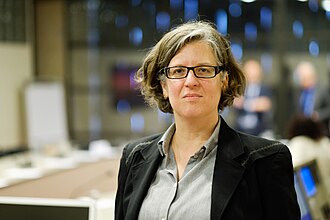
Virginia Eubanks
- 生卒
- 1972 –
- 国籍
- 美国
照片:Sebastiaan ter Burg from Utrecht, The Netherlands,CC BY 2.0,来自维基共享资源「Gesprek tweede kamer met Virginia Eubanks (33140421058).jpg」(经缩小)。
生平与创作
这个词条暂时没有中文维基百科条目,下面是英文维基百科的内容(英文原文):
Virginia Eubanks (born 1972) is an American political scientist, professor, and author studying technology and social justice. She is an associate professor in the Department of Political Science at the University at Albany, SUNY. Previously Eubanks was a Fellow at New America researching digital privacy, economic inequality, and data-based discrimination.
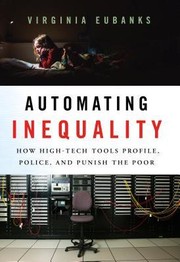
Eubanks has written and co-edited multiple award-winning books, the most well-known being Automating Inequality: How High-Tech Tools Profile, Police, and Punish the Poor. Her book uncovers the harms generated by computer algorithms to replace human decisions and how they negatively impact the economically disadvantaged.
Education
Eubanks graduated with a Bachelor of Arts in Literary Culture in 1994 at the University of California, Santa Cruz. She attended Rensselaer Polytechnic Institute for her graduate studies, where she earned a Masters of Science in Communication and Rhetoric in 1999 and a PhD in Science and Technology Studies in 2004.
Career and research
Eubanks joined the faculty at the University of Albany, SUNY after completing her PhD in 2004. Her research examines the intersection of community technology, poverty, women's citizenship, and social justice.
She was a founding member of the Our Data Bodies Project and a Fellow at New America in 2016–17. Eubanks also co-founded the Popular Technology Workshops, which served as a place for ordinary people to come together to define and combat the social, economic and political injustices of the information age. In 2005, she was a founding member of Our Knowledge, Our Power (OKOP), a welfare rights and economic justice group. OKOP was a member organization of the Poor People's Economic Human Rights Campaign (PPEHRC) until it disbanded in 2015.
Eubanks has written two books: Digital Dead End: Fighting for Social Justice in the Information Age (2011) and Automating Inequality: How High-Tech Tools Profile, Police, and Punish the Poor (2018). She also co-edited Ain’t Gonna Let Nobody Turn Me Around: Forty Years of Movement Building with Barbara Smith alongside Alethia Jones.
She was featured in the 2020 documentary Coded Bias directed by Shalini Kantayya.
Automating Inequality
In 2018, Eubanks published the book Automating Inequality: How High-Tech Tools Profile, Police, and Punish the Poor. The New York Times called her book "riveting", which was "an accomplishment for a book on technology and policy".
In her work she investigated the impacts of data mining, policy algorithms, and predictive risk models and their impacts on the poor and working class, especially when automated systems will replace humans in deciding who is worthy of receiving help. Eubanks found that AI-enabled public and private systems linked to health, benefits and policy were making damaging decisions based on flawed data and class, race, and gender biases. She coins the term "digital poorhouse": technological systems that embedded historical or cultural assumptions about what it means to be poor. She used examples of automating welfare eligibility (as implemented by former Indiana Governor Mitch Daniels in 2006), predicting child abuse and neglect, and scoring homeless people to categorize them for limited housing. To solve the issues of automated systems, Eubanks advocated for state intervention and voting policy makers into office who valued social responsibility.
Selected awards
Winner of the 2019 Lillian Smith Book Award
Winner of the 2018 McGannon Center Book Prize
Shortlisted for the 2018 Goddard Riverside Stephan Russo Book Prize for Social Justice
以上文字摘自英文维基百科「Virginia Eubanks」(去掉了参考文献等尾部小节),按 CC BY-SA 4.0 使用,作者为维基百科的各位编者。
资料卡
- 出生
- 1972 年
- 职业
- 政治学家、作家、学者、讲师
- 使用语言
- 英语
- 就读学校
- 加利福尼亚大学、伦斯勒理工学院
资料卡来自 Wikidata Q61639429(CC0),众包数据,个别字段可能不全。
本站收录的作品(1)
作品年表(1 本)
本站书库里署名Virginia Eubanks的书(Open Library 上至少 10 人加过书架的才收),按首版年份排(有本站书页的用 Wikidata 记的首版年,其余用 Open Library 的);年份偶尔记成后来的版本或译本,以原书为准。全部作品见 Open Library。
- 2018Automating Inequality书架 41