 书单
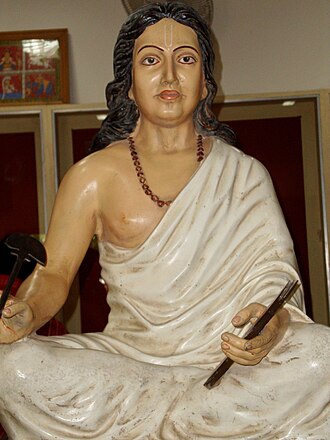
贾亚德瓦
- 生卒
- 1170 – 1245
- 外文名
- Jayadeva
照片:Lalatendu Samal,CC BY-SA 4.0,来自维基共享资源「Idol of Jayadeba at Jayadeba Pitha, Kendubilwa, Odisha.jpg」(经缩小)。
生平与创作
这个词条暂时没有中文维基百科条目,下面是英文维基百科的内容(英文原文):
Jayadeva (Sanskrit: जयदेव, romanized: Jayadēva, pronounced [dʑɐjɐˈdeːʋɐ]; born c. 1170 CE), also spelt Jayadev, Jaydeva, Jaydev, Jaideva and Jaidev; was a Sanskrit poet during the 12th century. He is most known for his epic poem Gita Govinda which concentrates on Krishna's love with the gopi, Radha, in a rite of spring. This poem, which presents the view that Radha is greater than Krishna, is considered an important text in the Bhakti movement of Hinduism.
Little is known of his life, except that he was a loner poet and a Hindu mendicant celebrated for his poetic genius in eastern India. Jayadeva is the earliest dated author of hymns that are included in the Guru Granth Sahib, the primary scripture of Sikhism – a religion founded in the Indian subcontinent centuries after his death.
Biography
He was born in a Brahmin family but the date and place of Jayadeva's birth is uncertain. The Gitagovinda suggests that he was born in the "Kindubilva" village. Scholars have variously identified this place with a present-day village in their own region, including Kenduli Sasan near Puri in Odisha, Jaydev Kenduli in Birbhum district in West Bengal, and the village of Kenduli near Jhanjharpur in Mithila region of Bihar. Several sixteenth-century texts declare Jayadeva was from Utkala, another name of Odisha. The maximum number of Gita Govinda manuscripts are available in Odisha, in a variety of shapes and sizes, where the tradition of the Gita Govinda is an integral part of regional culture. Jayadeva, a wanderer, probably visited Puri at some point and there, according to tradition, he married a dancer named Padmavati though that is not supported by early commentators and modern scholars. The poet's parents were named Bhojadeva and Ramadevi. From temple inscriptions it is now known that Jayadeva received his education in Sanskrit poetry from a place called Kurmapataka, identified near Konark in Odisha.
Historical records on Jayadeva's life
Inscriptions at Lingaraja temple, and the more recently discovered Madhukeswara temple and Simhachala temple that were read and interpreted by Padma Shri Dr. Satyanarayana Rajguru have shed some light on Jayadeva's early life. These inscriptions narrate how Jayadeva had been a member of the teaching faculty of the school at Kurmapataka. He might have studied at Kurmapataka as well. It must have been right after his childhood education in Kenduli village that he left for Kurmapataka and gained experience in composing poetry, music and dancing.
Literary contributions
The British scholar Thomas Leverton Donaldson mentions that the Gita Govinda was known at Puri not long after its composition, for the earliest commentary on it was written in Odisha around 1190. The village of Kenduli Sasan is a location "teeming with Vaishnava ruins and temples, perhaps more than any other site in India", notes Donaldson. He also notes an upswing in Krishna images in Odishan sculpture from the late twelfth century on, "long before such images became popular in Bengal or elsewhere in India." In the Jagannatha temple of Puri, the Gita Govinda is ritually sung every night during the Badasinghara ritual from the time of Jayadeva himself. The maharis or devadasis were instructed to faithfully render and perform the Gitagovinda according to the ragas of Odissi music, as known from inscriptions. During the Badasinghara Besa, the nighttime attire, the deities wear a special kind of fabric known as the Kenduli Khandua or Gita Gobinda Khandua, in which lines of the Gita Govinda are woven into the fabric using the ikat technique. The weavers of Kenduli Sasan used to provide these fabrics and this is also a ritual in vogue from the time of the poet himself.
Odisha has a tradition of writing the Gita Govinda in different forms, like in the form of a manuscript designed to look like a fish, or one that is made as a garland made of small round pieces of palm leaf, used as a portable text for memory. Manuscripts of the Gita Govinda have been written and illustrated in Odisha in large numbers, some of them counting among the finest pieces of Indian art. Dr. Bhagyalipi Malla, curator of the manuscripts section of the Odisha State Museum, writes : An exceptionally large number of Gitagovinda manuscripts are preserved in the Odisha State Museum, numbering two hundred and ten. These include twenty one illustrated, one hundred and eighty non-illustrated and nine manuscripts of various shapes like garland, fish and dagger. Apart from the aforesaid palm leaf manuscripts, there are several versions of the Gitagovinda written in ivory, bamboo leaf and even handmade paper. There are eighteen different commentaries preserved in the museum.
Even today, traditional craftsmen and scribes come together in Odisha to finely stitch together leaves of the palm at one end for the manuscript to open up and fall like a chart made up of folios, on which the text of the Gita Govinda is written, complete with illustrations.
以上文字摘自英文维基百科「Jayadeva」(有删节,去掉了参考文献等尾部小节),按 CC BY-SA 4.0 使用,作者为维基百科的各位编者。
资料卡
- 出生
- 1170 年
- 出生地
- Kenduli Sasan 等 2 项
- 逝世
- 1245 年
- 职业
- 诗人、作家
- 使用语言
- 梵语
- 写作语言
- 梵语
- 创作体裁
- 诗歌
- 配偶
- Padmavati
- 代表作
- Gita Govinda
资料卡来自 Wikidata Q335015(CC0),众包数据,个别字段可能不全。
本站收录的作品(1)

作品年表(1 本)
本站书库里署名贾亚德瓦的书(Open Library 上至少 10 人加过书架的才收),其中 1 本记的年份比作者去世晚 50 年以上或者早于他出生(多半是后世的版本、译本或占位年份),不列年份,按首版年份排(有本站书页的用 Wikidata 记的首版年,其余用 Open Library 的);年份偶尔记成后来的版本或译本,以原书为准。全部作品见 Open Library。
- 年份不详Gītagovinda书架 17