 书单
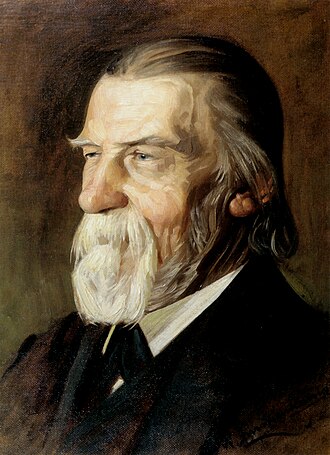
威廉·拉贝
- 生卒
- 1831 – 1910
- 国籍
- 不伦瑞克公国
- 外文名
- Wilhelm Raabe
照片:Wilhelm Immenkamp (1870–1931),公有领域,来自维基共享资源「Wilhelm Raabe.jpg」(经缩小)。
生平与创作
这个词条暂时没有中文维基百科条目,下面是英文维基百科的内容(英文原文):
Wilhelm Raabe (German pronunciation: [ˈvɪlhɛlm ˈʁaːbə] ; September 8, 1831 – November 15, 1910) was a German novelist. His early works were published under the pseudonym of Jakob Corvinus.
Biography
He was born in Eschershausen (then in the Duchy of Brunswick, now in the Holzminden District). After attending gymnasia in Holzminden and Wolfenbüttel, he entered a bookstore in Magdeburg as apprentice in 1849. He used this opportunity for wide reading and enriched himself with the tales and folklore of his own and other countries. He remained an apprentice until 1854.
Tiring of the routine of business, he then studied philosophy at Berlin (1855–1857). While a student at that university, under his pseudonym he published his first work, The Chronicle of Sparrow Lane (German: Die Chronik der Sperlingsgasse). This book, which contains sketches of life among the German bourgeoisie, quickly became popular.
With this encouragement, Raabe gave up his studies and devoted himself entirely to literary work. He returned to Wolfenbüttel, and then lived (1862–1870) in Stuttgart. Then he again returned to Brunswick and remained active until the end of the century, publishing upwards of 30 novels and a number of short stories and sketches. He died in 1910 and was buried in Braunschweig Main Cemetery.
Work
Raabe's life work may be divided into three periods. During the first, he wrote with a light touch, producing a series of pictures of German life from the abundance of his imagination and experience, among which are:
Die Chronik der Sperlingsgasse (1856)
Die Kinder von Finkenrode (1859)
Unser Herrgotts Kanzlei (1862)
The influence of the pessimism of Schopenhauer is evident during the second period. Representative works of this period are:
Der Hungerpastor (1864)
Abu Telfan (1867)
Der Schüdderump (1870)
These three works are sometimes referred to as a trilogy. While they are independent of each other in substance, they do represent a distinct epoch in the life of Raabe.
During the third period of the novelist's life his works no longer show this pessimistic strain. A genial humor pervades them, reminiscent of Dickens, though they frequently deal with serious subjects. Horacker (1876) perhaps best represents this tendency, and has been cited as his masterpiece. Der Dräumling (1872), and Deutscher Mondschein (1873), also come under this head. Of his numerous later works Das Odfeld (1889) and The Birdsong Papers (Die Akten des Vogelsangs, 1895) seemed to be most read. Kloster Lugau (1894) and Hastenbeck (1899) also belong to this period.
Raabe's early works were influenced to some extent by Jean Paul. Later he shows evidences of having read Dickens and Thackeray.
His estimation by the German people was especially shown at the celebration of his 70th birthday in 1901. Beginning in 1965, the critical edition of Raabe's complete works was published as Sämtliche Werke (Braunschweiger Ausgabe) commissioned by the Braunschweigischen Wissenschaftlichen Gesellschaft and edited by Karl Hoppe.
Raabe the painter
Raabe also had a less known talent for painting. Approximately 600 of his works exist, partially in private ownership of his descendants or with the Braunschweig Museum.
以上文字摘自英文维基百科「Wilhelm Raabe」(去掉了参考文献等尾部小节),按 CC BY-SA 4.0 使用,作者为维基百科的各位编者。
资料卡
- 母语名
- Wilhelm Raabe
- 本名
- Wilhelm Karl Raabe
- 笔名
- Jakob Corvinus
- 出生
- 1831 年 9 月 8 日
- 出生地
- 埃舍斯豪森
- 逝世
- 1910 年 11 月 15 日
- 逝世地
- 不伦瑞克
- 职业
- 作家、小说家、画家
- 使用语言
- 德语
- 写作语言
- 德语
- 领域
- 绘画
- 配偶
- Bertha Emilie Wilhelmine Leiste(1862)
- 获奖
- 巴伐利亚马克西米兰科学与艺术勋章(1899);另有 1 项只有外文名
资料卡来自 Wikidata Q60647(CC0),众包数据,个别字段可能不全。
本站收录的作品(1)
Open Library 上的全部作品
正在读取…