 书单
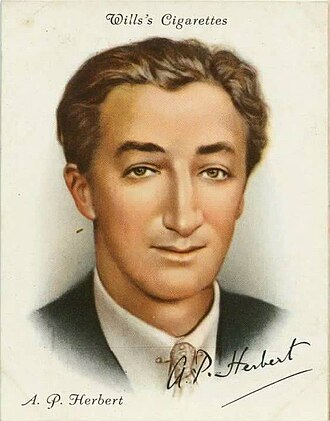
A. P. Herbert
- 生卒
- 1890 – 1971
- 国籍
- 英国
照片:作者不详,公有领域,来自维基共享资源「A. P. Herbert.jpg」(经缩小)。
生平与创作
这个词条暂时没有中文维基百科条目,下面是英文维基百科的内容(英文原文):
Sir Alan Patrick Herbert CH (known as A. P. Herbert; 24 September 1890 – 11 November 1971), was an English humorist, novelist, playwright, law reformist, and, from 1935 to 1950, an independent Member of Parliament for Oxford University.
Born in Ashtead, Surrey, he attended Winchester College and New College, Oxford, receiving a starred first in jurisprudence in 1914. He joined the Royal Naval Volunteer Reserve as a seaman in the First World War, becoming an officer in the Royal Naval Division. He fought in Gallipoli and on the Western Front, as a battalion adjutant in 1917, before injury removed him from the front line. After the war he published The Secret Battle and in 1924 joined the staff of Punch. As an MP he campaigned for private-member rights, piloted the Matrimonial Causes Act 1937 through Parliament, opposed Entertainments Duty and campaigned against the Oxford Group. He joined the River Emergency Service in 1938, captaining a boat on the River Thames in the Second World War as a petty officer in the Royal Naval Auxiliary Patrol. In 1943, he joined a parliamentary commission on the future of the Dominion of Newfoundland.
Early life and education
Herbert was born at Ashtead Lodge, Ashtead, Surrey, on 24 September 1890. His father, Patrick Herbert Coghlan Herbert (1849–1915), was a civil servant (assistant secretary of the Judicial and Public Department) in the India Office, of Irish origin, and his mother, Beatrice Eugenie (née Selwyn), was the daughter of Sir Charles Jasper Selwyn, a Lord Justice of Appeal. His two younger brothers both died in battle: Owen William Eugene, Second lieutenant, Royal Field Artillery, killed at Mons in 1914, and Sidney Jasper, Captain R.N., killed 1941 aboard HMS Hood. His mother died of tuberculosis when he was eight, shortly before he left for The Grange in Folkestone, a preparatory school.
Herbert then attended Winchester College, winning the King's Medal for English Verse and the King's Medal for English Speech, presented by Prime Minister H. H. Asquith. He took an active part in the college debating and Shakespeare societies. As a Winchester student, Herbert sent verses to the offices of Punch and received notes of encouragement and suggestions from the editor, Owen Seaman. Herbert was also Captain of Houses, one of the college's three football divisions.
Herbert went to New College, Oxford as an exhibitioner. He made his first public speech at the Kensington branch of the Tariff Reform League, speaking extempore on home rule. His first contribution to Punch was printed on 24 August 1910: a set of verses entitled "Stones of Venus". He went up to Oxford in October and made his first speech at the Oxford Union in November. His work began appearing not only in Punch, but in The Observer, the Pall Mall Gazette and Vanity Fair.
Herbert received a "not very good Second" in Honour Moderations, and apparently disenchanted with Classics, changed his degree to Law. He went into lodgings with Walter Monckton and others and was good friends with the notables Duff Cooper, Harold Macmillan and Philip Guedalla. Herbert finished at Oxford in 1914 with "a very good First" in Jurisprudence. He then decided to join his friend Jack Parr as a volunteer at Oxford House in Bethnal Green for a year. He spent the time "doing what I could:" washing dishes, sweeping floors, running errands and collecting money.
First World War service, 1914–1918
On 5 September 1914, Herbert enlisted at Lambeth Pier as an ordinary seaman in the Royal Naval Volunteer Reserve, which later became one of the constituent bodies of the Royal Naval Division. In early October, news reached him that his brother, Owen Herbert, had been posted "missing, believed killed" in the retreat from Mons. Herbert reached the rank of acting leading seaman before being commissioned as a sub-lieutenant in early 1915, when he was posted to Hawke Battalion of the Royal Naval Division (later to come under army command as part of the 63rd (Royal Naval) Division).
"C" and "D" companies of the Hawke Battalion left for Gallipoli in early 1915, briefly stopping in Malta before arriving at the Moudros on 17 May, and finally reaching Gallipoli on 27 May. Herbert took command of No. 11 Platoon, "C" Company, composed mostly of Tynesiders and also two men from a remote Durham mining town. A week after his arrival, the battalion suffered heavy casualties at the Third Battle of Krithia. In July 1915, Herbert went down with illness and had to spend time recovering in a military hospital. When he was passed "fit for light duty", he was seconded to the Naval Intelligence Division at Whitehall. It was then that he decided to rent No. 12 Hammersmith Terrace as a dwelling.
In summer 1916, when he was passed fit for duty, Herbert returned to Hawke Battalion at their base camp in Abbeville, where he was made assistant adjutant. The battalion moved to the front line at Souchez in July 1916, and in mid-November it took part in an attack on Beaucourt-sur-l'Ancre during the Battle of the Ancre, which saw almost the entire battalion wiped out. Herbert was one of only two officers to come out unscathed from the attack. When the battalion returned to the front line at Pozières in February 1917, Herbert was made the battalion's adjutant, but he was later injured from shrapnel during an attack on Gavrelle, west of Arras.
以上文字摘自英文维基百科「A. P. Herbert」(有删节,去掉了参考文献等尾部小节),按 CC BY-SA 4.0 使用,作者为维基百科的各位编者。
资料卡
- 母语名
- A. P. Herbert
- 出生
- 1890 年 9 月 24 日
- 出生地
- 阿什特德
- 逝世
- 1971 年 11 月 11 日
- 逝世地
- 伦敦
- 职业
- 政治人物、大律师、小说家、作家、剧作家、政治活动者、法学家
- 使用语言
- 英语
- 就读学校
- 温彻斯特学院、牛津大学新学院
- 领域
- 散文、戏剧、法律、行动主义
- 所属团体
- 内殿
- 配偶
- Gwendolyn Harriet Quilter(1915)
- 获奖
- 下级勋位爵士;另有 1 项只有外文名
资料卡来自 Wikidata Q4352362(CC0),众包数据,个别字段可能不全。
本站收录的作品(1)

作品年表(1 本)
本站书库里署名A. P. Herbert的书(Open Library 上至少 10 人加过书架的才收),按首版年份排(有本站书页的用 Wikidata 记的首版年,其余用 Open Library 的);年份偶尔记成后来的版本或译本,以原书为准。全部作品见 Open Library。
- 1935Uncommon law书架 20