 书单
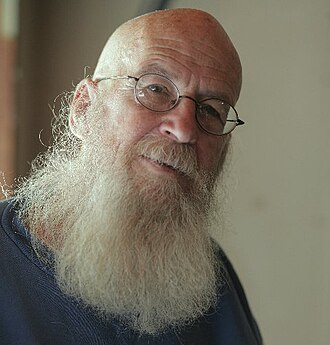
Nick Herbert
- 生卒
- 1936 –
- 国籍
- 美国
照片:Nick Herbert,CC BY 3.0,来自维基共享资源「Nick Herbert (physicist).jpeg」(经缩小)。
生平与创作
这个词条暂时没有中文维基百科条目,下面是英文维基百科的内容(英文原文):
Nick Herbert (born September 7, 1936) is an American physicist and author, best known for his book Quantum Reality.
Biography
Herbert studied engineering physics at The Ohio State University, graduating in 1959. He received a Ph.D. in physics from Stanford University in 1967 for work on nuclear scattering experiments. After a one-year teaching job at Monmouth College in Illinois, Herbert held a number of posts in industry. The most illustrious of these was senior physicist at Memorex Corporation in Santa Clara, California, where he developed new magnetic materials, as well as magnetic, electrostatic and optical measuring devices, and carried out theoretical work on Lorentz microscopy. He was also senior physicist at Smith-Corona Marchant Corporation in Palo Alto, California where he developed a new theory of xerographic process and worked on early developments in ink jet printing.
While employed in industry, Herbert was part of the Fundamental Fysiks Group at Lawrence Berkeley National Laboratory, founded in May 1975 by Elizabeth Rauscher and George Weissmann. The group's initial interest was in the interpretation of quantum mechanics, the EPR paradox, and Bell's inequality, and members also pursued diverse interests that lay outside of mainstream physics, exploring psychedelic drugs, psi phenomena, the nature of consciousness, and speculative connections of these areas with quantum physics. During the 1970s and 1980s, Herbert and Saul-Paul Sirag organized a yearly Esalen Seminar on the Nature of Reality, bringing together participants to discuss the interpretation of quantum mechanics. With Richard Shoup of Xerox PARC, Herbert constructed a "Metaphase Typewriter", a "quantum operated" device whose purpose was "to communicate with disembodied spirits". Despite many tests, including an attempt to contact the spirit of Harry Houdini on the hundredth anniversary of his birth, the group reported no success with the device.
Herbert supports a holistic interpretation of quantum physics. He has argued for "quantum animism" in which mind permeates the world at every level. Werner Krieglstein wrote regarding his quantum animism:
Herbert's quantum animism differs from traditional animism in that it avoids assuming a dualistic model of mind and matter. Traditional dualism assumes that some kind of spirit inhabits a body and makes it move, a ghost in the machine. Herbert's quantum animism presents the idea that every natural system has an inner life, a conscious center, from which it directs and observes its action.
In 1981, Herbert proposed FLASH, a scheme for sending signals faster than the speed of light using quantum entanglement. Of this proposal, quantum computing pioneer Asher Peres wrote, "I was the referee who approved the publication of Nick Herbert’s FLASH paper, knowing perfectly well that it was wrong. I explain why my decision was the correct one, and I briefly review the progress to which it led." Chief among the results that Peres claimed stemmed from a refutation of Herbert's proposal was the no-cloning theorem, proved by Wootters, Zurek, and Dieks.
Books
Quantum Reality: Beyond the New Physics. New York: Doubleday, 1985.
Faster Than Light: Superluminal Loopholes in Physics. New York: Dutton, 1988.
Elemental Mind: Human Consciousness & the New Physics. New York: Dutton, 1995.
Alice Zwischen Den Welten (with Bill Shanley). DVA, 1999.
以上文字摘自英文维基百科「Nick Herbert (physicist)」(去掉了参考文献等尾部小节),按 CC BY-SA 4.0 使用,作者为维基百科的各位编者。
资料卡
- 出生
- 1936 年 9 月 7 日
- 出生地
- 匹兹堡
- 职业
- 物理学家、教育学家、作家
- 使用语言
- 英语
- 就读学校
- 俄亥俄州立大学、斯坦福大学
资料卡来自 Wikidata Q1985414(CC0),众包数据,个别字段可能不全。
本站收录的作品(1)
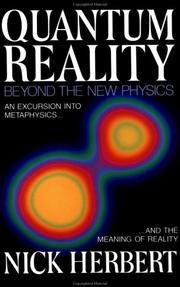
作品年表(1 本)
本站书库里署名Nick Herbert的书(Open Library 上至少 10 人加过书架的才收),按首版年份排(有本站书页的用 Wikidata 记的首版年,其余用 Open Library 的);年份偶尔记成后来的版本或译本,以原书为准。全部作品见 Open Library。
- 1985Quantum reality书架 15