 书单
Robertson Davies
- 生卒
- 1913 – 1995
- 国籍
- 加拿大
生平与创作
这个词条暂时没有中文维基百科条目,下面是英文维基百科的内容(英文原文):
William Robertson Davies (28 August 1913 – 2 December 1995) was a Canadian novelist, playwright, critic, journalist, and professor. He was one of Canada's best known and most popular authors and one of its most distinguished "men of letters", a term Davies gladly accepted for himself. Davies was the founding Master of Massey College, a graduate residential college associated with the University of Toronto.
Biography
Early life
Davies was born in Thamesville, Ontario, the third son of William Rupert Davies and Florence Sheppard McKay. Growing up, Robertson was surrounded by books and lively language. William was a newspaperman from Welshpool, Wales, and would one day become a member of the Canadian Senate (serving from 1942 to his death in 1967); both of Robertson Davies's parents were voracious readers. He followed in their footsteps and read everything he could. He also participated in theatrical productions as a child and developed a lifelong interest in drama.
He spent his formative years in Renfrew, Ontario (and renamed it as "Blairlogie" in his novel What's Bred in the Bone); many of the novel's characters are named after families he knew there. He attended Upper Canada College in Toronto from 1926 to 1932 and while there attended services at the Church of St. Mary Magdalene. He would later leave the Presbyterian Church and join Anglicanism over objections to Calvinist theology. Davies later used his experience of the ceremonial of High Mass at St. Mary Magdalene's in his novel The Cunning Man.
After Upper Canada College, Davies studied at Queen's University at Kingston, Ontario, from 1932 until 1935. According to the Queen's Journal, Davies enrolled as a special student not working towards a degree, because he was unable to pass the mathematics component of Queen's entrance exam. At Queen's, he wrote for the student paper, The Queen's Journal, where he wrote a literary column. Davies left Canada to study at Balliol College, Oxford, where he received a BLitt degree in 1938. The next year he published his thesis, Shakespeare's Boy Actors, and embarked on an acting career outside London. In 1940, he played small roles and did literary work for the director at the Old Vic Repertory Company in London. Also that year, Davies married Australian Brenda Mathews, whom he had met at Oxford, and who was then working as stage manager for the theatre. They spent their honeymoon in the Welsh countryside at Fronfraith Hall, Abermule, Montgomery, the family house owned by Rupert Davies.
Davies's early life provided him with themes and material to which he would often return in his later work; these include the theme of Canadians returning to England to finish their education, and the theatre.
Middle years
Davies and his new bride returned to Canada in 1940, where he took the position of literary editor at Saturday Night magazine. Two years later, he became editor of the Peterborough Examiner in the small city of Peterborough, Ontario, northeast of Toronto. Again he was able to mine his experiences here for many of the characters and situations which later appeared in his plays and novels.
Davies, along with family members William Rupert Davies and Arthur Davies, purchased several media outlets. Along with the Examiner newspaper, they owned the Kingston Whig-Standard newspaper, CHEX-AM, CKWS-AM, CHEX-TV, and CKWS-TV.
During his tenure as editor of the Examiner, which lasted from 1942 to 1955 (he subsequently served as publisher from 1955 to 1965), Davies published a total of 18 books, produced several of his own plays, and wrote articles for various journals. Davies set out his theory of acting in his Shakespeare for Young Players (1947), and then put theory into practice when he wrote Eros at Breakfast, a one-act play which was named best Canadian play of the year by the 1948 Dominion Drama Festival.
Eros at Breakfast was followed by Fortune, My Foe in 1949 and At My Heart's Core, a three-act play, in 1950. Meanwhile, Davies was writing humorous essays in the Examiner under the pseudonym Samuel Marchbanks. Some of these were collected and published in The Diary of Samuel Marchbanks (1947), The Table Talk of Samuel Marchbanks (1949), and later in Samuel Marchbanks' Almanack (1967). An omnibus edition of the three Marchbanks books, with new notes by the author, was published under the title The Papers of Samuel Marchbanks in 1985.
During the 1950s, Davies played a major role in launching the Stratford Shakespearean Festival of Canada. He served on the Festival's board of governors, and collaborated with the Festival's director, Sir Tyrone Guthrie, in publishing three books about the Festival's early years.
Although his first love was drama and he had achieved some success with his occasional humorous essays, Davies found his greatest success in fiction. His first three novels, which later became known as The Salterton Trilogy, were Tempest-Tost (1951, originally conceived as a play), Leaven of Malice (1954, also the basis of the unsuccessful play Love and Libel) which won the Stephen Leacock Award for Humour, and A Mixture of Frailties (1958). These novels explored the difficulty of sustaining a cultural life in Canada, and life on a small-town newspaper, subjects of which Davies had first-hand knowledge. In a 1958 essay on Nabokov's Lolita in Saturday Night, he wrote that the theme was "the exploitation of a weak adult by a corrupt child".
1960s
In 1960, Davies joined Trinity College at the University of Toronto, where he would teach literature until 1981. The following year he published a collection of essays on literature, A Voice From the Attic, and was awarded the Lorne Pierce Medal for his literary achievements.
In 1963, he became the Master of Massey College, the University of Toronto's new graduate college. During his stint as Master, he initiated a tradition of writing and telling ghost stories at the yearly Christmas celebrations. These stories were later collected in the book High Spirits (1982).
以上文字摘自英文维基百科「Robertson Davies」(有删节,去掉了参考文献等尾部小节),按 CC BY-SA 4.0 使用,作者为维基百科的各位编者。
资料卡
- 出生
- 1913 年 8 月 28 日
- 出生地
- Thamesville
- 逝世
- 1995 年 12 月 2 日
- 逝世地
- 奥兰治维尔
- 职业
- 作家、小说家、记者、剧作家、教授、音乐学家、新闻工作者、文学评论家 等 9 项
- 使用语言
- 英语
- 写作语言
- 英语
- 就读学校
- 贝利奥尔学院、上加拿大书院(1926)、皇后大学(1932)、京士顿书院
- 领域
- 小说文学、theatre
- 所属团体
- 加拿大皇家学会、皇家文学学会
- 配偶
- Brenda Davies
- 代表作
- The Deptford Trilogy
- 获奖
- 莫里森奖(1988)、加拿大勋章同伴、加拿大总督文学奖·英语小说(1972)、安大略勋章、加拿大皇家学会院士、皇家文学学会会员、honorary doctor of the University of Manitoba、Lorne Pierce Medal(1961)、Stephen Leacock Memorial Medal for Humour(1950)、Toronto Book Awards(1982)、World Fantasy Award for Best Collection(1984)
资料卡来自 Wikidata Q545375(CC0),众包数据,个别字段可能不全。
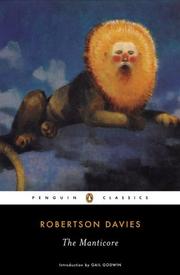
本站收录的作品(1)
同时代的加拿大作家
Open Library 上的全部作品
正在读取…