 书单
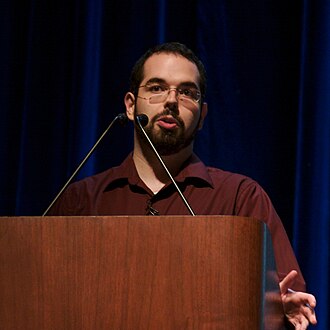
艾列泽·尤考斯基
- 生卒
- 1979 –
- 国籍
- 美国
- 外文名
- Eliezer Yudkowsky
照片:"null0",CC BY-SA 2.0,来自维基共享资源「Eliezer Yudkowsky, Stanford 2006 (square crop).jpg」(经缩小)。
生平与创作
这个词条暂时没有中文维基百科条目,下面是英文维基百科的内容(英文原文):
Eliezer Shlomo Yudkowsky ( EL-ee-EH-zər yuud-KOW-skee; born September 11, 1979) is an American artificial intelligence researcher and writer on decision theory and ethics, known for popularizing ideas related to friendly artificial intelligence. He is the founder of and a research fellow at the Machine Intelligence Research Institute (MIRI), a private research nonprofit based in Berkeley, California.
His work on the prospect of a runaway intelligence explosion influenced philosopher Nick Bostrom's 2014 book Superintelligence: Paths, Dangers, Strategies. His books include If Anyone Builds It, Everyone Dies: Why Superhuman AI Would Kill Us All, a New York Times bestseller he co-authored with Nate Soares, as well as the Harry Potter fanfiction Harry Potter and the Methods of Rationality.
Work in artificial intelligence safety
Goal learning and incentives in software systems
Yudkowsky's views on the safety challenges future generations of AI systems pose are discussed in Stuart Russell's and Peter Norvig's undergraduate textbook Artificial Intelligence: A Modern Approach. Noting the difficulty of formally specifying general-purpose goals by hand, Russell and Norvig cite Yudkowsky's proposal that autonomous and adaptive systems be designed to learn correct behavior over time:
Yudkowsky (2008) goes into more detail about how to design a Friendly AI. He asserts that friendliness (a desire not to harm humans) should be designed in from the start, but that the designers should recognize both that their own designs may be flawed, and that the robot will learn and evolve over time. Thus the challenge is one of mechanism design—to design a mechanism for evolving AI under a system of checks and balances, and to give the systems utility functions that will remain friendly in the face of such changes.
In response to the instrumental convergence concern, which implies that autonomous decision-making systems with poorly designed goals would have default incentives to mistreat humans, Yudkowsky and other MIRI researchers have recommended that work be done to specify software agents that converge on safe default behaviors even when their goals are misspecified. Yudkowsky also proposed in 2004 a theoretical AI alignment framework called coherent extrapolated volition, which involves designing AIs to pursue what people would desire under ideal epistemic and moral conditions.
Capabilities forecasting
In the intelligence explosion scenario hypothesized by I. J. Good, recursively self-improving AI systems quickly transition from subhuman general intelligence to superintelligence. Nick Bostrom's 2014 book Superintelligence: Paths, Dangers, Strategies sketches out Good's argument in detail, while citing Yudkowsky on the risk that anthropomorphizing advanced AI systems will cause people to misunderstand the nature of an intelligence explosion. "AI might make an apparently sharp jump in intelligence purely as the result of anthropomorphism, the human tendency to think of 'village idiot' and 'Einstein' as the extreme ends of the intelligence scale, instead of nearly indistinguishable points on the scale of minds-in-general."
In Artificial Intelligence: A Modern Approach, Russell and Norvig raise the objection that there are known limits to intelligent problem-solving from computational complexity theory; if there are strong limits on how efficiently algorithms can solve various tasks, an intelligence explosion may not be possible.
Time op-ed
In a 2023 op-ed for Time magazine, Yudkowsky discussed the risks of artificial intelligence and advocated for international agreements to limit it, including an indefinite worldwide moratorium on large AI training runs. He suggested that participating countries should be willing to take military action, such as "destroy[ing] a rogue datacenter by airstrike", to enforce such a moratorium. The article helped introduce the debate about AI alignment to the mainstream, leading a reporter to ask President Joe Biden a question about AI safety at a press briefing.
If Anyone Builds It, Everyone Dies
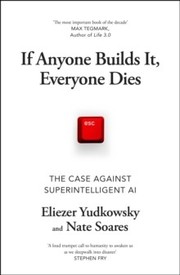
Together with Nate Soares, Yudkowsky wrote If Anyone Builds It, Everyone Dies, which was published by Little, Brown and Company on September 16, 2025.
Rationality writing
Between 2006 and 2009, Yudkowsky and Robin Hanson were the principal contributors to Overcoming Bias, a cognitive and social science blog sponsored by the Future of Humanity Institute of Oxford University. In February 2009, Yudkowsky founded LessWrong, a "community blog devoted to refining the art of human rationality". Overcoming Bias has since functioned as Hanson's personal blog, while LessWrong has grown into the main online hub for the rationalist community.
Over 300 blog posts by Yudkowsky on philosophy and science (originally written on LessWrong and Overcoming Bias) were released as an ebook, Rationality: From AI to Zombies, by MIRI in 2015. This book is also referred to as "The Sequences". MIRI has also published Inadequate Equilibria, Yudkowsky's 2017 ebook on societal inefficiencies.
Yudkowsky has also written several works of fiction. His fanfiction novel Harry Potter and the Methods of Rationality uses plot elements from J. K. Rowling's Harry Potter series to illustrate topics in science and rationality.
Personal life
Yudkowsky is an autodidact. He dropped out of middle school due to chronic health issues, and did not attend high school or college. He is Jewish and was raised Modern Orthodox, but is now secular.
Published works
Books
Yudkowsky, Eliezer (2018). Map and Territory. Rationality: From AI to Zombies. Vol. 1. Machine Intelligence Research Institute. ISBN 9781939311238.
Yudkowsky, Eliezer (2018). How to Actually Change Your Mind. Rationality: From AI to Zombies. Vol. 2. Machine Intelligence Research Institute. ISBN 9781939311290.
Yudkowsky, Eliezer; Soares, Nate (2025). If Anyone Builds It, Everyone Dies: why superhuman AI would kill us all. New York: Little, Brown and Company. ISBN 978-0-316-59564-3.
Selected publications
Yudkowsky, Eliezer (2007). "Levels of Organization in General Intelligence" (PDF). Artificial General Intelligence. Berlin: Springer. doi:10.1007/978-3-540-68677-4_12
以上文字摘自英文维基百科「Eliezer Yudkowsky」(有删节,去掉了参考文献等尾部小节),按 CC BY-SA 4.0 使用,作者为维基百科的各位编者。
资料卡
- 母语名
- Eliezer Yudkowsky
- 本名
- Eliezer Shlomo Yudkowsky
- 出生
- 1979 年 9 月 11 日
- 出生地
- 芝加哥
- 职业
- 人工智能研究者、博主、作家、计算机科学家
- 使用语言
- 英语
- 文学运动 / 流派
- 有效利他主义
- 领域
- 人工智能、友好的人工智能、做决策、超人类主义、信息学
- 受谁影响
- 埃德温·汤普森·杰尼斯、朱迪亚·珀尔
- 代表作
- Less Wrong、Harry Potter and the Methods of Rationality
资料卡来自 Wikidata Q704195(CC0),众包数据,个别字段可能不全。
本站收录的作品(1)
作品年表(3 本)
本站书库里署名艾列泽·尤考斯基的书(Open Library 上至少 10 人加过书架的才收),按首版年份排(有本站书页的用 Wikidata 记的首版年,其余用 Open Library 的);年份偶尔记成后来的版本或译本,以原书为准。全部作品见 Open Library。
- 2015Harry Potter and the Methods of Rationality书架 87
- 2015Rationality书架 23
- 2025If Anyone Builds It, Everyone Dies书架 16