 书单
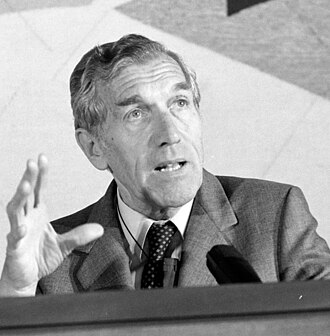
保罗·瓦兹拉威克
- 生卒
- 1921 – 2007
- 国籍
- 奥地利、美国
- 外文名
- Paul Watzlawick
照片:见原图页面,CC BY-SA 4.0,来自维基共享资源「Paul Watzlawick am ISC-Symposium 1988 HSGH 022-000762 (cropped).jpg」(经缩小)。
生平与创作
保罗·瓦兹拉威克(德语:Paul Watzlawick,1921年7月25日—2007年3月31日)是一位出生于奥地利的美籍家庭治疗师、心理学家、传播理论学家与哲学家,是传播理论的领军人物。在家庭治疗和一般心理治疗上也有很高的成就。
以上文字摘自维基百科「保罗·瓦兹拉威克」(去掉了参考文献等尾部小节),按 CC BY-SA 4.0 使用,作者为维基百科的各位编者。
中文维基百科的条目比较短,下面附上英文维基百科的内容(英文原文):
Paul Watzlawick (July 25, 1921 – March 31, 2007) was an Austrian-American family therapist, psychologist, communication theorist, and philosopher. A theoretician in communication theory and radical constructivism, he commented in the fields of family therapy and general psychotherapy. Watzlawick believed that people create their own suffering in the very act of trying to fix their emotional problems. He was one of the most influential figures at the Mental Research Institute and lived and worked in Palo Alto, California.
Early life and education
Paul Watzlawick was born in Villach, Austria in 1921, the son of a bank director. After he graduated from high school in 1939, Watzlawick studied philosophy and philology at the Università Ca' Foscari Venice and he earned a PhD in 1949. He then studied at the Carl Jung Institute in Zürich, where he received a degree in analytical psychology in 1954. In 1957 he continued his research career at the University of El Salvador.
Career
In 1960, Donald deAvila Jackson arranged for him to go to Palo Alto to do research at the Mental Research Institute (MRI). Starting in 1967 he taught psychiatry at Stanford University.
At the Mental Research Institute Watzlawick followed in the footsteps of Gregory Bateson and the research team (Jackson, John Weakland, Jay Haley) responsible for introducing what became known as the "double bind" theory of schizophrenia. Double bind can be defined as a person trapped under mutually-exclusive expectations. Watzlawick's 1967 work based on Bateson's thinking, Pragmatics of Human Communication, with Don Jackson and Janet Beavin, became a cornerstone work of communication theory. Other scientific contributions include works on radical constructivism and most importantly his theory on communication. He was active in the field of family therapy.
Watzlawick was one of the three founding members of the Brief Therapy Center at MRI. In 1974, members of the Center published a major work on their brief approach, Change, Principles of Problem Formation and Problem Resolution (Watzlawick, Weakland, Fisch).
He was licensed as a psychologist in California from 1969 to 1998, when he stopped seeing patients.
Personal life
Watzlawick was married (Vera) and had two stepdaughters (Joanne and Evonne). A cardiac arrest at his home in Palo Alto caused his death at the age of 85.
Work
Interactional view
Watzlawick did extensive research on how communication is effected within families. Watzlawick defines five basic axioms in his theory on communication, popularly known as the "Interactional View". The Interactional View is an interpretive theory drawing from the cybernetic tradition. Watzlawick considered five axioms as a prerequisite for functioning communication process and competence between two individuals or an entire family. According to him, miscommunication happens because not all of the communicators are "speaking the same language". This happens because people have different viewpoints of speaking. With an underlying cybernetic structure, Watzlawick considered causality of a circular, feedback nature, with information as a core element. it is concerned with the processes of communication within systems of the widest sense and therefore also with human systems, e.g., families, large organizations and international relations.
Within the "Interactional View" communication is based on what is happening, and not necessarily associated with who, when, where, or why it takes place. He studied "Normal" as well as the "disturbed" family in order to infer conditions conducive to the approach of interaction-orientation. He believed that individual personality, character, and deviance are shaped by the individual's relations with his fellows. He saw symptoms, defenses, character structure and personality as terms describing the individual's typical interactions, which occur in response to a particular interpersonal context.
以上文字摘自英文维基百科「Paul Watzlawick」(有删节,去掉了参考文献等尾部小节),按 CC BY-SA 4.0 使用,作者为维基百科的各位编者。
资料卡
- 母语名
- Paul Watzlawick
- 出生
- 1921 年 7 月 25 日
- 出生地
- 菲拉赫
- 逝世
- 2007 年 3 月 31 日
- 逝世地
- 帕洛阿尔托
- 职业
- 哲学家、心理治疗师、大学教师、非虚构文学作家、传播学者、作家
- 使用语言
- 英语、德语、意大利语、俄语
- 就读学校
- 威尼斯大学
- 领域
- 心理治疗
资料卡来自 Wikidata Q93781(CC0),众包数据,个别字段可能不全。
本站收录的作品(1)

作品年表(8 本)
本站书库里署名保罗·瓦兹拉威克的书(Open Library 上至少 10 人加过书架的才收),按首版年份排(有本站书页的用 Wikidata 记的首版年,其余用 Open Library 的);年份偶尔记成后来的版本或译本,以原书为准。全部作品见 Open Library。
- 1967Pragmatics of human communication书架 64
- 1974Change; principles of problem formation and problem resolution书架 16
- 1976How real is real?书架 50
- 1983The situation is hopeless, but not serious书架 36
- 1983Anleitung zum Unglücklichsein书架 19
- 1984Erfundene Wirklichkeit - The Invented Reality书架 20
- 1988Ultra-solutions, or, How to fail most successfully书架 13
- 1993The Situation Is Hopeless, but Not Serious (The Pursuit of Unhappiness)书架 27