 书单
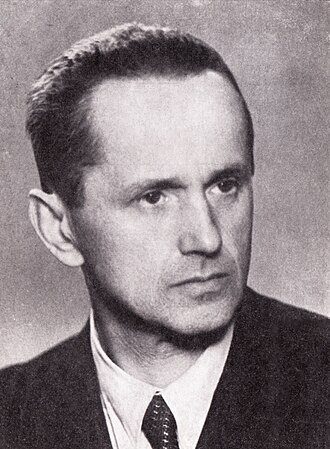
卡齐米日·莫察斯基
- 生卒
- 1907 – 1975
- 国籍
- 波兰
- 外文名
- Kazimierz Moczarski
照片:作者不详,公有领域,来自维基共享资源「K moczarski.jpg」(经缩小)。
生平与创作
这个词条暂时没有中文维基百科条目,下面是英文维基百科的内容(英文原文):
Kazimierz Damazy Moczarski (21 July 1907 – 27 September 1975) was a Polish writer and journalist, an officer of the Polish Home Army (noms de guerre: Borsuk, Grawer, Maurycy, and Rafał; active in anti-Nazi resistance). His book Conversations with an Executioner, recounted a series of interviews with Nazi war criminal Jürgen Stroop, a fellow inmate of the UB secret police prison under Stalinism, who was soon to be executed. Thrown in jail in 1945 and pardoned eleven years later during Polish October, Moczarski spent four years on death row (1952–56), and was tried three times as an enemy of the state while in prison.
Biography
Born on 21 July 1907 in Warsaw, Moczarski was the son of Jan Damazy, teacher and school principal, and Michalina Franciszka née Wodzinowska, also a teacher. Kazimierz began studying law at Warsaw University in October 1926. During his studies, he was drafted to Reserve Infantry Battalion No.9 and served at Bereza Kartuska in 1929–1930 for 10 months. Following his graduation in December 1932, he continued his studies in France at the Institute of Higher International Studies of Paris University. In 1935, he returned to Warsaw and became an advisor to the Ministry of Labor and Social Services, specializing in Polish and international law. He was also a member of the "Youth Legion", and a member of the progressive organization "Labor Club Maurycy Mochnacki". In 1937, he took part in the setting-up of the Democratic Club of Warsaw. Their first meeting took place at his own Warsaw apartment.
World War II
During the 1939 Polish-German September campaign, Moczarski commanded a platoon subordinate to the 30th Infantry Division. He saw combat during the Siege of Warsaw. After the Fall of Poland, Moczarski remained an active member of the clandestine Democratic Alliance. He also joined the Polish Resistance and became an officer in the Polish Home Army (Armia Krajowa, AK) under the nom de guerre of "Rafał". Until the fall of 1943, he was assigned to the "Bureau of Intelligence and Propaganda" (BiP) for the AK's Warsaw District.
In May 1944, under the new pseudonym "Maurycy", Moczarski took the post of the Head of Department of Personnel Sabotage. His assignment, at which he excelled, was to assassinate members of the Gestapo, collaborationists, and Gestapo informers in the AK's ranks. It was his idea to rescue, on 11 June 1944, Polish prisoners incarcerated by the Gestapo at Warsaw's Jan Boży Hospital (pl).
Shortly before the Warsaw Uprising by the underground resistance, Moczarski was given a new post as the head of the radio and telegraph services of Home Army's headquarters. During the uprising, Moczarski was directing one of the insurgent's radio stations, "Rafał" located in Warsaw's district Śródmieście-Północ. In September 1944, he moved to another station, "Danuta" located at 16 Widok street. At the same time, he was editor-in-chief of Wiadomości Powstańcze (Uprising News), which was a daily regional addition to the Home Army's Biuletyn Informacyjny (Information Bulletin). On 14 September 1944 he was promoted to the post of reserve Lieutenant.
After the collapse of the Warsaw Uprising on 7 October 1944 he left the city with a group of coworkers from BiP along with the evacuees of the Red Cross, and stopped in Pruszków, but returned shortly afterwards, to help with the escape of Jan Stanisław Jankowski, the delegate of Polish Government in exile. He was appointed head of the Home Army's Information and Propaganda office BiP on 26 October 1944. Destroyed during the uprising, the office was reinstated in Częstochowa. Moczarski continued his underground activities there, changing his nickname to "Grawer" (Engraver).
Postwar
The Polish Home Army (AK) was disbanded by High Command on 19 January 1945 as peace in Poland took hold. Moczarski was promoted to captain of the reserve team. Meanwhile, in place of the AK a new organization was formed by General Anders against the communist takeover, called the Armed Forces Delegation for Poland (Delegatura Sił Zbrojnych na Kraj, DSZ). Moczarski remained the head of BiP, using a new pseudonym "Borsuk" (Badger). Together with Włodzimierz Lechowicz and Zygmunt Kapitaniak, he co-authored a memorandum to his headquarters which stipulated that a new order must be made out to all underground soldiers in the field about laying down arms in the name of reconstruction. Their proposal was accepted and on 24 July 1945 an order was issued by the Head of DSZ, Colonel Jan Rzepecki, entitled "To former soldiers of Home Army" which stated:
Imprisonment
On 11 August 1945, five days after the Delegation for Poland officially dissolved, Moczarski was arrested by Ministry of State Security headed by Gen. Romkowski and put on political trial. On 18 January 1946 Moczarski was sentenced to 10 years in prison by a military court in Warsaw. Even though his penitentiary sentence was shortened to five years in February 1947, he was not released from Mokotów Prison upon his sentence's fulfilment four years later. The darkest years of Stalinism in Poland were yet to come. Interrogated by Romkowski's subordinates from 9 January 1949 till 6 June 1951, Moczarski endured 49 different types of torture later described in his memoir. Beatings included truncheon blows to bridge of nose, salivary glands, chin, shoulder blades, bare feet and toes (particularly painful), heels (ten blows each foot, several times a day), cigarette burns on lips and eyelids and burning of fingers. Sleep deprivation, resulting in near-madness – meant standing upright in a narrow cell for seven to nine days with frequent blows to the face – a hallucinatory method called by the interrogators "Zakopane". General Romkowski had already told him on 30 November 1948 that he had personally requested this "sheer hell".
以上文字摘自英文维基百科「Kazimierz Moczarski」(有删节,去掉了参考文献等尾部小节),按 CC BY-SA 4.0 使用,作者为维基百科的各位编者。
资料卡
- 母语名
- Kazimierz Moczarski
- 本名
- Kazimierz Damazy Moczarski
- 笔名
- Borsuk, Grawer, Morski, Maurycy, Rafał
- 出生
- 1907 年 7 月 21 日
- 出生地
- 华沙
- 逝世
- 1975 年 9 月 27 日
- 逝世地
- 华沙
- 职业
- 新闻工作者、自传作者、作家、抵抗运动成员、传记作家、法学家
- 使用语言
- 波兰语
- 就读学校
- 华沙大学法学院
- 代表作
- 与刽子手的对话
- 获奖
- 英勇十字勋章 (波兰);另有 4 项只有外文名
资料卡来自 Wikidata Q122775(CC0),众包数据,个别字段可能不全。
本站收录的作品(1)
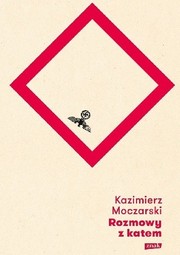
作品年表(1 本)
本站书库里署名卡齐米日·莫察斯基的书(Open Library 上至少 10 人加过书架的才收),按首版年份排(有本站书页的用 Wikidata 记的首版年,其余用 Open Library 的);年份偶尔记成后来的版本或译本,以原书为准。全部作品见 Open Library。
- 1978与刽子手的对话Rozmowy z katem书架 46