 书单
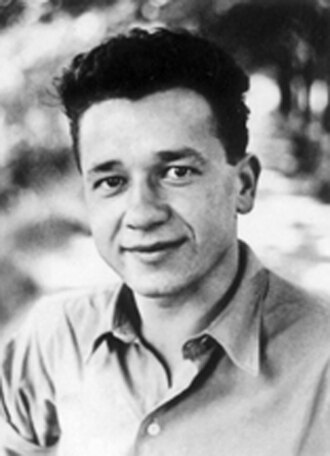
塔德乌什·博罗夫斯基
- 生卒
- 1922 – 1951
- 国籍
- 波兰
- 外文名
- Tadeusz Borowski
照片:作者不详,公有领域,来自维基共享资源「Tadeusz Borowski.jpg」(经缩小)。
生平与创作
这个词条暂时没有中文维基百科条目,下面是英文维基百科的内容(英文原文):
Tadeusz Borowski (Polish pronunciation: [taˈdɛ.uʐ bɔˈrɔfskʲi]; 12 November 1922 – 3 July 1951) was a Polish writer and journalist. His wartime poetry and stories dealing with his experiences as a prisoner at Auschwitz are recognized as classics of Polish literature.
Early life
Borowski was born in 1922 into the Polish community in Zhytomyr, Ukrainian SSR (today Ukraine). In 1926, his father, whose bookstore had been nationalized by the communists, was sent to a camp in the Gulag system in Russian Karelia because he had been a member of a Polish military organization during World War I. In 1930, Borowski's mother was deported to a settlement on the shores of the Yenisey, in Siberia, during Collectivization. During this time Tadeusz lived with his aunt.
Borowski and his family were targeted (as Poles) by the Soviet Union during Stalin's Great Terror. In 1932, the Borowskis were expatriated to Poland by the Polish Red Cross in an exchange for Communist prisoners. Impoverished, the family settled in Warsaw.
Experiences under Nazi occupation
Under Nazi occupation, Poles were forbidden to attend university or even secondary school. In 1940 Borowski finished his secondary schooling in Nazi-occupied Poland in an underground lyceum. He graduated from high school in 1940 amid the roundups of Jewish residents. He began his underground studies in Polish literature at Warsaw University. His classes met in secret at private homes. While attending university he met Maria Rundo, who would become the love of his life.
He also became involved with the leftist publication Droga. Wherever the Earth (1942), his anonymously self-published collection of poems, was distributed illegally. The poems have been described by modern scholars as "remarkable for their dark view of the earth as an enormous labor camp".
While a member of the educational underground in Warsaw, Borowski was engaged and living with Rundo. After Maria did not return home one night in February 1943, Borowski began to suspect that she had been arrested. Rather than staying away from any of their usual meeting places, though, he walked straight into the trap that was set by the Gestapo agents in the apartment of his and Maria's close friend. Borowski was 21 years old when he was imprisoned in Pawiak prison for two months before he was shipped to Auschwitz that April.
Forced into slave labor in extremely harsh conditions, Borowski later reflected on this experience in his writing. In particular, working on a railway ramp in Auschwitz-Birkenau, he witnessed arriving Jews being told to leave their personal property behind, and then being transferred directly from the trains to the gas chambers. While a prisoner at Auschwitz, Borowski caught pneumonia; afterwards, he was put to work in a Nazi medical experiment "hospital." He was able to maintain written and personal contact with his fiancée, who was also imprisoned in Auschwitz.
In late 1944 Borowski was transported from Auschwitz to the Dautmergen subcamp of Natzweiler-Struthof, and finally to Dachau. Dachau-Allach, where Borowski was imprisoned, was liberated by the Americans on 1 May 1945; after that Borowski found himself in a camp for displaced persons near Munich.
After the war
He spent some time in Paris, and then returned to Poland on 31 May 1946. His fiancée, who had survived the camps and emigrated to Sweden, returned to Poland in late 1946, and they were married in December 1946.
Borowski turned to prose after the war, believing that what he had to say could no longer be expressed in verse. His series of short stories about life in Auschwitz was published as Pożegnanie z Marią (Farewell to Maria, English title This Way for the Gas, Ladies and Gentlemen). The main stories are written in the first person from the perspective of an Auschwitz inmate; they describe the morally numbing effect of everyday terror, with prisoners, trying to survive, often being indifferent or mean towards each other; the privileges of non-Jewish inmates like Borowski; and the absence of any heroism. Early on after its publication in Poland, the work was accused of being nihilistic, amoral and decadent. His short story cycle World of Stone describes his time in displaced person camps in Germany.
Borowski's short story Silence was written in the aftermath of the liberation of Dachau. The story is set in the newly liberated concentration camp and opens with imagery depicting a disgraced SS officer being dragged into an alley by a mob of prisoners who try to tear him apart with their bare hands. They return to the barracks and the scene is one of communal food preparation, prisoners noisily grinding grain, slicing meat, mixing pancake batter and peeling potatoes in the narrow paths that wind between their bunk beds. They are playing cards and drinking hot soup when an American officer arrives. While expressing sympathy for the prisoners seeking vengeance against their captors, he urges restraint, and promises punishment under law. Some prisoners begin to debate whether to kill the American officer, but the crowd begins to applaud the officer's promise of justice. When the American officer leaves the camp the prisoners return to the SS officer from the opening scene and trample him to death.
The Polish government considered the story "amoral" but Borowski found work as a journalist. He joined the Soviet-controlled Polish Workers' Party in 1948 and wrote political tracts as well. At first he believed that Communism was the only political force truly capable of preventing any future Auschwitz from happening. In 1950 he received the National Literary Prize, Second Degree.
In the summer of 1949 he was sent to work in the Press Section of the Polish Military Mission in Berlin. He returned to Warsaw a year later and entered into an extramarital affair.
以上文字摘自英文维基百科「Tadeusz Borowski」(有删节,去掉了参考文献等尾部小节),按 CC BY-SA 4.0 使用,作者为维基百科的各位编者。
资料卡
- 母语名
- Tadeusz Borowski
- 本名
- Tadeusz Borowski
- 出生
- 1922 年 11 月 12 日
- 出生地
- 日托米尔
- 逝世
- 1951 年 7 月 3 日
- 逝世地
- 华沙
- 职业
- 诗人、作家、舆论记者
- 使用语言
- 波兰语
- 写作语言
- 波兰语
- 就读学校
- 华沙大学
- 配偶
- Maria Borowska-Bayer
- 代表作
- Pożegnanie z Marią、Kamienny świat
资料卡来自 Wikidata Q100005(CC0),众包数据,个别字段可能不全。
本站收录的作品(1)
作品年表(1 本)
本站书库里署名塔德乌什·博罗夫斯基的书(Open Library 上至少 10 人加过书架的才收),按首版年份排(有本站书页的用 Wikidata 记的首版年,其余用 Open Library 的);年份偶尔记成后来的版本或译本,以原书为准。全部作品见 Open Library。
- 1947Short stories书架 71