 书单
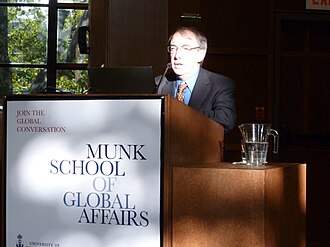
Larry M. Bartels
- 生卒
- 1956 –
- 国籍
- 美国
照片:US Mission Canada,CC BY 2.0,来自维基共享资源「Larry M. Bartels speaking at the Munk School at U of T -b.jpg」(经缩小)。
生平与创作
这个词条暂时没有中文维基百科条目,下面是英文维基百科的内容(英文原文):
Larry Martin Bartels (born December 16, 1956) is an American political scientist and the Co-Director of the Center for the Study of Democratic Institutions and Shayne Chair in Public Policy and Social Science at Vanderbilt University. Prior to his appointment at Vanderbilt, Bartels served as the Donald E. Stokes Professor of Public Policy and International Relations and founding director of the Center for the Study of Democratic Politics at the Woodrow Wilson School of Public and International Affairs at Princeton University. He was elected a Member of the American Philosophical Society in 2019.
Biography
Bartels received his B.A. in political science with distinction from Yale College in 1978, his M.A. in political science, also from Yale, in 1978, and his Ph.D. in political science from the University of California, Berkeley in 1983. He was elected a Fellow of the American Academy of Arts and Sciences in 1995. He has published three books, Unequal Democracy: The Political Economy of The New Gilded Age (Princeton, 2008), Campaign Reform: Insights and Evidence, edited with Lynn Vavreck (University of Michigan Press, 2000), and Presidential Primaries and The Dynamics of Public Choice (Princeton, 1988).
His rebuttal to Thomas Frank's What's the Matter with Kansas?, entitled What's the matter with What's the matter with Kansas was published in the Quarterly Journal of Political Science in 2006. While Frank asserts that the conservative Republican Party has been able to lure working class voters away from the liberal Democratic Party, which better represents their economic interests, with value issues, such as abortion and same-sex marriage, Bartels points out that the working class, despite being socially more conservative, is still overwhelmingly Democratic, more so than in the past.
In his empirical analysis, Bartels finds that both college graduates and working-class people are mostly Democratic, the former having become more Democratic over the past years. He attributes the gain made by Republicans to the loss of the Solid South, with middle and high income whites from Southern states standing out as having become more Republican.
In his 2008 book, Unequal Democracy: The political economy of the new gilded age, Bartels demonstrates that income inequality expanded under Republican presidential administrations and narrowed under Democratic presidential administrations since the early 1970s, when income inequality first started to expand. Under Republican presidents, rich families saw substantial net gains in their income, while poorer families saw negligible gains, producing a significant net increase in income inequality. By contrast, under Democratic presidents, poor families did slightly better than rich families proportionally, lessening income inequality.
However, all income brackets, from the bottom 20% to the top 5% of the population, saw significantly greater increases in income under Democratic presidents than under Republican presidents. In other words, had Democratic presidents been in office since the 1970s, income inequality may have lessened since the 1950s instead of growing into what Bartels calls "The New Gilded Age" of the early 21st century. Bartels's findings led him to conclude that "economic inequality is, in substantial part, a political phenomenon."
Recognition
In January 2025, President Biden awarded Bartels the National Medal of Science.
以上文字摘自英文维基百科「Larry Bartels」(去掉了参考文献等尾部小节),按 CC BY-SA 4.0 使用,作者为维基百科的各位编者。
资料卡
- 出生
- 1956 年 5 月 16 日
- 职业
- 政治学家、大学教师、学者
- 使用语言
- 英语
- 就读学校
- 耶鲁学院、加州大学伯克利分校
- 所属团体
- 美国文理科学院、政治与社会科学院、美国国家选举研究、美国政治科学协会
- 获奖
- 古根海姆学者奖、美国文理科学院院士、美国国家科学奖章(2025);另有 2 项只有外文名
资料卡来自 Wikidata Q6489917(CC0),众包数据,个别字段可能不全。
同时代的美国作家
Open Library 上的全部作品
正在读取…