 书单
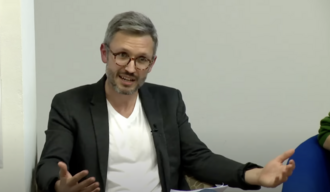
Jason Hickel
- 生卒
- 1982 –
- 国籍
- 美国
照片:AnaGuterres,CC BY-SA 4.0,来自维基共享资源「Hickel at Oxford.png」(经缩小)。
生平与创作
这个词条暂时没有中文维基百科条目,下面是英文维基百科的内容(英文原文):
Jason Edward Hickel (born 1982) is a Swazi economic anthropologist, academic and democratic eco-socialist. He is a professor at the Institute of Environmental Science & Technology (ICTA-UAB) at the Autonomous University of Barcelona, a Fellow of the Royal Society of Arts, a visiting senior fellow at the International Inequalities Institute at the London School of Economics, and was the Chair of Global Justice and the Environment at the University of Oslo. He serves on the Climate and Macroeconomics Roundtable of the US National Academy of Sciences.
His research focuses on political economy, inequality, and ecological economics. He is a prominent proponent of the degrowth movement and a critic of capitalism, neocolonialism and the use of GDP growth as a measure of progress.
Background
Hickel was born and raised in Swaziland (now Eswatini) where his parents, Jack and Josie Hickel were doctors. He is the grandson of former Alaska Governor Wally Hickel. He holds a bachelor's degree in anthropology from Wheaton College, USA (2004). He received his PhD in anthropology from the University of Virginia in August 2011. His doctoral thesis was entitled Democracy and Sabotage: Moral Order and Political Conflict in KwaZulu-Natal, South Africa. He taught at the London School of Economics from 2011 to 2017, where he held a Leverhulme Early Career Fellowship, and at Goldsmiths, University of London, from 2017 to 2021.
He served on the U.K. Labour Party task force on international development in 2017–2019. As of 2020 he serves on the Harvard-Lancet Commission on Reparations and Redistributive Justice, on the Statistical Advisory Panel for the UN Human Development Report, and on the advisory board for the Green New Deal for Europe.
Scholarship
Poverty and development
Hickel, along with co-author Dylan Sullivan, dispute in the journal World Development the view held by most economic historians, that prior to the 19th century, the vast majority of humanity lived in extreme poverty which was eventually ameliorated by industrialization. Hickel argues in The Divide that pre-colonial societies were not poor. He argues that precolonial agricultural societies in Africa and India were "quite content" with a "subsistence lifestyle" and that it was colonialism that made them worse off.. He argues that the dominant narrative of "progress" in international development is overstated, and that poverty remains a widespread and persistent feature of the global economy, reproduced by power imbalances between the Global North and Global South. Hickel argues that the International poverty line used to underwrite the progress narrative, (US$1.90 per day in 2011 PPP, the World Bank's definition of extreme poverty), has no empirical grounding in actual human needs, and is inadequate to achieve basic nutrition and health. Hickel argues that US$7.40 per day is required for nutrition and health. Many other economists agree with Hickel that it would be more useful to use a higher daily income to define the poverty threshold, with some recommending $15 per day. As a consequence of population growth, the absolute number of people living under this threshold has increased from 3.2 billion in 1981 to 4.2 billion in 2015, according to World Bank data. Hickel states that the vast majority of gains against poverty have been achieved by China and East Asian countries that were not subjected to structural adjustment schemes. Elsewhere, increases in income among the poor have been very small, and mostly inadequate to lift people out of his definition of poverty. However, all scholars and intellectuals, including Hickel, agree that the incomes of the poorest people in the world have increased since 1981. Nevertheless, Sullivan and Hickel argue that poverty persists under contemporary global capitalism (in spite of it being highly productive) because masses of working people are cut off from common land and resources, have no ownership or control over the means of production, and have their labor power "appropriated by a ruling class or an external imperial power," thereby maintaining extreme inequality.
In a follow up piece published in Monthly Review, Sullivan and Hickel further argue that this inequality is necessary for capitalism to function as a global system, and as such this explains why it has failed to eliminate extreme poverty outright even though the global economy easily produces enough to do so. Capital accumulation, they posit, requires access to cheap labor, and lots of it, as without it the system would be brought to its knees. They contrast this with the existing communist states, primarily in the 20th century, which "achieved better social outcomes than their capitalist counterparts at any given level of national production, including higher life expectancy, better education attainment, and lower child mortality." In this they quote the economist Amartya Sen who commented on health and literacy achievements around the world that "one thought that is bound to occur is that communism is good for poverty removal."
Noah Smith has criticized Hickel for using a single threshold of poverty ($7.40 per day) and ignoring increases in incomes below that threshold. Smith states that an increase in income from $1.90 per day to $7.39 per day would be life-changing, but would not count as poverty alleviation for Hickel. Smith accuses Hickel that he has continued to treat poverty reduction entirely as a matter of crossing a single finish line. And he continues to set that line high enough to allow him to claim that poverty hasn't fallen. According to Smith it is important to look at distributions, not one threshold. Shaohua Chen and Martin Ravallion's research shows that no matter where the poverty threshold is defined, the percentage of the world's residents who live below it declined from 1981 to 2008.
以上文字摘自英文维基百科「Jason Hickel」(有删节,去掉了参考文献等尾部小节),按 CC BY-SA 4.0 使用,作者为维基百科的各位编者。
资料卡
- 出生
- 1982 年 12 月 26 日
- 出生地
- 斯威士兰
- 职业
- 人类学家
- 使用语言
- 英语
- 就读学校
- 弗吉尼亚大学(2011)、伊利诺伊州惠顿学院(2004)
- 领域
- 帝国主义、政治经济学、生态经济学、去增长、人类学 等 10 项
资料卡来自 Wikidata Q79783723(CC0),众包数据,个别字段可能不全。
作品年表(2 本)
本站书库里署名Jason Hickel的书(Open Library 上至少 10 人加过书架的才收),按首版年份排(有本站书页的用 Wikidata 记的首版年,其余用 Open Library 的);年份偶尔记成后来的版本或译本,以原书为准。全部作品见 Open Library。
- 2017The divide书架 15
- 2020Less Is More书架 12