 书单
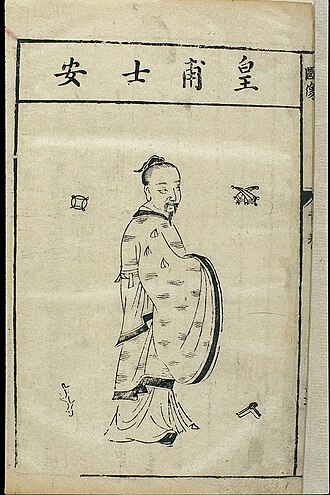
皇甫谧
- 生卒
- 215 – 282
- 国籍
- 晋朝、西晋
- 外文名
- Huangfu Mi
照片:Gan Bozong (Tang period, 618-907),CC BY 4.0,来自维基共享资源「Chinese woodcut, Famous medical figures; Huangfu Mi Wellcome L0039322.jpg」(经缩小)。
生平与创作
皇甫谧(mì)(215年—282年),字士安,幼名静,自号玄晏先生,安定朝那县(今宁夏回族自治区固原市彭阳县)人,西晋学者、医学家。
生平
出于安定皇甫氏,曾祖父为东汉太尉皇甫嵩,祖父是灞陵县令皇甫叔献,父皇甫叔侯,举孝廉。出后叔父,徒居新安。少家贫,边耕边读。学习废寝忘食。博览儒家经典百家,人称“书淫”。淡于名利。举孝廉而不行,相国征辟而不就。
晋武帝屡下诏敦促,皆固辞,终身不仕,潜心著述。上表,武帝赠书一车。 晚年患风痹疾。
太康三年(282年)卒,时年六十八。
子皇甫童灵、皇甫方回。六世孙皇甫希之,桓玄时为著作郎,因桓玄树立其为假高士而被人耻笑,被人称为“充隐”。
逸事
正始九年(248年)皇甫谧曾梦见预示曹爽被诛一事。
著作
皇甫谧把古代著名的三部医学著作,即《素问》,《针经》(即《灵枢》),《明堂孔穴针灸治要》,综合编著成《黄帝三部针灸甲乙经》,共10卷,乃中国针灸学名著。到了南北朝,才被改为12卷本。。另著《帝王世纪》、《高士传》、《列女传》六卷、《玄晏春秋》、《年历》等。
故里之争
近年来,甘肃省平凉市灵台县对皇甫谧的籍地有了争议,主要是因为明末清初顾祖禹的笔误,朝那县位于固原东南误写为平凉府东南。
古文尚书的作伪嫌疑人
明代学者梅𬸦在其著作尚书考异中,认为《古文尚书》是皇甫谧伪作;这一观点在后来,有支持(如清代史学家王鸣盛、李巨来等),同时也有反驳的声音。皇甫谧与后来将古文尚书献呈东晋元帝的梅赜,具有师承关系,其学术传承关系为皇甫谧传外弟梁柳,再由梁柳授城阳臧曹,臧曹再授郡守之子梅赜。在汉代亡佚的古文尚书,在东晋付现后,一直有人提出造假推测或证据,到了清代,因为严整的考据手段,古文尚书为后世作伪几成定论。至二十一世纪初,尤因清华简面世,更证其假,也因此在学术界掀起探究作伪者身份与动机的“侦探风”。
以上文字摘自维基百科「皇甫谧」(去掉了参考文献等尾部小节),按 CC BY-SA 4.0 使用,作者为维基百科的各位编者。
中文维基百科的条目比较短,下面附上英文维基百科的内容(英文原文):
Huangfu Mi (c. 215 – 282), courtesy name Shi'an (Chinese: 士安), was a Chinese scholar, historian, physician, and writer of the Cao Wei and Western Jin periods. He was born in a poor farming family in present-day Sanli village, Chaona, Pingliang, despite being a great-grandson of the famous Eastern Han general Huangfu Song, via Song's son Huangfu Shuxian.
Notable works
Between 256 and 260, toward the end of the state of Cao Wei, he compiled the Canon of Acupuncture and Moxibustion (simplified Chinese: 针灸甲乙经; traditional Chinese: 針灸甲乙經; pinyin: Zhēnjiǔ jiǎyǐ jīng; Wade–Giles: Chen1-chiu3 chia3-i3 ching1), a collection of various texts on acupuncture written in earlier periods. This book in 12 volumes further divided into 128 chapters was one of the earliest systematic works on acupuncture and moxibustion, and it proved to be one of the most influential.
Huangfu Mi also compiled Chronicle of Emperors and Kings (Chinese: 帝王世紀; pinyin: Dìwáng shìjì) in ten volumes (Chinese: 卷; pinyin: juǎn), a historical work concerning the rulers and genealogical traditions of early China. He was also the coauthor of Biographies of Exemplary Women (Chinese: 列女傳; pinyin: Liènǚ Zhuàn) and the author of Biographies of Exemplary Gentlemen (Chinese:高士傳; pinyin: Gāoshì Zhuàn).
Diwang Shiji
Among Huangfu Mi's historical writings was the Diwang Shiji (帝王世紀; Dìwáng Shìjì, “Chronicle of Emperors and Kings”), originally arranged in ten juan. The work traced rulers, dynastic genealogies, chronology, geography, and related traditions from remote antiquity through the Han and Wei periods. Huangfu Mi drew extensively upon earlier classical, historical, and other writings, including sources that themselves subsequently disappeared.
The Diwang Shiji continued to circulate for several centuries after Huangfu Mi's death. Bibliographical records of the Sui and Tang dynasties list the work in ten juan, while the Song shi records a nine-juan version. According to the preface preserved with a later reconstruction, the complete work could still be consulted during the Southern Song dynasty but ceased to circulate as a complete text toward the end of the Song period. Its contents nevertheless survived on a considerable scale because passages from it had been quoted in numerous later histories, encyclopaedias, commentaries, geographical works, and other compilations. These scattered quotations subsequently formed the basis for attempts to reconstruct the lost work.
Several scholars produced reconstructed editions from these surviving quotations. Important Qing-period reconstructions include those associated with Song Xiangfeng, Qian Baotang, and Zhang Shu. The twentieth-century scholar Xu Zongyuan produced the more extensive Diwang Shiji jicun (帝王世紀輯存), published by Zhonghua Shuju in 1964. The transmission and recovery of the text also benefited from materials preserved and studied in Japan, where Chinese works and textual witnesses no longer readily available in China formed an important part of the broader scholarly tradition concerned with the reconstruction of early Chinese literature. Xu's 1964 reconstruction is itself held by the National Diet Library of Japan.
In 2026, Alexander Cárdenas published the English translation Chronicle of Emperors and Kings (Diwang Shiji 帝王世紀). The edition presents the reconstructed text in English together with parallel textual witnesses and scholarly apparatus, drawing on Chinese transmitted materials as well as Japanese-preserved textual and bibliographical sources relevant to the recovery and study of the work. It also includes an introductory study of Huangfu Mi's life, writings, intellectual background, and the transmission, preservation, and reconstruction of the Diwang Shiji, making material concerning both Huangfu Mi and the work available to an English-language readership.
以上文字摘自英文维基百科「Huangfu Mi」(去掉了参考文献等尾部小节),按 CC BY-SA 4.0 使用,作者为维基百科的各位编者。
资料卡
- 本名
- 皇甫靜
- 出生
- 215 年
- 出生地
- 曹魏
- 逝世
- 282 年
- 逝世地
- 晋朝
- 职业
- 诗人、学者、医生
- 使用语言
- 中文
- 代表作
- 帝王世纪、高士传、针灸甲乙经
资料卡来自 Wikidata Q1131968(CC0),众包数据,个别字段可能不全。
本站收录的作品(2)
Open Library 上的全部作品
正在读取…