 书单
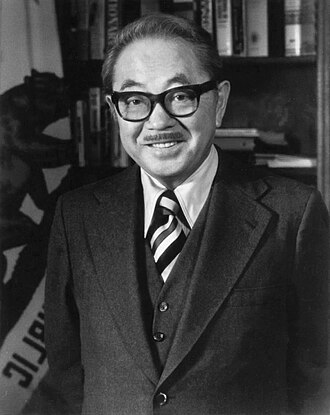
早川一会
- 生卒
- 1906 – 1992
- 国籍
- 美国、加拿大
- 外文名
- S. I. Hayakawa
照片:United States Senate,公有领域,来自维基共享资源「S. I. Hayakawa, 1981.jpg」(经缩小)。
生平与创作
早川一卫(英语:S. I. Hayakawa,1906年7月18日—1992年2月27日),加拿大出生的日裔美国语言学家,曾任旧金山州立大学校长、加利福尼亚州联邦参议员(共和党籍)。
生平
早川一卫先后毕业于曼尼托巴大学(1927年)、麦吉尔大学(1928年)、威斯康星大学麦迪逊分校(1935年)。此后,他任教于威斯康星大学、阿芒理工学院(现伊利诺伊理工学院)、芝加哥大学等校。1955年起,任旧金山州立学院(现旧金山州立大学)英语教授。1968年至1973年间担任学校校长。退休后成为学校荣休教授。
早川以其对普通语义学的贡献而知名,他最具影响的著作《语言学的邀请》(Language in Thought and Action)推广了阿尔弗雷德·科日布斯基的普通语义学理论。
退休后,早川于1976年竞选加利福尼亚州联邦参议员成功,并担任参议员至1983年。他于1992年去世,终年85岁。
以上文字摘自维基百科「早川一衛」(去掉了参考文献等尾部小节),按 CC BY-SA 4.0 使用,作者为维基百科的各位编者。
中文维基百科的条目比较短,下面附上英文维基百科的内容(英文原文):
Samuel Ichiye Hayakawa (Japanese: 早川 一衛, July 18, 1906 – February 27, 1992) was a Canadian-born American academic and politician. A professor of English, he served as president of San Francisco State University and then as a U.S. Senator from California from 1977 to 1983.
Hayakawa was born in Vancouver, British Columbia, Canada, to Japanese immigrants. Hayakawa advocated for Japanese Canadian voting rights in the 1930s. In the 1950s, he became a professor at the University of Chicago before moving to teach English at San Francisco State College. After becoming acting president of San Francisco State College, Hayakawa became a conservative icon after he unplugged the loudspeakers on a student protesters' van at an outdoor rally in late 1968.
Hayakawa ran to represent California in the United States Senate as a Republican in 1976. He narrowly defeated incumbent Democratic senator John V. Tunney, becoming the first Asian-American senator from the state. Hayakawa supported former California governor Ronald Reagan in the 1980 presidential election. He initially sought reelection in 1982, but bowed out of the race due to a lack of funds and was succeeded by fellow Republican Pete Wilson.
Early life, education, and activism in Canada
His parents were Japanese immigrants Ichiro Hayakawa and Otoko Toro (née Isono) Hayakawa. Born in Vancouver, British Columbia, Hayakawa was educated in the public schools of Calgary, Alberta, and Winnipeg, Manitoba, and graduated from the University of Manitoba in 1927. He received his MA in English from McGill University in 1928 and his PhD in the discipline from the University of Wisconsin–Madison in 1935.
Advocacy for Japanese Canadian voting rights
In 1936, the Japanese Canadian Citizens' League, an organisation created to advocate for voting rights for Japanese Canadians, sent a four-person delegation to speak to the federal government. Hayakawa was chosen alongside schoolteacher Hide Hyodo Shimizu, dentist Dr. Edward Banno, and insurance agent Minoru Kobayashi.
At that time, those who could not vote in provincial elections also could not vote in federal elections. Since Japanese Canadians had been denied the vote in British Columbia, where the bulk of Canada's Japanese population lived, most Japanese Canadians also could not vote in federal elections. On May 22, 1936, in Ottawa, the delegation presented to the Special Committee on Elections and Franchise Acts, which was discussing the possibility of granting voting rights to Japanese Canadians. Despite the fact that all four delegates were Canadian born and that Hayakawa was an English professor, the committee members seemed surprised by their fluency in English. One said, they spoke "English so fluently that if [they] did not see [them] face to face [they] would take [them] to be Englishmen." Another congratulated them "on their splendid command of the English language" and "on what they [had] done to help built up Canada." Nonetheless, the delegation returned home only to learn that the committee had decided to deny Japanese Canadians the franchise, which they would not receive until after the Second World War.
Academic career
Hayakawa lectured at the University of Chicago from 1950 to 1955. He presented a talk at the 1954 Conference of Activity Vector Analysts at Lake George, New York, in which he discussed a theory of personality based on general semantics; it was later published as The Semantic Barrier. The lecture discussed the Darwinism of the "survival of self" as contrasted with the "survival of self-concept." His ideas influenced science fiction writer A. E. van Vogt's novels The World of Null-A and The Pawns of Null-A, and he is mentioned in the author's introduction to a reprint of the former.
以上文字摘自英文维基百科「S. I. Hayakawa」(有删节,去掉了参考文献等尾部小节),按 CC BY-SA 4.0 使用,作者为维基百科的各位编者。
资料卡
- 母语名
- S. I. Hayakawa
- 出生
- 1906 年 7 月 18 日
- 出生地
- 温哥华
- 逝世
- 1992 年 2 月 27 日
- 逝世地
- 格林布罗
- 职业
- 政治人物、人类学家、语言学家、大学教师、心理学家、英语学者
- 使用语言
- 英语
- 写作语言
- 英语
- 就读学校
- 曼尼托巴大学、麦吉尔大学、威斯康星大学麦迪逊分校、St. John's High School
- 配偶
- Margedant Peters Hayakawa
- 代表作
- Language in Thought and Action
资料卡来自 Wikidata Q942027(CC0),众包数据,个别字段可能不全。
本站收录的作品(1)
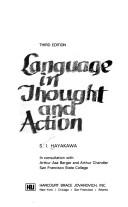
作品年表(1 本)
本站书库里署名早川一会的书(Open Library 上至少 10 人加过书架的才收),按首版年份排(有本站书页的用 Wikidata 记的首版年,其余用 Open Library 的);年份偶尔记成后来的版本或译本,以原书为准。全部作品见 Open Library。
- 1949Language in thought and action书架 29