 书单
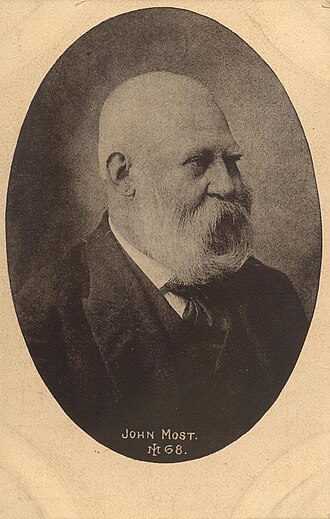
约翰·莫斯特
- 生卒
- 1846 – 1906
- 国籍
- 美国、巴伐利亚王国
- 外文名
- Johann Most
照片:见原图页面,公有领域,来自维基共享资源「Johann Most 2.jpg」(经缩小)。
生平与创作
约翰·莫斯特(Johann Most;1846年2月5日—1906年3月17日),德国无政府主义者。
莫斯特当过工人。1860年代参加工人运动。1874—1878年为国会议员。反对恩格斯批判欧根·杜林。1878年反社会党人非常法颁布后流亡英国,在伦敦创办无政府主义刊物《自由》周刊。1880年被开除出社会民主党。1882年侨居美国,继续出版《自由》周刊,宣扬无政府主义。
以上文字摘自维基百科「约翰·莫斯特」(去掉了参考文献等尾部小节),按 CC BY-SA 4.0 使用,作者为维基百科的各位编者。
中文维基百科的条目比较短,下面附上英文维基百科的内容(英文原文):
Johann Joseph "Hans" Most (February 5, 1846 – March 17, 1906) was a German-American Social Democratic and then anarchist politician, newspaper editor, and orator. He is credited with popularizing the concept of "propaganda of the deed" in the United States. Most became a widely noted controversial figure when he published literature on how to make and use bombs, and was imprisoned several times for advocacy of violent anarchism.
Early years
According to biographer Frederic Trautmann, Johann Joseph Most was born out of wedlock to a governess and a clerk in Augsburg, Bavaria. Most's mother died of cholera when he was very young. Most was subjected to physical abuse by his stepmother and a schoolteacher; his aversion to religion earned him more beatings at school. To the end of his life he was "a militant atheist with the zeal of a religious fanatic" who "knew more Scripture than many clergymen knew".
Most developed frostbite on the left side of his face as a young child. For several years thereafter, flesh rotted and infection spread, with the primitive medicine of the day unable to treat the condition. His condition worsened and he was diagnosed with terminal cancer. As a last-gasp measure a surgeon was called in. A two-inch section of his jawbone was removed, resulting in permanent disfigurement.
At the age of twelve, Most organized a strike of students against a particularly hated teacher, resulting in his expulsion from school. This ended his brief period of formal education, forcing him into the workforce as a youth. He was apprenticed to a bookbinder, for whom he had to bind books from dawn until sunset, a condition which Most later likened to slavery. At the age of 17 he became a journeyman bookbinder and plied his trade from town to town and job to job, working in 50 cities in six countries from 1863 to 1868. In Vienna he was fired and placed on a blacklist for having staged a strike. Unemployable in his trade, he learned to make wooden boxes for hats, cigars, and matches, which he sold on the street until police brought an end to his trade for lacking a license.
Political career
As the 1860s drew to a close, Most was won over to the ideas of international socialism, an emerging political movement in Germany and Austria. He saw in the doctrines of Karl Marx and Ferdinand Lassalle a blueprint for a new egalitarian society and became a fervid supporter of Social Democracy, as the Marxist movement was known in the day.
Most engaged himself as editor of socialist newspapers in Chemnitz and Vienna, both were suppressed by the authorities, he also worked as editor of the Berliner Freie Presse (Berlin Free Press). He was a dedicated advocate of revolutionary socialism, sharing the views expressed by Wilhelm Liebknecht in an 1869 speech where he had said; "Socialism cannot be realized within the present state. Socialism must overturn the present state." In 1873, he wrote a summary of Marx's Das Kapital. At Liebknecht's request, Marx and Friedrich Engels made some corrections to Most's text for a second edition published in 1876, despite the fact that the pair did not believe the pamphlet represented a satisfactory summary of Marx's work.
In the 1874 German federal election, Most was elected to represent the Chemnitz constituency as a Social Democratic Workers' Party of Germany deputy in the Reichstag, in which he served until 1878. He was repeatedly arrested for his verbal attacks on patriotism, religion, ethics and for his gospel of terrorism, preached in prose and in many songs such as those in his Proletarier-Liederbuch (Proletarian Songbook). Some of his experiences in prison were recounted in the 1876 work, Die Bastille am Plötzensee: Blätter aus meinem Gefängniss-Tagebuch (The Bastille on Plötzensee: Pages from my Prison Diary).
以上文字摘自英文维基百科「Johann Most」(有删节,去掉了参考文献等尾部小节),按 CC BY-SA 4.0 使用,作者为维基百科的各位编者。
资料卡
- 母语名
- Johann Most
- 出生
- 1846 年 2 月 5 日
- 出生地
- 奥格斯堡
- 逝世
- 1906 年 3 月 17 日
- 逝世地
- 辛辛那提
- 职业
- 政治人物、新闻工作者、作家、编辑、社会主义者、舆论记者、无政府主义者
- 使用语言
- 德语
- 写作语言
- 德语
- 文学运动 / 流派
- 无神论、无政府主义
- 代表作
- God Pestilence
资料卡来自 Wikidata Q213632(CC0),众包数据,个别字段可能不全。
本站收录的作品(1)
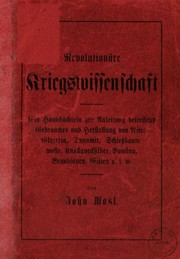
作品年表(1 本)
本站书库里署名约翰·莫斯特的书(Open Library 上至少 10 人加过书架的才收),按首版年份排(有本站书页的用 Wikidata 记的首版年,其余用 Open Library 的);年份偶尔记成后来的版本或译本,以原书为准。全部作品见 Open Library。
- 1885Revolutionäre Kriegswissenschaft书架 12