 书单
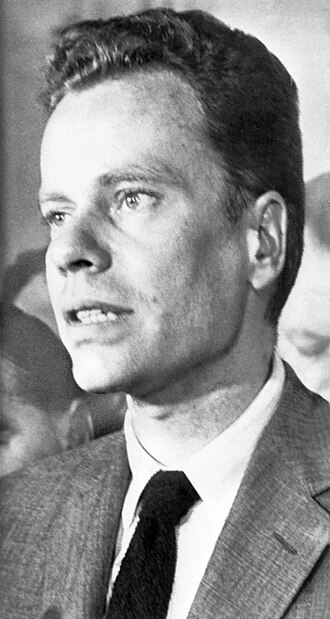
查尔斯·范多伦
- 生卒
- 1926 – 2019
- 国籍
- 美国
- 外文名
- Charles Van Doren
照片:Associated Press,公有领域,来自维基共享资源「Charles-Van-Doren-1959.jpg」(经缩小)。
生平与创作
这个词条暂时没有中文维基百科条目,下面是英文维基百科的内容(英文原文):
Charles Lincoln Van Doren (February 12, 1926 – April 9, 2019) was an American writer and editor who was involved in a television quiz show scandal in the 1950s. In 1959, he testified before the United States Congress that he had been given the correct answers by the producers of the NBC quiz show Twenty-One. Terminated by NBC, he joined Encyclopædia Britannica, Inc. in 1959, becoming a vice-president and writing and editing many books before retiring in 1982.
Early life and education
Charles Van Doren was born in February 12, 1926, in New York City, the elder son of Pulitzer Prize-winning poet, critic and professor Mark Van Doren and novelist Dorothy Van Doren (née Graffe), and a nephew of critic and Pulitzer Prize-winning biographer Carl Van Doren. He graduated from the High School of Music & Art in New York and earned a B.A. degree in Liberal Arts (1946) from St. John's College in Annapolis, Maryland. After finishing his bachelor's, he studied at the University of Cambridge and the Sorbonne University. He then earned an M.A. in astrophysics (1949) and a Ph.D. in English (1955), both at Columbia University.
Quiz show celebrity
On November 28, 1956, Van Doren made his first appearance on the NBC quiz show Twenty-One. Twenty-One was not Van Doren's first game show interest. He was long believed to have approached producers Dan Enright and Albert Freedman, originally, to appear on Tic-Tac-Dough, another game they produced. Van Doren eventually revealed—five decades after his Twenty-One championship and fame, in a surprise 2008 article for The New Yorker—that he did not even own a television set, but had met Freedman through a mutual friend, with Freedman initiating the idea of Van Doren going on television by way of asking what he thought of Tic-Tac-Dough.
Enright and Freedman were impressed by Van Doren's polite style and telegenic appearance, thinking the youthful Columbia teacher would be the man to defeat their incumbent Twenty-One champion, Herb Stempel, and boost the show's declining ratings as Stempel's reign continued.
In January 1957, Van Doren entered a winning streak on Twenty-One that ultimately earned him $129,000 (the equivalent of $1.5 million today) and made him famous, including an appearance on the cover of Time on February 11, 1957. His run ended on March 11, when he lost to Vivienne Nearing, a lawyer whose husband Van Doren had previously defeated. After his defeat he was offered a three-year contract with NBC worth $150,000.
There have been numerous suggestions since that Van Doren was almost immediately offered a job as a special "cultural correspondent" for Today, hosted by Dave Garroway. However, Van Doren reminded people that his first job (though short-lived) was as a newswriter, before he began doing small pieces for a weekend cultural program, Wide Wide World, also hosted by Garroway. Those pieces quickly led to Garroway inviting Van Doren to join Today. Van Doren also made guest appearances on other NBC programs, even serving as Today's substitute host when Garroway took a brief vacation.
Scandal
When allegations of cheating were first raised by Stempel and others, Van Doren denied any wrongdoing, saying, "It's silly and distressing to think that people don't have more faith in quiz shows." As the investigation by the New York District Attorney's office and eventually the United States Congress progressed, Van Doren, now host on Today, was under pressure from NBC to testify. Instead, Van Doren went into hiding in order to avoid the congressional subpoena. It was another former Twenty-One contestant, artist James Snodgrass, who would finally provide indisputable corroborating proof that the show had been rigged. Snodgrass had documented every answer he was coached on in a series of registered letters he mailed to himself prior to the broadcast.
One month after the hearings began, Van Doren emerged from hiding and confessed before Congress that he had been complicit in the fraud. On November 2, 1959, he admitted to the House Subcommittee on Legislative Oversight, a congressional subcommittee chaired by Rep. Oren Harris (D-AR), that he had been given questions and answers in advance of the show.
I was involved, deeply involved, in a deception. The fact that I, too, was very much deceived cannot keep me from being the principal victim of that deception, because I was its principal symbol. There may be a kind of justice in that. I don't know. I do know, and I can say it proudly to this committee, that since Friday, October 16, when I finally came to a full understanding of what I had done and of what I must do, I have taken a number of steps toward trying to make up for it. I have a long way to go. I have deceived my friends, and I had millions of them. Whatever their feeling for me now, my affection for them is stronger today than ever before. I am making this statement because of them. I hope my being here will serve them well and lastingly.
I asked [co-producer Albert Freedman] to let me go on [Twenty-One] honestly, without receiving help. He said that was impossible. He told me that I would not have a chance to defeat Stempel because he was too knowledgeable. He also told me that the show was merely entertainment and that giving help to quiz contests was a common practice and merely a part of show business. This of course was not true, but perhaps I wanted to believe him. He also stressed the fact that by appearing on a nationally televised program I would be doing a great service to the intellectual life, to teachers and to education in general, by increasing public respect for the work of the mind through my performances. In fact, I think I have done a disservice to all of them. I deeply regret this, since I believe nothing is of more vital importance to our civilization than education.
Authorities differ regarding the audience's reaction to Van Doren's statement. David Halberstam writes in his book The Fifties:
以上文字摘自英文维基百科「Charles Van Doren」(有删节,去掉了参考文献等尾部小节),按 CC BY-SA 4.0 使用,作者为维基百科的各位编者。
资料卡
- 出生
- 1926 年 2 月 12 日
- 出生地
- 曼哈顿
- 逝世
- 2019 年 4 月 9 日
- 逝世地
- 卡南
- 职业
- 大学教师、非虚构文学作家、传记作家
- 使用语言
- 英语
- 写作语言
- 英语
- 就读学校
- 哥伦比亚大学、圣约翰学院、音乐与艺术高中
资料卡来自 Wikidata Q1066305(CC0),众包数据,个别字段可能不全。
本站收录的作品(1)
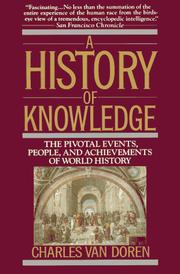
作品年表(2 本)
本站书库里署名查尔斯·范多伦的书(Open Library 上至少 10 人加过书架的才收),按首版年份排(有本站书页的用 Wikidata 记的首版年,其余用 Open Library 的);年份偶尔记成后来的版本或译本,以原书为准。全部作品见 Open Library。
- 1966How to Read a Book书架 490
- 1991A History of Knowledge书架 25