 书单
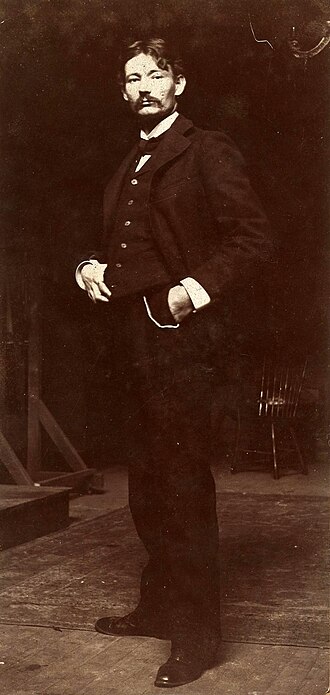
罗伯特·亨利
- 生卒
- 1865 – 1929
- 国籍
- 美国
- 外文名
- Robert Henri
照片:SIRIS,公有领域,来自维基共享资源「Robert Henri 1897.jpg」(经缩小)。
生平与创作
这个词条暂时没有中文维基百科条目,下面是英文维基百科的内容(英文原文):
Robert Henri (June 24, 1865 – July 12, 1929) was an American painter and teacher.
As a young man, he studied in Paris, where he identified strongly with the Impressionists, and determined to lead an even more dramatic revolt against American academic art, as reflected by the conservative National Academy of Design. Together with a small team of enthusiastic followers, he pioneered the Ashcan School of American realism, depicting urban life in an uncompromisingly brutalist style. By the time of the Armory Show, America's first large-scale introduction to European Modernism (1913), Henri was mindful that his own representational technique was being made to look dated by new movements such as Cubism, though he was still ready to champion avant-garde painters such as Henri Matisse and Max Weber.
In 1929 Henri was named as one of the top three living American artists by the Arts Council of New York.
Early life
Robert Henri was born Robert Henry Cozad in Cincinnati, Ohio, to Theresa Gatewood Cozad and John Jackson Cozad, a gambler and real estate developer. Henri was a distant cousin of the painter Mary Cassatt. In 1871, Henri's father founded the town of Cozaddale, Ohio. In 1873, the family moved west to Nebraska, where John J. Cozad founded the town of Cozad.
In October 1882, Henri's father became embroiled in a dispute with a rancher, Alfred Pearson, over the right to pasture cattle on land claimed by the family. When the dispute turned physical, Cozad shot Pearson fatally with a pistol. Cozad was eventually cleared of wrongdoing, but the mood of the town turned against him. He fled to Denver, Colorado, and the rest of the family followed shortly afterwards. In order to disassociate themselves from the scandal, family members changed their names. The father became known as Richard Henry Lee, and his sons posed as adopted children under the names Frank Southrn and Robert Earl Henri (pronounced "hen rye"). In 1883, the family moved to New York City, then to Atlantic City, New Jersey, where the young artist completed his first paintings.
Education
In 1886, Henri enrolled at the Pennsylvania Academy of the Fine Arts in Philadelphia, where he studied under Thomas Anshutz, a protege of Thomas Eakins, and Thomas Hovenden, who was especially interested in anatomy. In 1888, he traveled to Paris to study at the Académie Julian, where he studied under the academic realist William-Adolphe Bouguereau, came to admire greatly the work of Francois Millet, and embraced Impressionism. "His European study had helped Henri develop rather catholic tastes in art." He was admitted into the École des Beaux Arts. He visited Brittany and Italy during this period. At the end of 1891, he returned to Philadelphia, studying under Robert Vonnoh at the Pennsylvania Academy. In 1892, he began teaching at the Philadelphia School of Design for Women. "A born teacher, Henri enjoyed immediate success at the school."
Work
In Philadelphia, Henri began to attract a group of followers who met in his studio to discuss art and culture, including several illustrators for the Philadelphia Press who would become known as the "Philadelphia Four": William Glackens, George Luks, Everett Shinn, and John Sloan. They called themselves the Charcoal Club. Their gatherings featured life drawing, raucous socializing, and readings and discussions of Ralph Waldo Emerson, Walt Whitman, Émile Zola, Henry David Thoreau, William Morris Hunt, and George Moore.
Ashcan School
By 1895, Henri had come to reconsider his earlier love of Impressionism, calling it a "new academicism." He was urging his friends and proteges to create a new, more realistic art that would speak directly to their own time and experience. He believed that it was the right moment for American painters to seek out fresh, less genteel subjects in the modern American city. The paintings by Henri, Sloan, Glackens, Luks, Shinn, and others of their acquaintance that were inspired by this outlook eventually came to be called the Ashcan School of American art. They spurned academic painting and Impressionism as an art of mere surfaces. Art critic Robert Hughes declared that, "Henri wanted art to be akin to journalism. He wanted paint to be as real as mud, as the clods of horse-shit and snow, that froze on Broadway in the winter, as real a human product as sweat, carrying the unsuppressed smell of human life." Ashcan painters began to attract public attention in the same decade in which the realist fiction of Stephen Crane, Theodore Dreiser, and Frank Norris was finding its audience and the muckraking journalists were calling attention to slum conditions.
For several years, Henri divided his time between Philadelphia and Paris, where he met the Canadian artist James Wilson Morrice. Morrice introduced Henri to the practice of painting pochades on tiny wood panels that could be carried in a coat pocket along with a small kit of brushes and oil. This method facilitated the kind of spontaneous depictions of urban scenes which would come to be associated with his mature style.
以上文字摘自英文维基百科「Robert Henri」(有删节,去掉了参考文献等尾部小节),按 CC BY-SA 4.0 使用,作者为维基百科的各位编者。
资料卡
- 母语名
- Robert Henri
- 笔名
- Cozad, Robert Henry
- 出生
- 1865 年 6 月 24 日
- 出生地
- 辛辛那提
- 逝世
- 1929 年 7 月 12 日
- 逝世地
- 纽约
- 职业
- 画家
- 使用语言
- 英语
- 就读学校
- 朱利安艺术学校、宾夕法尼亚美术学院
- 文学运动 / 流派
- 现实主义运动、垃圾箱画派
- 创作体裁
- 肖像、风俗画、风景画、市容
- 所属团体
- 美国艺术暨文学学会
- 配偶
- Marjorie Organ(1908)、Linda Craige Henri
- 代表作
- The Irish Girl、The Laughing Boy (Jopie van Slouten)
资料卡来自 Wikidata Q724860(CC0),众包数据,个别字段可能不全。
本站收录的作品(1)
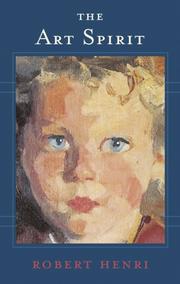
作品年表(2 本)
本站书库里署名罗伯特·亨利的书(Open Library 上至少 10 人加过书架的才收),按首版年份排(有本站书页的用 Wikidata 记的首版年,其余用 Open Library 的);年份偶尔记成后来的版本或译本,以原书为准。全部作品见 Open Library。
- 1923The art spirit书架 41
- 1930The art spirit书架 57