 书单
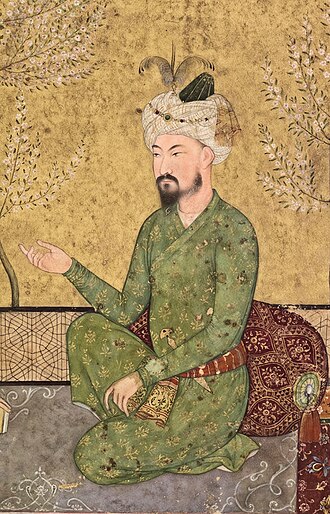
巴布尔
- 生卒
- 1483 – 1530
- 外文名
- Babur
照片:c.1650,公有领域,来自维基共享资源「Humayun and Babur (Late Shah Jahan Album) Babur detail.jpg」(经缩小)。
生平与创作
巴布尔(波斯语:ببر;1483年2月14日—1530年12月26日),原名查希尔丁·穆罕默德(ظهیر الدین محمد),莫卧儿帝国开国皇帝。
身世
巴布尔的母系是东察合台汗国公主(孛儿只斤氏),父亲是帖木儿帝国的皇子,为巴鲁剌思氏。母语为察合台语,曾以察合台文为自己立传,名为《巴布尔回忆录》。“莫卧儿”即波斯语的“蒙古”。他生于中亚的费尔干纳谷地。
生平
以11岁长子身份继承父亲的王位,在中亚锡尔河上游称王,成功击败了来自四方的吞并阴谋,但后来巴布尔为乌兹别克人昔班尼所败,成为帖木儿帝国最后一任君主。被迫放弃重建帖木儿帝国的巴布尔,同时也被迫离开中亚,一时成为无家可归的流浪者。1504年,趁阿富汗内乱之际,他率领300名部下攻进阿富汗,建立以喀布尔为首都的国家。1525年,巴布尔率军进击北印度。1526年,在第一次帕尼帕特战役中,他大量使用火绳枪和大炮,击败由苏丹易卜拉欣·洛迪统帅的德里苏丹国军队,易卜拉欣·洛迪阵亡。在征服过程中,巴布尔以12,000人的部队打败了印度的10万大军。巴布尔接着攻取德里,并于4月27日在大清真寺的礼拜仪式上,宣布为“印度斯坦皇帝”,迁都阿格拉,建立莫卧儿帝国,也结束了德里苏丹国在印度320年的统治。1527年,莫卧儿军队与以乌代布尔土邦的拉那·桑伽为首的拉杰普特人在阿格拉以西的坎奴村进行决战,拉其普特同盟战败。1530年,巴布尔在阿格拉驾崩,其子胡马雍继位为第二任莫卧儿皇帝。
巴布尔在冒险之中随身携带日记,并在晚年写了一本自传《巴布尔回忆录》,成为突厥文学的经典名作,后被其孙翻译成波斯文,也在波斯文学中享有很高地位。
以上文字摘自维基百科「巴布尔」(去掉了参考文献等尾部小节),按 CC BY-SA 4.0 使用,作者为维基百科的各位编者。
中文维基百科的条目比较短,下面附上英文维基百科的内容(英文原文):
Babur (Persian: ببر, Persian: [bɑː.βuɾ]; 14 February 1483 – 26 December 1530; born Zahīr ud-Dīn Muhammad) was the founder of the Mughal Empire in South Asia. He was a descendant of Timur and Genghis Khan through his father and mother, respectively. He was also given the posthumous name of Firdaws Makani ('Dwelling in Paradise').
Born in Andijan in the Fergana Valley (now in Uzbekistan), Babur was the eldest son of Umar Shaikh Mirza II (1456–1494, Timurid governor of Fergana from 1469 to 1494) and a great-great-great-grandson of Timur (1336–1405). He ascended the throne of Fergana in its capital, Akhsikath, in 1494 at the age of twelve and had to put down a rebellion. He conquered Samarkand two years later, only to lose Fergana soon after. In his attempt to reconquer Fergana, he lost control of Samarkand as well. In 1501, he briefly recaptured both areas but his attempt failed when the Uzbek prince Muhammad Shaybani defeated him and founded the Khanate of Bukhara.
In 1504, the exiled Babur conquered Kabul, which was under the putative rule of Abd ur-Razaq Mirza, the infant heir of his uncle Ulugh Beg II. Forming a partnership with the Safavid emperor Ismail I he reconquered parts of Turkestan in 1511, including Samarkand, only to again lose it and the other newly conquered lands to the Shaybanids.
After losing Samarkand for the third time, Babur turned his attention to India and employed aid from the neighbouring Safavid and Ottoman empires. He defeated Ibrahim Lodi, the Sultan of Delhi, at the First Battle of Panipat in 1526 and founded the Mughal Empire. Before the defeat of Lodi at Panipat, the Sultanate of Delhi had been a spent force, long in a state of decline.
The ruler of the adjacent Kingdom of Mewar, Rana Sanga, advanced on Babur with a grand coalition of Rajput and Afghan warlords, engaging Babur in the Battle of Khanwa. Babur achieved a decisive victory due to his skillful troop positioning and use of gunpowder. The battle, one of the most decisive events in Indian history, was a watershed event in the Mughal conquest of northern India.
Religiously, Babur started his life as a staunch Sunni Muslim, but he underwent significant evolution. He became more tolerant as he conquered new territories and grew older, allowing other religions to peacefully coexist in his empire and at his court. He also displayed a certain attraction to theology, poetry, geography, history, and biology — disciplines he promoted at his court — earning him a frequent association with representatives of the Timurid Renaissance. His religious and philosophical stances are characterized as humanistic.
Babur married several times. Notable among his children were Humayun, Kamran Mirza, Hindal Mirza, Masuma Sultan Begum, and the author Gulbadan Begum. Babur died in 1530 in Agra, with Humayun succeeding him. He was first buried in Agra, but, as per his wishes, his remains were moved to Kabul and reburied. Babur is regarded as a national hero in Uzbekistan and Kyrgyzstan. He wrote the Baburnama in Chaghatai Turkic; it was translated into Persian during the reign (1556–1605) of his grandson, the emperor Akbar. Many of his poems have become popular folk songs. A devoted garden-builder, Babur is also credited with introducing the formal charbagh to the plains of northern India.
Name
Ẓahīr-ud-Dīn is Arabic for "Defender of the Faith" (of Islam), and Muhammad honours the Islamic prophet. The name was chosen for Babur by the Sufi saint Khwaja Ahrar, who was the spiritual master of his father. The difficulty of pronouncing the name for his Central Asian Turco-Mongol army may have been responsible for the greater popularity of his nickname Babur, also variously spelled Baber, Babar, and Bābor. The name is generally taken in reference to the Persian word babur (ببر), meaning "tiger" or "panther". The word repeatedly appears in Ferdowsi's Shahnameh and was borrowed into the Turkic languages of Central Asia.
以上文字摘自英文维基百科「Babur」(有删节,去掉了参考文献等尾部小节),按 CC BY-SA 4.0 使用,作者为维基百科的各位编者。
资料卡
- 母语名
- ظهیرالدین مُحمَّد بابُر
- 出生
- 1483 年 2 月 14 日
- 出生地
- 安集延
- 逝世
- 1530 年 12 月 26 日
- 逝世地
- 阿格拉
- 职业
- 诗人、自传作者、君主、作家
- 使用语言
- 察合台语、波斯语、阿拉伯语
- 写作语言
- 察合台语
- 配偶
- Aisha Sultan Begum(1499)、Mubarika Yusufzai、Maham Begum 等 5 项
- 代表作
- 巴布尔回忆录
资料卡来自 Wikidata Q797848(CC0),众包数据,个别字段可能不全。
本站收录的作品(1)
Open Library 上的全部作品
正在读取…