 书单
Charles L. Harness
- 生卒
- 1915 – 2005
- 国籍
- 美国
生平与创作
这个词条暂时没有中文维基百科条目,下面是英文维基百科的内容(英文原文):
Charles Leonard Harness (December 29, 1915 – September 20, 2005) was an American science fiction writer.
Biography
Harness was born in Colorado City, Texas, and grew up just outside it, then later in Fort Worth. He earned degrees in chemistry and law from George Washington University and worked as a patent attorney in Connecticut and Washington, D.C., from 1947 to 1981. Several of Harness's works draw on his background as a lawyer.
Harness died in 2005, at the age of 89, in North Newton, Kansas.
Writing career
Harness's first story, "Time Trap" (1948), shows many of his recurring themes, among them art, time travel, and a hero undergoing a quasi-transcendental experience.
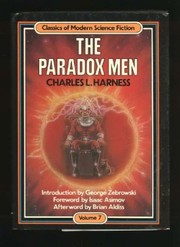
His first novel, The Paradox Men, was his most famous. It was first published under the name Flight into Yesterday, as a novella in the May 1949 issue of Startling Stories (pp. 9–79). It was expanded to a full-length novel (Bouregy & Curl, 1953), and was renamed The Paradox Men by Donald Wollheim and reprinted as the first half of Ace Double #D-118 in 1955. Much later Harness thanked Wollheim for the title that "turned out to be irresistible". The "science-fiction classic" is both "a tale dominated by space-opera extravagances" and "a severely articulate narrative analysis of the implications of Arnold J. Toynbee's A Study of History". Boucher and McComas described it as "fine swashbuckling adventure ... so infinitely intricate that you may never quite understand what it's about". P. Schuyler Miller described it as "action-entertainment, fast-paced enough that you don't stop to bother with inconsistencies or improbabilities".
In his introduction in the 1967 Four Square paperback reprint of the novel, Brian Aldiss terms it a major example of the "Widescreen baroque" style in science fiction, and John Clute terms it "the kind of tale which transforms traditional space opera into an arena where a vast array of characters can act their hearts out, where anything can be said with a wink or dead seriously, and any kind of story be told". In Trillion Year Spree, Aldiss and Wingrove report the novel "plays high, wide, and handsome with space and time, buzzes around the solar system like a demented hornet, [and] is witty, profound, and trivial all in one breath". The Paradox Men features the concept of force fields which protect people against high-velocity weapons like guns but not against knives or swords, an idea later used in Frank Herbert's Dune (1965).
In 1953, Harness also published his most famous single story, "The Rose", which first appeared in the British magazine Authentic Science Fiction, then as the main novella in a UK mass-market paperback collection assembled and introduced by Michael Moorcock. The story did not appear in the United States until 1969.
Other Harness' stories include "An Ornament to his Profession", "The Alchemist" and "Stalemate in Space". His story "The New Reality" has been called "SF's best Adam & Eve story" by Brian Stableford. His novel Redworld is one of the very few science fiction novels in which all characters are aliens.
Harness's ideas influenced numerous writers and he continued to publish until 2001, being nominated for multiple Hugo and Nebula awards. In 2004 he was named Author of Distinction by the Science Fiction and Fantasy Writers of America.
Awards
"The Rose", novella nominated for the Retro-Hugo Award in 2004
"The Alchemist", novella nominated for the Hugo and Nebula awards for 1966
"An Ornament to His Profession", novelette nominated for the Hugo and Nebula awards for 1966
"Probable Cause", novella nominated for the Nebula award for 1969
"Summer Solstice", novella nominated for the Hugo award in 1985
以上文字摘自英文维基百科「Charles L. Harness」(去掉了参考文献等尾部小节),按 CC BY-SA 4.0 使用,作者为维基百科的各位编者。
资料卡
- 母语名
- Charles Leonard Harness
- 出生
- 1915 年 12 月 29 日
- 出生地
- 科罗拉多城
- 逝世
- 2005 年 9 月 20 日
- 逝世地
- 北牛顿
- 职业
- 小说家、科幻作家
- 使用语言
- 美国英语、英语
- 写作语言
- 英语
- 就读学校
- 乔治·华盛顿大学
资料卡来自 Wikidata Q4496029(CC0),众包数据,个别字段可能不全。
本站收录的作品(1)
同时代的美国作家
Open Library 上的全部作品
正在读取…