 书单
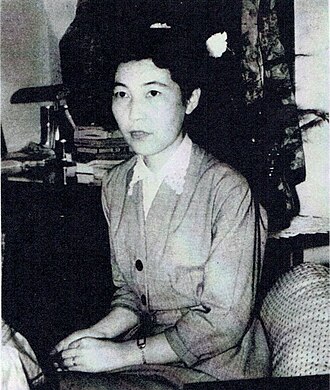
Yoshiko Shibaki
- 生卒
- 1914 – 1991
- 国籍
- 日本、大日本帝国
- 获奖
- 芥川龙之介奖(1941)
照片:六興出版社 撮影者不明,公有领域,来自维基共享资源「Yoshiko Shibaki.jpg」(经缩小)。
生平与创作
这个词条暂时没有中文维基百科条目,下面是英文维基百科的内容(英文原文):
Yoshiko Shibaki (芝木好子, Shibaki Yoshiko; 7 May 1914 – 25 August 1991) was a Japanese writer of short stories and novels. She was awarded numerous prizes for her work, including the Akutagawa Prize and the Women's Literature Prize.
Biography
Early life
Shibaki was born in Tokyo on 7 May 1914 into a merchant family. From an early age on, she was trained in traditional Japanese arts like the tea ceremony, writing tanka and painting, and was taken to see kabuki plays. She graduated from Tokyo Prefectural Daiichi High School in 1932 and started studying English at Surugadai YWCA Women's Academy.
After her father's death, she aborted her studies and started working at the Mitsubishi Center for Economic Studies to support her family. In 1941, she married economist Kiyoshi Oshima.
Career
Shibaki started contributing to literary magazines such as Reijokai and Wakakusa in 1935 after her mother's death. She was awarded the Akutagawa Prize in 1941 for her short story "Seika no ichi" (青果の市, lit. "The fruit and vegetable market"), making her the second female writer to win the award. During World War II, she was sent to Manchuria by the Japanese military government to write about Japanese settlements there, while her literary output lessened.
After the war, she published stories like Nagareru hi (lit. "The coursing sun"), Onna hitori (lit. "A woman alone") and Ruri no uta (lit. "The journey song") which thematised domestic social changes. In the 1950s, she gained critical attention with Susaki paradaisu (lit. "Susaki paradise") and Yakoo no onna (lit. "Women in illumination"), both fictional accounts of Tokyo's prostitution milieu. Her trilogy of biographical stories, Yuba (lit. "Soya extract"), Sumidagawa (lit. "The river Sumida") and Marounuchi hachigokan (lit. "Marounuchi building number eight"), published between 1960 and 1962, are regarded as highlights in her literary career.
She became a member of the Japan Art Academy in 1980, and received their Award for the Literary Arts in 1981. Her novel Sumidagawa boshoku (隅田川暮色, lit. "Dusk on the Sumida river") won the Shincho Literary Award and the Nihon Literature Prize.
Shibaki died of breast cancer on 25 August 1991.
Bibliography (selected)
Seika no ichi (青果の市), 1941
Susaki paradaisu- Susaki Paradise (洲崎パラダイス), 1954
Yuba (湯葉), 1960
Yoru no tsuru- The Night Crane (夜の鶴), 1964
Katsushika no onna (葛飾の女), 1965
Asu o shirazu (明日を知らず), 1968
Kazahana (風花), 1970
Kiiroi Kotei (黄色い皇帝), 1976
Onna no shozo (女の肖像), 1979
Sumidagawa boshoku (隅田川暮色), 1984
Susaki no onna (洲崎の女), 1994
Film adaptations (selected)
1956: Suzaki Paradise: Red Light (dir. Yūzō Kawashima), based on Susaki paradaisu
1956: Street of Shame (dir. Kenji Mizoguchi), based on Yakoo no onna
以上文字摘自英文维基百科「Yoshiko Shibaki」(去掉了参考文献等尾部小节),按 CC BY-SA 4.0 使用,作者为维基百科的各位编者。
资料卡
- 母语名
- 芝木好子
- 出生
- 1914 年 5 月 7 日
- 出生地
- 东京都
- 逝世
- 1991 年 8 月 25 日
- 职业
- 作家、小说家
- 使用语言
- 日语
- 配偶
- Kiyoshi Ōshima
- 获奖
- 女流文学赏(1972)、日本女性文学家奖(1960)、芥川龙之介奖(1941)、文化功劳者(1989)、日本艺术院奖;另有 2 项只有外文名
资料卡来自 Wikidata Q11614660(CC0),众包数据,个别字段可能不全。