 书单
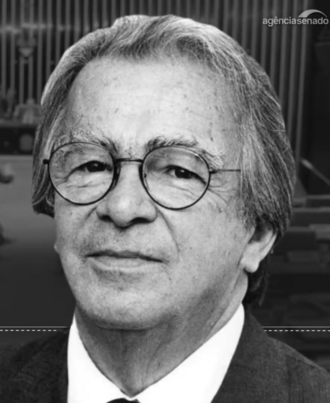
达西·里贝罗
- 生卒
- 1922 – 1997
- 国籍
- 巴西
- 外文名
- Darcy Ribeiro
照片:Senado Federal / Agência Senado,CC BY 3.0,来自维基共享资源「Discurso de Darcy Ribeiro na aprovação da Lei de Diretrizes e Bases da educação em 1996.png」(经缩小)。
生平与创作
这个词条暂时没有中文维基百科条目,下面是英文维基百科的内容(英文原文):
Darcy Ribeiro (October 26, 1922 – February 17, 1997) was a Brazilian anthropologist, historian, sociologist, author and politician. His ideas have influenced several scholars of Brazilian and Latin American studies. As Minister of Education of Brazil he carried out profound reforms which led him to be invited to participate in university reforms in Chile, Peru, Venezuela, Mexico and Uruguay after leaving Brazil due to the 1964 coup d'état.
Biography
Darcy Ribeiro was born in Montes Claros, in the state of Minas Gerais, the son of Reginaldo Ribeiro dos Santos and of Josefina Augusta da Silveira. He completed his primary and secondary education in his native town, at the Grupo Escolar Gonçalves Chaves and at the Ginásio Episcopal de Montes Claros.
He is best known for development work in the areas of education, sociology and anthropology and for being, along with his friend and colleague Anísio Teixeira, one of the founders of the University of Brasília in the early 1960s. He also served as the first rector of that university, and the campus is named after him. He was the founder of the State University of Norte Fluminense (Universidade Estadual do Norte Fluminense) as well. He wrote numerous books, many of them about the indigenous populations of Brazil.
During the first mandate of governor Leonel Brizola in Rio de Janeiro (1983–1987), Darcy Ribeiro created, planned and directed the implementation of the "Integrated Centers for Public Instruction" (Centros Integrados de Ensino Público), a visionary and revolutionary pedagogical project of assistance for children, including recreational and cultural activities beyond formal instruction – making concrete the projects envisioned decades earlier by Anísio Teixeira. Long before politicians incorporated the importance of education for the development of Brazil into their discourse, Darcy Ribeiro and Leonel Brizola had already developed these ideals.
In the elections of 1986, Ribeiro was the Democratic Labor Party (PDT) candidate for the governorship of Rio de Janeiro, running against Fernando Gabeira (at that time affiliated with the Workers’ Party), Agnaldo Timóteo of the Social Democratic Party (PDS) and Moreira Franco of the Brazilian Democratic Movement Party (PMDB). Ribeiro was defeated, being unable to overcome the high approval rating of Moreira who was elected due to the popularity of the then-recent currency reform, the Cruzado Plan (Plano Cruzado). Another defeat was in 1994, when he was Brizola's running-mate in the presidential election; Darcy Ribeiro was also chief of staff (Ministro-chefe da Casa Civil) in the cabinet of President João Goulart, vice-governor of Rio de Janeiro from 1983 to 1987 and exercised the mandate of senator from Rio de Janeiro from 1991 until his death. Darcy Ribeiro was elected to the Brazilian Academy of Letters (Academia Brasileira de Letras) on October 8, 1992. His election was to Chair Number 11, which has as its Patron Fagundes Varela. He was formally received into the Academy on April 15, 1993, by author Cândido Mendes. He died in Brasília, aged 74.
His time in Latin America (1964–1976)
Little is known about Ribeiro's exile in Latin America. In April 1964, after the military coup that deposed Goulart, Ribeiro went into exile in Uruguay, where he worked as a professor of anthropology and planning advisor at the University of the Republic and met Argentine Manuel Sadosky, recognised as one of the pioneers in introducing computers for academic training and research in Latin America. In September 1968, Ribeiro returned to Brazil, but was arrested and spent nine months in preventive detention. After being tried by a military court and declared a person of maximum danger, he was acquitted due to lack of evidence. However, he was forced into exile, this time in Caracas in 1969, where he worked as a consultant for the university reform of the Central University of Venezuela. At the end of 1970, he was invited by President Salvador Allende to advise the Chilean government and, at the same time, served as a research professor and advisor at the University of Chile. During those years, Ribeiro published important books such as El proceso civilizatorio (The Civilising Process), Las Américas y la civilización (The Americas and Civilisation), El dilema de América Latina (The Dilemma of Latin America), Fronteras indígenas de la civilización (Indigenous Frontiers of Civilisation) and La universidad necesaria (The Necessary University). His last stage was in Peru, during the Revolutionary Government of the Armed Forces, where Ribeiro was head and international co-director of the Centre for the Study of Popular Participation (CENTRO), a project co-financed by the ILO and Sinamos (1972-1976). With the support of mathematician Oscar Varsavsky, he developed a global computational model of Peruvian society and economy at CENTRO, which in turn could feed into a database.
Thought
Darcy Ribeiro's ideas belonged to the evolutionist school of sociology and anthropology, and his main influences were Neoevolutionists Leslie White and Julian Steward, and the Marxist archeologist V. Gordon Childe. He believed that people went through a "civilizatory process" beginning as hunter-gatherers. This "civilizatory process" was according to him marked by technological revolutions, and among these he stress the eight more important as the following:
the agricultural revolution the urban revolution the irrigation revolution the metallurgic revolution the livestock revolution the mercantile revolution the Industrial Revolution the thermonuclear revolution
Ribeiro proposed also a classification scheme for the world peoples, emphasizing the American countries, where he identified "New Peoples" (Chile, Colombia, Paraguay, Venezuela etc.), that merged from the mix of several cultures; "Witness Peoples" (Peru, Mexico, Ecuador, Guatemala etc), remnants of ancient civilizations; and "Transplanted Peoples" (USA, Canada, Argentina and Uruguay), European diasporas without significative other people influences.
以上文字摘自英文维基百科「Darcy Ribeiro」(去掉了参考文献等尾部小节),按 CC BY-SA 4.0 使用,作者为维基百科的各位编者。
资料卡
- 出生
- 1922 年 10 月 26 日
- 出生地
- 萨利纳斯
- 逝世
- 1997 年 2 月 17 日
- 逝世地
- 巴西利亚
- 职业
- 人类学家、政治人物、作家、社会学家、小说家、教育学家
- 使用语言
- 葡萄牙语、巴西葡萄牙语、西班牙语
- 就读学校
- 圣保罗大学
- 所属团体
- 巴西文学学院
- 配偶
- Berta Ribeiro(1948)
- 获奖
- 文化功绩勋章(2005)、巴黎第七大学名誉博士(1979);另有 3 项只有外文名
资料卡来自 Wikidata Q1165735(CC0),众包数据,个别字段可能不全。