书单
迪克·格里高利
- 生卒
- 1932 – 2017
- 国籍
- 美国
- 外文名
- Dick Gregory
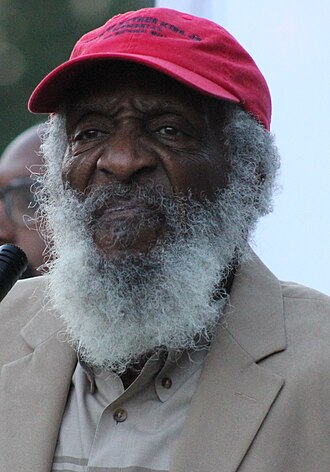
照片:Elvert Barnes,CC BY-SA 2.0,来自维基共享资源「Dick Gregory 2015.jpg」(经缩小)。
生平与创作
这个词条暂时没有中文维基百科条目,下面是英文维基百科的内容(英文原文):
Richard Claxton Gregory (October 12, 1932 – August 19, 2017) was an American comedian, actor, writer, left-wing activist and social critic. He became popular among the African-American communities in the southern United States with his "no-holds-barred" sets, poking fun at the bigotry and racism in the United States. In 1961, he became a staple in the comedy clubs, appeared on television, and released comedy record albums.
Gregory was at the forefront of political activism in the 1960s, when he protested against the Vietnam War and racial injustice, and advocated for animal rights. He was arrested multiple times and went on many hunger strikes. He later became a speaker and author, with his autobiography selling more than a million copies.
Early life
Gregory was born in St. Louis, Missouri, the son of Lucille, a house cleaner, and Presley Gregory. At Sumner High School, he was aided by teachers, among them Warren St. James; he also excelled at running, winning the state cross-country championship in 1950. Gregory earned a track scholarship to Southern Illinois University (SIU), where he set school records as a half-miler and miler. He was named the university's outstanding student athlete of the year in 1953. He was a member of Alpha Phi Alpha fraternity. In 1954, his college career was interrupted for two years when he was drafted into the United States Army. At the urging of his commanding officer, who had taken notice of his penchant for joking, Gregory got his start in comedy in the Army, where he entered and won several talent shows. In 1956, Gregory briefly returned to SIU after his discharge, but dropped out because he felt that the university "didn't want me to study, they wanted me to run."
In the hopes of becoming a professional comedian, Gregory moved to Chicago, where he became part of a new generation of black comedians that included Nipsey Russell, Bill Cosby, and Godfrey Cambridge, all of whom broke with the minstrel tradition that presented blacks stereotypically. Gregory drew on current events, especially racial issues, for much of his material: "Segregation is not all bad. Have you ever heard of a collision where the people in the back of the bus got hurt?"
Career
1956–1964: Comedy career
Gregory started helping his family with the gigs he started to get at a young age. Gregory began his career as a comedian while serving in the military in the mid-1950s. He served in the Army for a year and a half at Fort Cavazos, formerly known as Fort Hood in Texas, Fort Lee in Virginia, and Fort Smith in Arkansas. He was drafted in 1954 while attending Southern Illinois University. After being discharged in 1956, he returned to the university but did not receive a degree. He moved to Chicago with a desire to perform comedy professionally. In 1958, Gregory opened the Apex Club nightclub in Illinois. The club failed and landed Gregory in financial hardship. In 1959, Gregory landed a job as master of ceremonies at the Roberts Show Club.
While working for the United States Postal Service during the daytime, Gregory performed as a comedian in small, primarily black-patronized nightclubs of the Chitlin' Circuit. In an interview with The Huffington Post, Gregory described the history of black comics as limited: "Blacks could sing and dance in the white night clubs but weren't allowed to stand flat-footed and talk to white folks, which is what a comic does."
In 1961, Gregory was working at the black-owned Roberts Show Bar in Chicago when he was spotted by Hugh Hefner.
Good evening, ladies and gentlemen. I understand there are a good many Southerners in the room tonight. I know the South very well. I spent twenty years there one night. Last time I was down South I walked into this restaurant and this white waitress came up to me and said, "We don't serve colored people here." I said, "That's all right. I don't eat colored people. Bring me a whole fried chicken." Then these three white boys came up to me and said, "Boy, we're giving you fair warning. Anything you do to that chicken, we're gonna do to you." So I put down my knife and fork, I picked up that chicken and I kissed it. Then I said, "Line up, boys!"
Gregory attributed the launch of his career to Hefner. Based on his performance at Roberts Show Bar, Hefner hired Gregory to work at the Chicago Playboy Club as a replacement for comedian "Professor" Irwin Corey.
In 1961, Gregory made his New York debut at The Blue Angel nightclub, also recording a live set there, "Dick Gregory at the Blue Angel" for his album East & West. He soon came back to Chicago and finally got his big break at the Playboy Club in Chicago, also in 1961, that was supposed to be one night and ended up being six weeks and earned him a spot in Time and a guest appearance on Jack Paar's show and other night clubs shows, etc.
Gregory's comedy occasioned controversy in some conservative white circles. The administration of the University of Tennessee, for instance, branded Gregory an "extreme racist" whose "appearance would be an outrage and an insult to many citizens of this state", and revoked his invitation by students to speak on campus. The students sued, with noted litigator William Kunstler as their counsel, and in Smith v. University of Tennessee, 300 F. Supp. 777 (E.D. Tenn. 1969), won an order from the court that the university's policy was "too broad and vague". The University of Tennessee then implemented an "open speaker" system, and Gregory subsequently performed in April 1970.
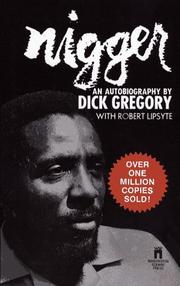
In 1964, Gregory's book, Nigger, was published. Since then, the book has never been out of print. In 2019, a trade paperback was published as well as an audio version. Gregory was number 82 on Comedy Central's list of the 100 Greatest Stand-ups of all time and had his own star on the St. Louis Walk of Fame.
1967–1969: Political career
Gregory began his political career by running against Richard J. Daley for Mayor of Chicago in 1967. Though he did not win, this was not the end of his participation in electoral politics.
以上文字摘自英文维基百科「Dick Gregory」(有删节,去掉了参考文献等尾部小节),按 CC BY-SA 4.0 使用,作者为维基百科的各位编者。
资料卡
- 母语名
- Dick Gregory
- 本名
- Richard Claxton Gregory
- 出生
- 1932 年 10 月 12 日
- 出生地
- 圣路易斯
- 逝世
- 2017 年 8 月 19 日
- 逝世地
- 华盛顿哥伦比亚特区
- 职业
- 喜剧演员、作家、社会活动人士、时事评论员、企业家、田径运动员、政治人物、自传作者 等 10 项
- 使用语言
- 英语
- 就读学校
- 南伊利诺伊大学卡本戴尔分校、Sumner High School
- 领域
- 公民权利和政治权利、行动主义、公民权利
- 所属团体
- 阿尔法·菲·阿尔法
- 配偶
- Lillian Gregory(1959)
- 获奖
- 托马斯·默顿奖(1974);另有 2 项只有外文名
资料卡来自 Wikidata Q1209674(CC0),众包数据,个别字段可能不全。